


Next: Star Detection
Up: Star DetectionAstrometry, and
Previous: Simulated Test Data
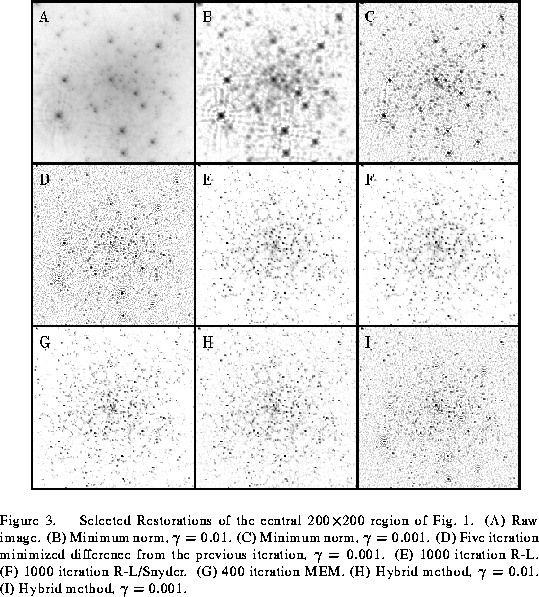
The following restoration methods were evaluated. The central
200 200 region of the restored images are shown in Fig. 3 for
selected results.
200 region of the restored images are shown in Fig. 3 for
selected results.

- Minimum norm.
This technique is a linear constrained least squares method which minimizes the
norm of the solution. It is solved using the method of Lagrange multipliers
(Andrews and Hunt 1977). A reciprocal Lagrangian multiplier,
 , can be
adjusted to control the smoothness of the solution or to satisfy chi-squared
test for the solution. Results are evaluated with = 0.1,
0.01, and 0.001.
, can be
adjusted to control the smoothness of the solution or to satisfy chi-squared
test for the solution. Results are evaluated with = 0.1,
0.01, and 0.001.
- Five iteration minimized difference from the previous iteration.
This is a constrained least-squares method which minimizes the norm of the
difference of the solution from a trial solution (Twomey 1963). A reciprocal
Lagrangian multiplier, , controls the amount of constraint. In our
solution we have used the raw blurred image as the initial trial solution and
performed 5 iterations. After each iteration, a new trial solution was set to
the results of the previous iteration with a positivity constraint applied.
Results are evaluated with = 0.1, 0.01, and 0.001.
- Richardson-Lucy method.
This technique is the Richardson-Lucy (R-L) maximum likelihood solution for
Poisson statistics (Richardson 1972, Lucy 1974). Results were evaluated after
100, 300 and 1000 iterations.
- Richardson-Lucy/Snyder.
This method is the R-L method with the Snyder modification for non-Poisson
read-out noise (Snyder 1990; Snyder, Hammoud, &White 1993). Results were
evaluated after 100, 300 and 1000 iterations.
- Maximum entropy method.
This is the Image Reduction and Analysis Facility (IRAF) maximum entropy method
(MEM) developed by Wu (1994). The results were evaluated after
100, 200 and 400 iterations.
- Hybrid method.
This approach minimizes the norm of difference of the restored image from a
trial solution (Twomey 1963). The trial solution was selected as the results
of 1000 iterations of the R-L/Snyder method. Results are evaluated with the
reciprocal Lagrangian multiplier = 0.1, 0.01 and 0.001.
Next: Star Detection
Up: Star DetectionAstrometry, and
Previous: Simulated Test Data