


R. Falomo, R. Scarpa
Osservatorio Astronomico di Padova, Vicolo dell'Osservatorio
5, Padova, Italy
J. Pesce, C.M. Urry
Space Telescope Science Institute, 3700 San Martin Dr., Baltimore,
MD 21218 USA
A. Treves
SISSA/ISAS, Via Beirut 2--4, 34014 Trieste, Italy
Keywords: BL Lac objects
BL Lac objects are AGNs characterized by high variability, polarization, and modest emission lines. Recently it was shown that they may be, at least sporadically, strong gamma ray sources. It is generally accepted that BL Lacs should be interpreted within a picture where they are associated with relativistic jets pointing in the direction of the observer. The population hosting BL Lacs should, therefore, be much more abundant than the population of BL Lacs, and it was suggested that it consists of FR--I radio galaxies (see e.g., Urry & Padovani 1995 and references therein).
The nature of the parent population can be explored focusing on properties which are essentially independent of the beaming. In particular, the morphological study of the hosts, their clustering properties, and the possible presence of close companions, perhaps related to the triggering of the BL Lac activity, seem to be of key importance for interpreting the BL Lac phenomenology. All these arguments go into the study of BL Lac environments.
Several groups have presented results based on ground-based
observations (Abraham et al. 1991, Stickel et al. 1993, Pesce et al.
1995, Wurtz et al. 1995, Falomo 1996 and references therein). In most
cases, host galaxies are giant ellipticals, but in a few cases spirals
are claimed. BL Lacs are members of poor clusters (Abell class  0), which may indicate that they are associated with only a subgroup
of FR--I radio sources. Moreover, some evidence is accumulating that
BL Lacs are frequently associated with close companions, a fact which
has been recently discussed extensively for close-by quasars.
0), which may indicate that they are associated with only a subgroup
of FR--I radio sources. Moreover, some evidence is accumulating that
BL Lacs are frequently associated with close companions, a fact which
has been recently discussed extensively for close-by quasars.
It is obvious that the exploration of the environment of BL Lacs can greatly profit from the use of HST since, for instance, the angular resolution can allow the extension of the studies to larger z. We are involved with two cycle 5 HST proposals (for low z and high z BL Lacs), and one cycle 6 proposal (snapshots of BL Lacs).
As shown by the studies of the environment of QSOs, it is of particular importance to understand the merits of HST vs ground-based observations, and to complement the use of the two sets of data (see e.g., McLeod & Rieke 1995). In this spirit we are presenting here images of three BL Lacs: PKS 2254+07, S4 1823+56 and B2 1308+32 -- obtained with high quality ground-based telescopes during sub-arcsec seeing conditions. The first two sources have been observed with HST in October 1995, but the data analysis is only at a preliminary stage. The third source is scheduled for early 1996.
Optical images were obtained using both the 3.5m New Technology Telescope (NTT), at the European Southern Observatory, and the 2.5m Nordic Optical Telescope (NOT) at La Palma. The data were acquired using the Superb Seeing Imager (SUSI; Melnick et al. . 1992) installed at one of the Nasmyth foci of the NTT and the BroCam direct imaging camera mounted at the NOT. In both cases, an R-band filter (Cousins system) and a CCD (TK 1024) was used. The scale is of 0.13 and 0.176 arcsec/pixel for NTT and NOT, respectively. Conditions were photometric and seeing was always sub-arcsec.
Surface photometry analysis was performed using an interactive package (AIAP, Fasano 1990). After proper masking of isophotes, ellipses were fitted with free parameters. These yield the photometrical and structural parameters of the objects (surface brightness, ellipticity, position angle, center of ellipses and Fourier coefficients describing deviations of isophotes from pure ellipse).
The Point Spread Function (PSF) was derived independently for each observed frame averaging many stars detected in the frame. When bright (saturated) and faint (unsaturated) stars are available we combined them in order to properly determine the core and the wings of the PSF. This is particularly important for the marginally resolved objects because the reliability of the derived properties significantly depends on assumptions of the PSF shape. The combination of stars of different magnitude permits, in fact, an increase of the dynamical range of the PSF.
2254+07
This is a relatively low redshift (z = 0.19) BL Lac object. We
obtained three NTT subsequent images with seeing of 0.95 and then
stacked them into an average frame for a total integration time of 420
sec. The nebulosity is well visible (see Fig. 1a) and looks rather
round (
and then
stacked them into an average frame for a total integration time of 420
sec. The nebulosity is well visible (see Fig. 1a) and looks rather
round ( 0.1). The galaxy extends up to
  10
10 at
surface brightness
at
surface brightness  26 mag/arcsec
 . The radial profile
(Fig. 1b) is well fitted by an elliptical model plus point source
yielding a galaxy of absolute magnitude M
. The radial profile
(Fig. 1b) is well fitted by an elliptical model plus point source
yielding a galaxy of absolute magnitude M = -23.9 (H
 = 50
kms
= 50
kms kpc
kpc and q
and q = 0) which is typical for galaxies
hosting BL Lacs. However, even a disc model plus point source gives a
satisfactory fit to the radial profile. In this case the host
galaxy's total magnitude would be 0.3 mag fainter. Our analysis of
the Fourier coefficients does not, however, show any significant
excess due to the disky isophotes, favouring the elliptical
model.
= 0) which is typical for galaxies
hosting BL Lacs. However, even a disc model plus point source gives a
satisfactory fit to the radial profile. In this case the host
galaxy's total magnitude would be 0.3 mag fainter. Our analysis of
the Fourier coefficients does not, however, show any significant
excess due to the disky isophotes, favouring the elliptical
model.
The host galaxy of this source has also been also studied by Stickel, Fried
& Kühr (1988) who report a very similar absolute magnitude for the host
galaxy although no satisfactory fit with either elliptical or disc
models was found. These authors also took spectra of two galaxies
close to the BL Lac object finding one at the same z as
2254+07.
Higher resolution images obtained with the WFPC2 camera would be able
to set stronger constraints to the galaxy morphology since the region
close to the nucleus, where the  and exponential disc models
greatly differ, becomes accessible.
and exponential disc models
greatly differ, becomes accessible.
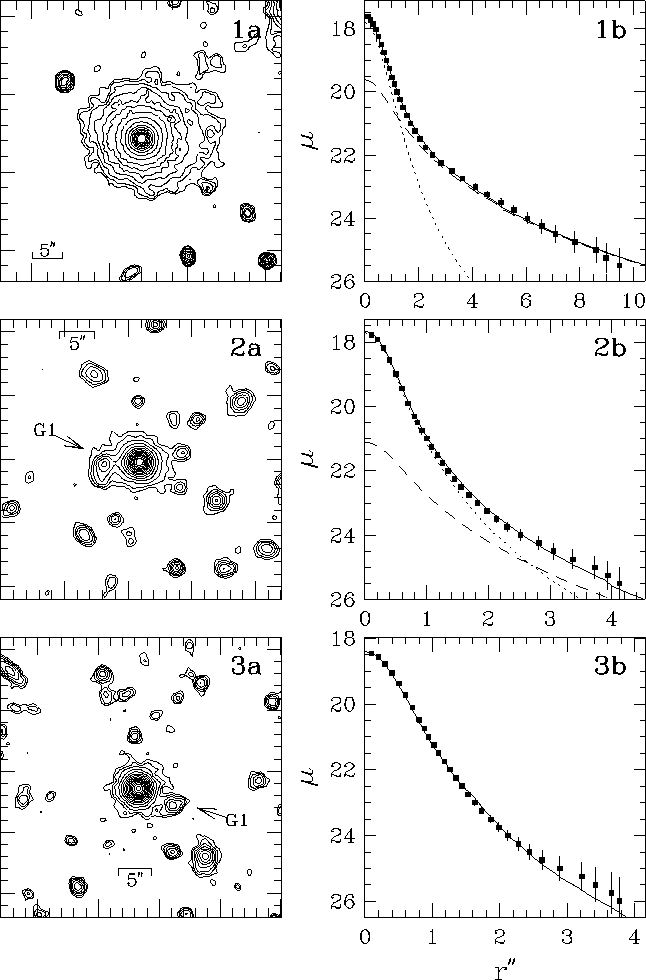
Figure: PKS 2254+07 (z=0.19). XXFigure 2. S4 1823+56 (z=0.664).
Figure 3. B2 1308+32 (z=0.997).
a)
Contour plot of the central portion of the R-band image;
spacing between isophotes is 0.5 mag/arcsec .
b) Surface brightness profile ( filled
squares). The solid line is the sum of a PSF ( dotted line) plus an
elliptical r
.
b) Surface brightness profile ( filled
squares). The solid line is the sum of a PSF ( dotted line) plus an
elliptical r law ( short-dashed line).
1823+56
This is a moderately high redshift (z=0.664) source whose spectrum
exhibits, however, only one confirmed emission line identified as
[OII] 3727Å (Stickel et al. . 1993). We secured subsequent images at
NOT with seeing of 0.7 arcsec for a total exposure of 1800 sec and
combined them into a single frame (see Fig 2a). Despite the high
redshift, the object is well resolved (Fig 2b). If the excess of light
over the PSF is interpreted as emission of the associated host galaxy
(modeled by an elliptical galaxy), this would correspond to an
extremely luminous galaxy with M truept
 .truept
< -25.3. This questions
the reliability of the redshift.
.truept
< -25.3. This questions
the reliability of the redshift.
There are many faint galaxies in the neighborhood of 1823+56 that
could be associated with the BL Lac object. However the only redshift
known for a galaxy in this group (z = 0.394) is quite different from
that proposed for the BL Lac. The closest galaxy (G1) is at 5 (projected distance
  46 Kpc at z = 0.664). This object appears
highly distorted with an asymmetric faint emission elongated towards
South. Observations with WFPC2 would permit both to further constraint
the properties of the nebulosity, and to detect possible signs of
interaction with the close companion.
46 Kpc at z = 0.664). This object appears
highly distorted with an asymmetric faint emission elongated towards
South. Observations with WFPC2 would permit both to further constraint
the properties of the nebulosity, and to detect possible signs of
interaction with the close companion.
1308+32
This is a high redshift (z = 0.997) BL Lac object that exhibits strong
optical variability. Due to its high z we do not expect to resolve
the nebulosity even at sub-arcsec resolution. However, Stickel (1991)
reported the detection of a faint nebulosity at brightness levels
below 26 mag/arcsec using images of 1.3
 seeing. This was interpreted as
evidence for a foreground galaxy. We took two 20 minutes NOT
exposure with seeing of 0.8
seeing. This was interpreted as
evidence for a foreground galaxy. We took two 20 minutes NOT
exposure with seeing of 0.8 and derived isophotal analysis down
to
and derived isophotal analysis down
to  = 26 mag/arcsec
 (see Fig 3a,b). The radial profile is
perfectly matched by a scaled PSF down to
(see Fig 3a,b). The radial profile is
perfectly matched by a scaled PSF down to  = 25 mag/arcsec
 and
show a small excess below it. We tried to derive the properties of the
galaxy that could produce such an excess but found rather unrealistic
values. Moreover, we note that this excess is mainly due to some faint
emission on the East side of the source and could be produced by a
diffuse companion object a few arcsec East from the BL Lac
nucleus. This feature could be resolved by WFPC2 observations and be
related to the z = 0.879 absorption system seen in the spectrum of
1308+32. The companion object (G1) at 5.6
and
show a small excess below it. We tried to derive the properties of the
galaxy that could produce such an excess but found rather unrealistic
values. Moreover, we note that this excess is mainly due to some faint
emission on the East side of the source and could be produced by a
diffuse companion object a few arcsec East from the BL Lac
nucleus. This feature could be resolved by WFPC2 observations and be
related to the z = 0.879 absorption system seen in the spectrum of
1308+32. The companion object (G1) at 5.6 SW is resolved and its
projected distance is 60 Kpc. If associated with 1308+32, it would have
M
SW is resolved and its
projected distance is 60 Kpc. If associated with 1308+32, it would have
M . Several other faint galaxies are detected around
the BL Lac and we are testing if some evidence of clustering is
present.
. Several other faint galaxies are detected around
the BL Lac and we are testing if some evidence of clustering is
present.
Abraham, R. G., M Hardy, I. M., & Crawford, C. S. 1991,
MNRAS, 252, 482
Hardy, I. M., & Crawford, C. S. 1991,
MNRAS, 252, 482
Falomo, R. 1996, submitted to MNRAS
Fasano, G. 1990, Padova Internal Report
Pesce, J. E., Falomo, R., & Treves, A. 1995, AJ, 110, 1554
Melnick, J., Dekker, H., & D'Odorico, S. 1992, The EMMI and SUSI ESO Operating Manual
McLeod, K.K. & Rieke, G.K. 1995, ApJ, 454, L77
Stickel, M., Fried, J.W. & Kühr, H. 1988, å, 191, L16
Stickel, M. 1991, Variability of Active Galaxies, Springer, p. 303
Wurtz, R., Stocke, J. T., & Yee, H. K. C. 1995, ApJS, in press
Stickel, M., Fried, J. W., & Kühr, H. 1993, A&AS, 98, 393
Urry, C.M. & Padovani, P. 1995, PASP, 107, 803