Science with the Hubble Space Telescope -- II
Book Editors: P. Benvenuti, F. D. Macchetto, and E. J. Schreier
Electronic Editor: H. Payne
F. Hammer
DAEC, Observatoire de Paris-Meudon, 92195 Meudon, France
D. Schade
Department of Astronomy, University of Toronto, Toronto, Canada
D. Crampton
DAO, N.R.C.C., Victoria, Canada
O. Le Fèvre
DAEC, Observatoire de Paris-Meudon, 92195 Meudon, France
S. Lilly
Department of Astronomy, University of Toronto, Toronto, Canada
Visiting Astronomer, Canada-France-Hawaii Telescope, which
is operated by NRC of Canada, CNRS of France and the University of Hawaii.
Abstract:
Up to 50 of the
  Jy radio sources are associated to elliptical
galaxies, lying generally at z> 0.7. Other contributors to the
Jy radio sources are associated to elliptical
galaxies, lying generally at z> 0.7. Other contributors to the  Jy
radio source population are AGN-like spectrum galaxies and post-starburst
galaxies experiencing major interactions. In the field, a large fraction of
luminous and early type galaxies at z> 0.7 and of post-starburst galaxies
have radio emission at
Jy
radio source population are AGN-like spectrum galaxies and post-starburst
galaxies experiencing major interactions. In the field, a large fraction of
luminous and early type galaxies at z> 0.7 and of post-starburst galaxies
have radio emission at  Jy levels. The abundant population of starburst
galaxies at z> 0.5 is a very small contributor to the radio emission.
Assuming that radio emission in ellipticals is actually linked with
low-powered AGNs lying in their cores, provides that the radio emission at
Jy levels. The abundant population of starburst
galaxies at z> 0.5 is a very small contributor to the radio emission.
Assuming that radio emission in ellipticals is actually linked with
low-powered AGNs lying in their cores, provides that the radio emission at
 Jy is related more to active nuclei than to star formation.
Keywords: galaxies,radiogalaxies,cosmology
Deep radio counts show a surprisingly steep slope close to the Euclidean value,
below a few 0.1 mJy (at 1.4 to 8 GHz, Fomalont et al. 1991, hereafter FWKK).
This suggests an evolution of faint radio source properties. At sub mJy
levels, it is acknowledged that starburst galaxies are major contributors
to the radio source counts (Benn et al. 1993). Towards the  Jy levels
(S
Jy levels
(S 16
16 Jy at 5 GHz), the projected density of radiosources reaches
the number density of B= 21.5 field galaxies. The fraction of flat spectrum
radio sources also increases continuously towards extremely low radio fluxes
(FWKK). The understanding of
Jy at 5 GHz), the projected density of radiosources reaches
the number density of B= 21.5 field galaxies. The fraction of flat spectrum
radio sources also increases continuously towards extremely low radio fluxes
(FWKK). The understanding of  Jy may provide new and interesting
contraints on the galaxy evolution as well as on the relative contribution of
AGNs in deep radio source counts.
Jy may provide new and interesting
contraints on the galaxy evolution as well as on the relative contribution of
AGNs in deep radio source counts.
During the preliminary deep imaging phase
of our large spectroscopic survey of faint field galaxies (CFRS),
one of our fields (10 arcmin  10 arcmin) was chosen to coincide
with the FWKK radiosource field, including 36 S
10 arcmin) was chosen to coincide
with the FWKK radiosource field, including 36 S 16
16 Jy
radiosources of their complete sample. All sources but
two have been identified to V < 25 and/or I
Jy
radiosources of their complete sample. All sources but
two have been identified to V < 25 and/or I
 24, and/or K
 21.
21.
In section 2 are described the results of the spectroscopic classification
of optical counterparts of  Jy radio sources (see Hammer et al. 1995
for details) and HST images of nearly half the complete sample are
presented in section 3.
Jy radio sources (see Hammer et al. 1995
for details) and HST images of nearly half the complete sample are
presented in section 3.
Among objects bright enough for spectroscopy, we find
five early type galaxies (26%),
six ``spirals'' (32%),
five emission line galaxies (26%), one QSO and one M star but we failed to
identify three objects.
The early type galaxies are rather luminous
( -21.9,
  50,
50,  0.5), and have redshift
ranging from 0.7 to 1, the latter being the limit of our completness for our
spectroscopy. Their spectra show a red continuum with a significant 4000Å\
break and very faint or no [OII] emission. They all have inverted radio
spectra (
0.5), and have redshift
ranging from 0.7 to 1, the latter being the limit of our completness for our
spectroscopy. Their spectra show a red continuum with a significant 4000Å\
break and very faint or no [OII] emission. They all have inverted radio
spectra ( = -0.4
 0.3). Inverted-spectrum radio emission has been
observed in nearby ellipticals (Wrobel & Heeschen 1984) and may indicate the
presence of a low-power AGN (Rees 1984), although other alternatives are
possible. We suggest that the radio emission from our high redshift early
type galaxies has the same origin, although their radio power is ten times
higher than the one of nearby galaxies.
0.3). Inverted-spectrum radio emission has been
observed in nearby ellipticals (Wrobel & Heeschen 1984) and may indicate the
presence of a low-power AGN (Rees 1984), although other alternatives are
possible. We suggest that the radio emission from our high redshift early
type galaxies has the same origin, although their radio power is ten times
higher than the one of nearby galaxies.
The ``spirals'' are rather luminous galaxies
( -21.6) and lie at
moderately high redshift (0.37 < z < 0.81). They all
show moderate [OII] emission (average W =12Å at rest), and
relatively
strong Balmer continuum and absorption lines (equivalent width ranging from
3 to 5Å), indicating the presence of A and F stars and
suggesting that strong star formation occurred in these objects
-21.6) and lie at
moderately high redshift (0.37 < z < 0.81). They all
show moderate [OII] emission (average W =12Å at rest), and
relatively
strong Balmer continuum and absorption lines (equivalent width ranging from
3 to 5Å), indicating the presence of A and F stars and
suggesting that strong star formation occurred in these objects
 1Gyr ago. We classify them as post-starbursting galaxies or ``S+A''.
They all have moderately steep
spectra (
1Gyr ago. We classify them as post-starbursting galaxies or ``S+A''.
They all have moderately steep
spectra ( = 0.40
 0.18), noticeably flatter
than the mJy starburst galaxies, which might indicate an
increasing contribution of thermal radiation from the IGM
(Condon 1992).
0.18), noticeably flatter
than the mJy starburst galaxies, which might indicate an
increasing contribution of thermal radiation from the IGM
(Condon 1992).
The emission line galaxies have relatively moderate luminosities
(L<L*), while the emission line ratio of all of them but the most distant
one are typical of AGNs (from current diagnostic diagrams, see Rola 1995).
The bluest emission-line galaxies have inverted spectra, also with the
exception of the most distant one ( = 0.7), which could be
classified as a starburst. This supports the hypothesis that AGNs
are present in their cores too, producing both the radio
emission and the emission lines.
= 0.7), which could be
classified as a starburst. This supports the hypothesis that AGNs
are present in their cores too, producing both the radio
emission and the emission lines.
There is considerable evidence that
virtually all of the 11 remaining
sources (fainter than I 22.5) are
likely to be at z > 1. Indeed all the ones for which we have K photometry have
I-K color much redder than any object in the CFRS sample. Several of the
faintest counterpart have inverted radio spectra and are suspected to be
early type galaxies at z > 1.
22.5) are
likely to be at z > 1. Indeed all the ones for which we have K photometry have
I-K color much redder than any object in the CFRS sample. Several of the
faintest counterpart have inverted radio spectra and are suspected to be
early type galaxies at z > 1.
HST images have been provided from Cycle 4 observations of CFRS galaxies
(see Schade et al. 1995) as well as from the Groth-Westphal strip (Groth et
al. 1995) which overlaps the FWKK radio field. Nineteen radio galaxies
have been identified in this sample, among them 16 belong to the complete
radio sample defined by FWKK (see Table 1).
Table 1 compares the spectral
properties derived by Hammer et al. (1995) to the morphological properties,
namely the fraction of bulge luminosity to the total luminosity (B/T, see
the contribution of Schade et al., same volume). It shows a very good
agreement between the two classifications. Spectral early-type galaxies
(with inverted radio spectra) are bulge-dominated objects, while galaxies
spectroscopically classified as S+A (post-starburst, moderately steep radio
spectra) show a lower contribution of the bulge or are irregulars. Among the
emission line objects (AGN-like spectra, spectral class EM), we find one
irregular, one spiral and one bulge-dominated object, the latter having the
spectrum of a Seyfert 1 (14.0573). HST images also allow to study the
environment of the radiosources. A rapid examination provides that(see Figure
1):
-2/3 of the ellipticals (E) show a very small companion within 25 kpc.
-3 of the 4 S+As (poststarbursts) are apparently experiencing a major
interaction with a neighbour of almost the same brightness.
-emission
line objects (EM) either show no obvious companions or have very irregular
morphologies.
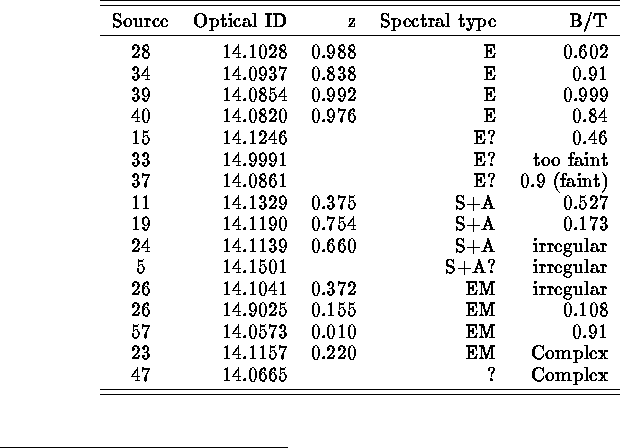
Table 1: HST observations of 16 sources of the complete sample

Figure: HST images of 14 optical counterparts of  Jy radio sources.
Early type galaxies (ellipticals) are shown in the two top lines, S+A
galaxies in the third line from the top and AGN-like spectrum objects in
the bottom line. Each stamp has a 5 size.
Jy radio sources.
Early type galaxies (ellipticals) are shown in the two top lines, S+A
galaxies in the third line from the top and AGN-like spectrum objects in
the bottom line. Each stamp has a 5 size.
Half of  Jy radio sources are associated to elliptical galaxies (B/T
> 0.45), while Schade et al. (1995) found 20
Jy radio sources are associated to elliptical galaxies (B/T
> 0.45), while Schade et al. (1995) found 20  of ellipticals in the
field at z
of ellipticals in the
field at z 0.6. This is mainly due to the emergence of radio
emission with inverted spectra in distant and luminous ellipticals (z >
0.7), an emission which can be related to the presence of an active nucleus
in their cores. Indeed, all the
0.6. This is mainly due to the emergence of radio
emission with inverted spectra in distant and luminous ellipticals (z >
0.7), an emission which can be related to the presence of an active nucleus
in their cores. Indeed, all the  Jy radio sources but one are compact
(size
Jy radio sources but one are compact
(size  ). We have compared the number of detected radio sources in
the complete sample of I
). We have compared the number of detected radio sources in
the complete sample of I galaxies in the same field (Lilly et
al. 1995). We find that a considerable fraction of high-z ellipticals (40%
at z > 0.7 and 66% if we only count the more luminous ones,
galaxies in the same field (Lilly et
al. 1995). We find that a considerable fraction of high-z ellipticals (40%
at z > 0.7 and 66% if we only count the more luminous ones, 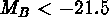 ) have radio emission at
  Jy levels.
In the field, we also find that half the luminous post-starbursts ( ) show radio emission at
  Jy levels. Conversely, in the very
abundant population of emission line galaxies (
Jy levels. Conversely, in the very
abundant population of emission line galaxies ( 70
70 at z >
0.5, Hammer et al. in preparation), we identify only one starburst emitting
at radio wavelengths. Radio emission in post-starburst galaxies is more
likely associated to the presence of major interactions that to star
formation.
at z >
0.5, Hammer et al. in preparation), we identify only one starburst emitting
at radio wavelengths. Radio emission in post-starburst galaxies is more
likely associated to the presence of major interactions that to star
formation.
The strong decrease of the radio spectral
index from sub-mJy to  Jy counts appears to be due
to a combination of three
factors: (1) the emergence of an elliptical population at high redshifts with
moderate radio emission; (2) an increasing fraction of
narrow emission-line AGNs (Seyfert 2 and LINER); (3) a higher
contribution of the thermal radiation to the radio emission from spirals, and
the almost complete disappearance of starburst galaxies.
The fact that radio sources have much flatter radio spectra
at
Jy counts appears to be due
to a combination of three
factors: (1) the emergence of an elliptical population at high redshifts with
moderate radio emission; (2) an increasing fraction of
narrow emission-line AGNs (Seyfert 2 and LINER); (3) a higher
contribution of the thermal radiation to the radio emission from spirals, and
the almost complete disappearance of starburst galaxies.
The fact that radio sources have much flatter radio spectra
at  Jy levels compared to those above 0.1 mJy can thus
be mostly attributed to the emergence of radio sources driven by
low-power AGNs (> 50 per cent of the whole
Jy levels compared to those above 0.1 mJy can thus
be mostly attributed to the emergence of radio sources driven by
low-power AGNs (> 50 per cent of the whole  Jy population).
Since the space density of AGN-driven sources apparently overtakes
those powered by stellar emission,
the contribution of AGN light to the faint source counts should be
reevaluated.
Jy population).
Since the space density of AGN-driven sources apparently overtakes
those powered by stellar emission,
the contribution of AGN light to the faint source counts should be
reevaluated.
References:
Benn, C.R. et al. 1993, MNRAS, 263, 98
Condon, J.J. 1992, A&A Review, 30, 575
Fomalont, E.B. et al. 1991, AJ, 102, 1258(FWKK)
Groth, E.J. et al. 1994, BAAS, 26, 1403
Hammer, F. et al. 1995, MNRAS, 276, 1085.
Lilly, S.J. et al. 1995, ApJ, 455, 75
Rees, M. 1984, ARA&A, 22, 471
Rola, C. 1995, PhD Thesis
Schade, D. et al. 1995, ApJ, 451, L1
Wrobel, J.M. & Heeschen, D. 1984, ApJ, 335, 677
payne@stsci.edu