


R.-P. Kudritzki, D.J. Lennon,
S.M. Haser, J. Puls, A.W.A. Pauldrach,
K. Venn
Universtitäts-Sternwarte München, D-81679 Munich, Germany
S.A. Voels
NASA-GSFC, Astrophysics Data Facility, Greenbelt, MD 20771, U.S.A
Max-Planck-Institut für Astrophysik, Karl-Schwarzschild-Str. 1, D-85740 Garching, Germany
 , may have a
mass of close to 200M
, may have a
mass of close to 200M .
.
Keywords: Hot stars, stellar winds, distances, abundances
Edwin Hubble was among the first of a long line of astronomers who attempted to use the most luminous supergiant stars as standard candles in order to determine the distances to other galaxies. These attempts have been frustrated due to the problems of multiplicity and the presence of strong stellar winds in these objects. The obstacle represented by possible multiplicity is obvious -- is one looking at one star or more than one star? The problem of the stellar wind is more subtle, however, but briefly stated it is that a precise determination of the intrinsic luminosity of a supergiant can only be achieved using stellar wind features in its spectrum and in the past the physics of stellar winds have been poorly understood. This failing has also been a major hindrance to astronomers in the abundance analysis of supergiants. This is an important point since it is now clear that metallicity plays an important role in driving stellar winds, so that both of these properties need to be studied simultaneously. The derivation of abundances in other galaxies using stars is of great intrinsic interest of course since most of our current knowledge relies upon studies of emission nebulae, following in the steps of Shapley's discovery of abundance gradients in spiral galaxies, and so our picture of the abundances of many refractory and heavier elements in other galaxies is rather incomplete.
The Hubble Space Telescope (HST) is the ideal vehicle with which to investigate luminous stars in other galaxies, since it has both high spatial resolution (to detect multiplicity) and high UV sensitivity (to study the stellar wind lines). For this reason a series of programs have been undertaken with the HST (and ground-based facilities) to investigate the stellar wind properties of luminous hot stars in the Magellanic Clouds and other Local Group galaxies. In this paper we review some of the highlights of this work and present results from some recently completed HST programs.
The strong stellar winds in luminous hot stars give rise to prominent features in their spectra, typically strong broad wind lines with emission features, originating from ionized metal resonance transitions in the UV or from hydrogen Balmer lines in the visible. Once the difficulties in interpreting these features are overcome, it is clear that these features can be regarded as a gift of nature since these luminous stars are individually observable in distant galaxies (to the distance of Virgo) and in the integrated spectra of unresolved starburst regions in galaxies even further afield. In principle, these features provide important information on the chemical composition and other properties of young stellar populations. However, it was the attempts made at understanding how these stellar winds were driven and the success of radiation driven wind theory (Abbott 1982, Pauldrach et al. 1986,1994, Kudritzki et al. 1989,1992), which led to the realization that these wind features also provide the key to distance determination using the wind momentum -- luminosity relationship (hereafter WLR).
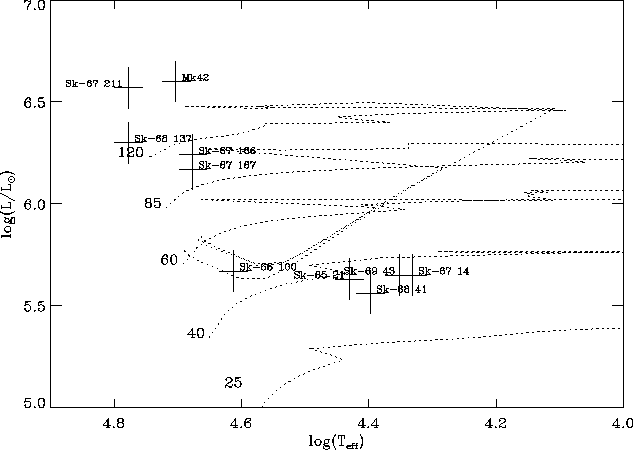
Figure: HRD for O-stars in the LMC compared with evolutionary
tracks for  from Schaerer et al. (1993)
More detailed discussions of this relationship are given elsewhere, in particular Puls et al. (1996) provide the theoretical justification for the simplified form of the relationship;

where  is the mass loss rate,
  is the wind
terminal velocity, R is the stellar radius,
is the wind
terminal velocity, R is the stellar radius,
 is the solar radius, L is the stellar luminosity and in
the exponent
is the solar radius, L is the stellar luminosity and in
the exponent  depends on the metallicity.
The constant of proportionality in this expression, A (the
precise value of which must be found through observation),
is also a function of the metallicity, the prediction of the
theory being that both A and
depends on the metallicity.
The constant of proportionality in this expression, A (the
precise value of which must be found through observation),
is also a function of the metallicity, the prediction of the
theory being that both A and  decrease with decreasing metallicity.
Clearly, if both of these factors are known and we can measure both
decrease with decreasing metallicity.
Clearly, if both of these factors are known and we can measure both
 and
and  for a given star, then we can determine the
star's intrinsic luminosity. The distance then follows from comparing
observed and predicted stellar fluxes or magnitudes.
for a given star, then we can determine the
star's intrinsic luminosity. The distance then follows from comparing
observed and predicted stellar fluxes or magnitudes.

Figure: HRD for O-stars in the SMC compared with evolutionary
tracks for  from Schaller et al. (1993).
The Magellanic Clouds, given their different metallicities, are the
ideal laboratories in which to test this relationship and its
dependencies and, in fact, Puls et al. (1996) also carried out such an
investigation using O-stars. This work made use of Cycle 1 HST/FOS
observations (program GO2233 and GO4110) which provided the UV
spectra, while ESO facilities were used to obtain visual region
spectra. In figures 1 and 2 we show, for the LMC and SMC, respectively,
the positions of these objects in the HR diagram along with some standard
evolutionary tracks. We have included in these figures additional
B-type supergiants, Sk , Sk
, Sk and AV488,
which were
observed in the same Cycle 1 program as the O-stars but
not previously analyzed. Also, for the LMC, we have included two
further B-type supergiants, Sk
and AV488,
which were
observed in the same Cycle 1 program as the O-stars but
not previously analyzed. Also, for the LMC, we have included two
further B-type supergiants, Sk and Sk
 ,
which were observed
with HST/FOS during Cycle 4 (GO5346). These B-type supergiants
were analyzed using similar methods as were adopted for the O-star
sample, further details of which may be found in the paper of Puls et al.
or see Haser et al. (1995). An important diagnostic feature of this
method is the use of H
,
which were observed
with HST/FOS during Cycle 4 (GO5346). These B-type supergiants
were analyzed using similar methods as were adopted for the O-star
sample, further details of which may be found in the paper of Puls et al.
or see Haser et al. (1995). An important diagnostic feature of this
method is the use of H for a precise determination of
the mass-loss rate, a typical fit to the H
for a precise determination of
the mass-loss rate, a typical fit to the H profile of Sk
 is shown
in Fig. 3 which illustrates the constraint imposed upon the mass-loss
rate by this method (wind terminal velocities were derived from
UV P-Cygni profiles in the FOS data).
is shown
in Fig. 3 which illustrates the constraint imposed upon the mass-loss
rate by this method (wind terminal velocities were derived from
UV P-Cygni profiles in the FOS data).

Figure: Fit to the H profile of Sk
 , a B1Ia
supergiant in the LMC. The HST/FOS data for this star yield
, a B1Ia
supergiant in the LMC. The HST/FOS data for this star yield

 and
and  and together with the
H
and together with the
H profile we obtain
  .
The dashed lines show the profiles if
.
The dashed lines show the profiles if  is changed by
  dex (about 30%).
The important result from this is work is shown in figures 4 and 5, namely that
the predictions of radiation driven wind theory concerning the
dependence of A and  on metallicity are at least qualitatively
correct, the effect on the SMC stars (lowest metallicity) appears to be
quite startling while it is also interesting that the effect for
the LMC is apparently small. Indeed, this is consistent with the morphological
appearance of the O-star UV spectra in the LMC and SMC compared
with galactic counterparts as discussed by Walborn et al. (1995).
These results raise the additional issue of the reliability of
attempts to model the composite spectra of starburst regions in
other galaxies, in particular metal poor galaxies, using libraries
of IUE (solar composition) spectra.
This issue is only partially addressed by the observations described
above; fortunately, however, further important work in this
direction has been undertaken by Robert et al. (1996) where further
details may be found. Returning to the WLR, it is clear from figures 4 and 5
that
many more stars need to be observed in these galaxies in order to
delineate the precise nature of the relationship represented by
equation (1). While it is important to pursue this work using
O-stars, for example mass-loss is perhaps the dominant influence
on their evolution, these objects are unlikely to be of much use for
distance determination since they tend to occur in compact OB
associations where the problems of crowding are forbidding.
on metallicity are at least qualitatively
correct, the effect on the SMC stars (lowest metallicity) appears to be
quite startling while it is also interesting that the effect for
the LMC is apparently small. Indeed, this is consistent with the morphological
appearance of the O-star UV spectra in the LMC and SMC compared
with galactic counterparts as discussed by Walborn et al. (1995).
These results raise the additional issue of the reliability of
attempts to model the composite spectra of starburst regions in
other galaxies, in particular metal poor galaxies, using libraries
of IUE (solar composition) spectra.
This issue is only partially addressed by the observations described
above; fortunately, however, further important work in this
direction has been undertaken by Robert et al. (1996) where further
details may be found. Returning to the WLR, it is clear from figures 4 and 5
that
many more stars need to be observed in these galaxies in order to
delineate the precise nature of the relationship represented by
equation (1). While it is important to pursue this work using
O-stars, for example mass-loss is perhaps the dominant influence
on their evolution, these objects are unlikely to be of much use for
distance determination since they tend to occur in compact OB
associations where the problems of crowding are forbidding.
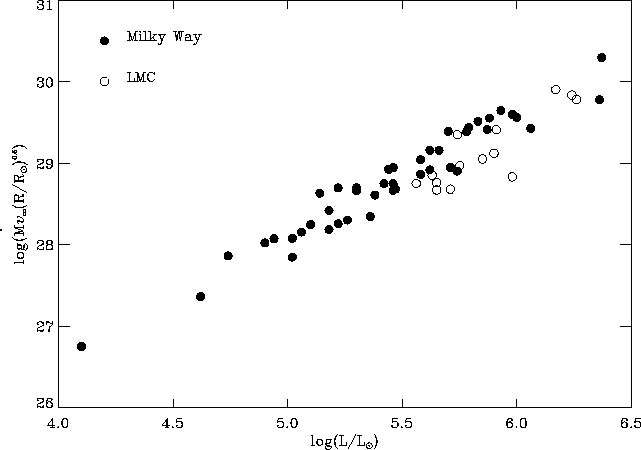
Figure: Wind momentum - luminosity relationship for the LMC
compared with galactic data.
However, Lennon et al. (1994) and Kudritzki et al. (1995) have shown empirically that a relationship as represented by equation (1) also appears to hold for O to A supergiants covering a wide range of luminosities. (These data are also included in figures 4 and 5 for comparison.) If this is confirmed by work in progress, it would imply that late B-type and A-type supergiants could be used in this manner for distance determination. Since these stars have absolute visual magnitudes in the range -7 to -10, and they are much less affected by crowding than O-stars, it raises the prospect of using these stars for distance (and abundance) determination of stars in galaxies as distant as the Virgo cluster using telescopes such as the Keck I, VLT or the HET. There remains the problem of calibrating the WLR for these types of supergiant, the winds of which are also not so well understood as those of O-stars. For this reason, we have invested considerable effort in a ground based observing campaign aimed at B- and A-type supergiants in the Magellanic Clouds and for which HST time in Cycles 5 and 6 has already been allocated.
From Figures 1 and 2 it can be seen that several stars lie close to,
or in the case of the LMC, well above the 85M track. In fact,
for the LMC we have five stars with masses greater than or equal to
100M
track. In fact,
for the LMC we have five stars with masses greater than or equal to
100M , while in the case of the SMC there are two such stars.
Looking at the LMC in more detail using the evolutionary
tracks of Langer (private communication), which extend to much higher
masses, we see that two stars lie close to the 200M
, while in the case of the SMC there are two such stars.
Looking at the LMC in more detail using the evolutionary
tracks of Langer (private communication), which extend to much higher
masses, we see that two stars lie close to the 200M track
(see Fig. 6). These two objects are the O3If/WN star Mk42, discussed
previously by Pauldrach et al. (1994), and the O3III(f
track
(see Fig. 6). These two objects are the O3If/WN star Mk42, discussed
previously by Pauldrach et al. (1994), and the O3III(f ) star
Sk
) star
Sk (alias HDE269810), which we will discuss in a little more detail here
(the stellar parameters for which are given by Puls et al. (1996)).
Fig. 6 implies that the ZAMS mass of Sk
(alias HDE269810), which we will discuss in a little more detail here
(the stellar parameters for which are given by Puls et al. (1996)).
Fig. 6 implies that the ZAMS mass of Sk exceeds 200M
 and is also slightly higher than that of Mk42. This situation depends
crucially upon the effective temperatures of these two stars, with estimates
of 50500K and 60000K for Mk42 and Sk
and is also slightly higher than that of Mk42. This situation depends
crucially upon the effective temperatures of these two stars, with estimates
of 50500K and 60000K for Mk42 and Sk , respectively.
The high effective temperature for Sk
, respectively.
The high effective temperature for Sk is partly
obtained from constraints on the HeI 4471Å line. In particular,
this line is not visible in Sk
is partly
obtained from constraints on the HeI 4471Å line. In particular,
this line is not visible in Sk (at less than the 0.5% level),
while, for example, it is weakly present in the galactic O3V((f))
star HD93250. Also,
new non-LTE calculations for the NV lines, which include
the effects of the wind and UV line blocking as in Taresch et al. (1996),
confirm this high effective temperature. Other estimates of the
mass of Sk
(at less than the 0.5% level),
while, for example, it is weakly present in the galactic O3V((f))
star HD93250. Also,
new non-LTE calculations for the NV lines, which include
the effects of the wind and UV line blocking as in Taresch et al. (1996),
confirm this high effective temperature. Other estimates of the
mass of Sk may be made using the
surface gravity and stellar radius
or using stellar wind theory following Kudritzki et al. (1992). These
two methods result in values of
may be made using the
surface gravity and stellar radius
or using stellar wind theory following Kudritzki et al. (1992). These
two methods result in values of  M
M and
and
 M
M , respectively, well above 100M
 .
.
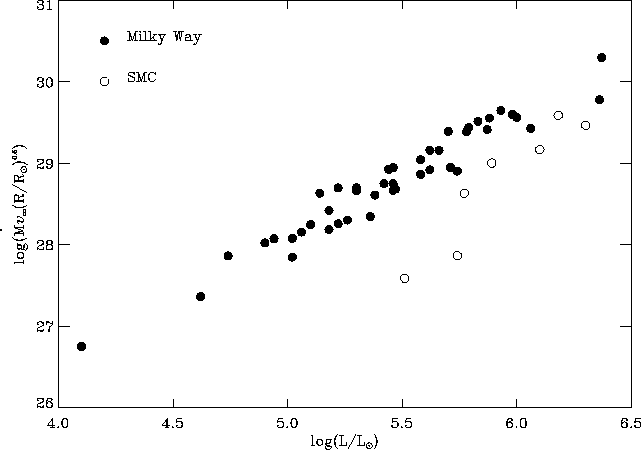
Figure: Wind momentum - luminosity relationship for the SMC
compared with galactic data.
There remains the question of the possible multiplicity of this object
and, indeed, of the other massive O-stars in this program. From a
careful examination of the visual and UV spectra of Sk , it was
concluded that this was probably a single star (see Walborn et al. 1995).
However, O-stars are infamous for being multiple, the best example perhaps
being that of R136a which at one time was thought to be a supermassive
star and which both HST and adaptive optics have shown to be a very
compact cluster. More recent examples of this sort from HST are
the studies of the galactic cluster NGC3603 by Drissen et al. (1995)
and the LMC clusters LH9 and LH10 by Walborn et al. (1995). In both cases,
objects apparently single from ground-based observations have split up
into two or more components under the scrutiny of HST. We, therefore,
decided to check the multiplicity of our O-stars using HST and WFPC2
and in Cycle 5 we acquired such data through a successful snapshot
program (GO6133). In Fig. 7 we show, for four of our target stars,
contour plots of a 21x21 pixel section (1 pixel = 0.046 arcsec)
of the PC frame (taken with the F555W filter)
approximately centered on the target star. From
this figure we can see that Sk
, it was
concluded that this was probably a single star (see Walborn et al. 1995).
However, O-stars are infamous for being multiple, the best example perhaps
being that of R136a which at one time was thought to be a supermassive
star and which both HST and adaptive optics have shown to be a very
compact cluster. More recent examples of this sort from HST are
the studies of the galactic cluster NGC3603 by Drissen et al. (1995)
and the LMC clusters LH9 and LH10 by Walborn et al. (1995). In both cases,
objects apparently single from ground-based observations have split up
into two or more components under the scrutiny of HST. We, therefore,
decided to check the multiplicity of our O-stars using HST and WFPC2
and in Cycle 5 we acquired such data through a successful snapshot
program (GO6133). In Fig. 7 we show, for four of our target stars,
contour plots of a 21x21 pixel section (1 pixel = 0.046 arcsec)
of the PC frame (taken with the F555W filter)
approximately centered on the target star. From
this figure we can see that Sk does indeed appear to be a
single star, as do Sk
does indeed appear to be a
single star, as do Sk and Sk
 .
The star Sk
.
The star Sk is an example of a star which was suspected of being multiple from
its spectrum, an expectation confirmed here in this image.
A more detailed publication on Sk
is an example of a star which was suspected of being multiple from
its spectrum, an expectation confirmed here in this image.
A more detailed publication on Sk is currently in preparation.
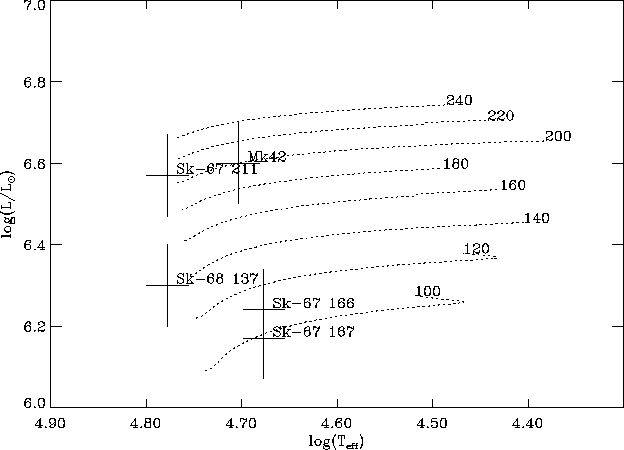
Figure: HRD for the most massive
O-stars in the LMC with the evolutionary tracks
of Langer (1996; private communication) computed assuming  .
.
In the discussion of the metallicity dependence of the WLR using O-stars
in the Magellanic Clouds (and also in Puls et al. 1996), it is
assumed that the composition of these objects is typical of that
deduced from analyses of B and A giants and supergiants. Such
an assumption, of course, needs to be checked by abundance analyses
of the individual O-stars involved. This is not a straightforward task
for O-stars, they have only a few weak metal lines in the visible
part of the spectrum and the strengths of these lines are strongly
influenced by NLTE effects and by the presence of a wind and
line blocking. The UV part of the spectrum offers much better
prospects given the multitude of strong and weak metal lines,
especially as there are many lines of iron,
one of the most important opacity sources for O-stars.
Besides the difficulties mentioned above, there are other problems
posed by a combination of the large number of lines, the typical
rotational velocities of O-stars (100 to 200 ), and in this case
the moderate resolution of the Faint Object Spectrograph. In order to
determine metallicities, therefore, we have resorted to a spectral
synthesis technique using an updated version
of the radiation driven wind model described by Pauldrach et al. (1994).
For the determination of abundances using this approach, care
must be taken to choose spectral regions where the line wavelengths and
gf values are well known. Furthermore, one has to compromise between
choosing lines which are too strong to be sensitive to the abundance
(essentially saturated over the range of abundances of interest), and
lines which are so weak that one is limited by the signal-to-noise and
blending/resolution problems.
), and in this case
the moderate resolution of the Faint Object Spectrograph. In order to
determine metallicities, therefore, we have resorted to a spectral
synthesis technique using an updated version
of the radiation driven wind model described by Pauldrach et al. (1994).
For the determination of abundances using this approach, care
must be taken to choose spectral regions where the line wavelengths and
gf values are well known. Furthermore, one has to compromise between
choosing lines which are too strong to be sensitive to the abundance
(essentially saturated over the range of abundances of interest), and
lines which are so weak that one is limited by the signal-to-noise and
blending/resolution problems.

Figure: Contour plots of a 1 arcsec square section of PC chip from
WFPC2 observations of four massive O-stars in the LMC, see text.
Note that the distortions in the contour plots displayed here
can be accounted for by a combination of undersampling of the
PSF by the PC chip and due to structure in the wings of the PSF.

Figure: Section of HST/FOS spectrum for the O3III star NGC346#3 in the SMC
(polyline) compared with synthetic spectra computed as described in the text
with abundances 0.11, 0.2, 0.3 and 0.4 times solar (smooth curves). Stellar
absorption is due to FeV,VI and NiV lines. Note
that the synthesis includes interstellar SiII 1264.74Å line
which is not included in Fig. 9 below.
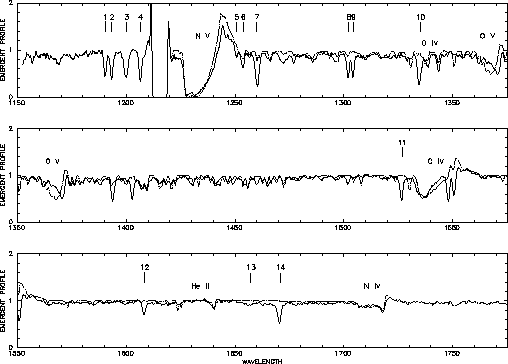
Figure: Fit to the observed spectrum of the O3III star NGC346#3 in the SMC
using the derived abundance of 0.2 times solar. Numbers 1 through 14
indicate the positions of the main interstellar lines.
We illustrate this method in Fig. 8 for the O3III star
NGC346#3 in the SMC using a region containing a blend of FeIV,V,VI
and NiV lines. This region is first synthesized using a range
of abundances from 0.11 to 0.4 times solar, this is then convolved
with appropriate rotational and instrumental profiles before being compared
with the observational data. From this and other selected
spectral regions one then arrives at an optimum fit for the abundance,
which in this case turns out to be 0.2 times solar. A final fit
to the complete spectrum from 1150Å to around 1750Å is shown in
Fig. 9. Note the relative strengths of the CIV and NV
resonance lines (the latter is unsaturated), from which it is deduced
that we are seeing material which has undergone CN processing.
From consideration of the O-stars discussed in section 2,
it is concluded that mean metallicities of  and
and  are appropriate for the SMC and
LMC stars, respectively (Haser 1995).
are appropriate for the SMC and
LMC stars, respectively (Haser 1995).
Although the HST observations of A and B supergiants in the Magellanic Clouds needed for the calibration of the WLR referred to in section 2 have not yet been taken, work has already begun on extending this kind of study to supergiants in other galaxies in the Local Group, in particular M31 and M33 (see, for example, Herrero et al. 1994, Monteverde et al. 1996). These two galaxies are important in their own right, both have strong abundance gradients and it is important to check if these gradients, determined from HII region studies, are echoed by the stars. Note that there are indications that this may not be the case for our galaxy, or at least that the picture of a constant exponential gradient may be too simple (Smartt et al. 1996). This idea has repercussions for Cepheid distance determinations since M31 is one of the key galaxies in the investigation of the still uncertain metallicity dependence of PL/PLC relations (Madore & Freedman 1990, Gould 1994, Stift 1995). Finally, in addition to the metallicity question, stellar studies also provide important estimates of the extinction in the host galaxies, another very important aspect for Cepheid work.
Two stars in
the M31 association OB78 in M31 have already been observed with HST/FOS, these
are a B1Ia supergiant and an O8.5Ia supergiant and were analyzed by
Bianchi et al. (1994) and Haser et al. (1995), respectively. A metallicity
for both objects of close to solar was deduced in this work, in
agreement with expectations from the association's position in
M31 (Massey et al. 1986) and the observed oxygen abundance
gradient (Vila-Costas & Edmunds 1992). Mass-loss rates and
wind terminal velocities lead to estimates of the wind momentum
and the results are plotted in Fig. 10 from which we can see that
there is good agreement with the WLR deduced for galactic stars.
Turning to M33, recently McCarthy et al. (1996) presented KeckI
high resolution data for two A-type supergiants in this
galaxy, designated B324 and
117A, and they determined both their chemical compositions and
mass-loss rates. Note that since UV spectra for these two objects
are not available, estimates of wind terminal velocities
were made using of the work of
Stahl et al. (1991) or, for B324 only, from P-Cygni FeII lines
in the visual spectral region. The positions of these stars
are plotted in the WLR diagram in Fig. 11 and compared with both
galactic and SMC results, from which we see that one star (B324) is
consistent with either of these galaxies but the other (117A) is
consistent only with the SMC data. However, from the abundance
analysis it turns out that B324 has close to solar composition
while 117A has a composition similar to, or a little less than, the
metallicity of the SMC. Thus, we see that the positions of these
two objects in Fig. 11 are easily understood. Moreover, the metallicities
of these two stars are also broadly consistent with their positions in
M33 (Humphreys & Sandage 1980) and with this galaxy's (oxygen)
abundance gradient (Vilchez et al. 1988, Henry & Howard 1995).
However, the work of McCarthy
et al. also provides for the first time estimates of iron, titanium, magnesium
and silicon abundances in M33. The continuation of this work, which
will also include cooler supergiants to probe the
abundances of s-process elements and hotter supergiants to probe CNO
abundances,
will provide important insights into the composition and the chemical
evolution of these spiral galaxies. On the question of determining
more precise estimates of the wind momentum for such objects, HST/WFPC2
time has been granted during Cycle 6 to check targets for multiplicity and
to obtain photometry which is uncontaminated by nearby companions, while
UV spectra will be sought during Cycle 7 using STIS.
supergiant and an O8.5Ia supergiant and were analyzed by
Bianchi et al. (1994) and Haser et al. (1995), respectively. A metallicity
for both objects of close to solar was deduced in this work, in
agreement with expectations from the association's position in
M31 (Massey et al. 1986) and the observed oxygen abundance
gradient (Vila-Costas & Edmunds 1992). Mass-loss rates and
wind terminal velocities lead to estimates of the wind momentum
and the results are plotted in Fig. 10 from which we can see that
there is good agreement with the WLR deduced for galactic stars.
Turning to M33, recently McCarthy et al. (1996) presented KeckI
high resolution data for two A-type supergiants in this
galaxy, designated B324 and
117A, and they determined both their chemical compositions and
mass-loss rates. Note that since UV spectra for these two objects
are not available, estimates of wind terminal velocities
were made using of the work of
Stahl et al. (1991) or, for B324 only, from P-Cygni FeII lines
in the visual spectral region. The positions of these stars
are plotted in the WLR diagram in Fig. 11 and compared with both
galactic and SMC results, from which we see that one star (B324) is
consistent with either of these galaxies but the other (117A) is
consistent only with the SMC data. However, from the abundance
analysis it turns out that B324 has close to solar composition
while 117A has a composition similar to, or a little less than, the
metallicity of the SMC. Thus, we see that the positions of these
two objects in Fig. 11 are easily understood. Moreover, the metallicities
of these two stars are also broadly consistent with their positions in
M33 (Humphreys & Sandage 1980) and with this galaxy's (oxygen)
abundance gradient (Vilchez et al. 1988, Henry & Howard 1995).
However, the work of McCarthy
et al. also provides for the first time estimates of iron, titanium, magnesium
and silicon abundances in M33. The continuation of this work, which
will also include cooler supergiants to probe the
abundances of s-process elements and hotter supergiants to probe CNO
abundances,
will provide important insights into the composition and the chemical
evolution of these spiral galaxies. On the question of determining
more precise estimates of the wind momentum for such objects, HST/WFPC2
time has been granted during Cycle 6 to check targets for multiplicity and
to obtain photometry which is uncontaminated by nearby companions, while
UV spectra will be sought during Cycle 7 using STIS.

Figure: Results for wind momentum - luminosity relationships in M31
compared to galactic results.
A high priority is clearly the calibration of the WLR using supergiants in both Magellanic Clouds and we are currently awaiting our Cycle 5 and 6 data from HST with great anticipation. The work on M31 and M33 is also very important with respect to the question of abundance gradients (plus extinction) and the relevance this has for Cepheid distance determinations to spiral galaxies. Beyond the Local Group, we intend to follow in the footsteps of the HST Cepheid Key Project (see Kennicutt et al. 1995) which will produce color-magnitude diagrams for many galaxies from which we can select A or B supergiant candidates for follow-up spectroscopy. Using HST and 8m class telescopes (and spectrographs with resolutions in the range 3000 to 5000), we expect to extend this kind work to galaxies as distant as the Virgo cluster.
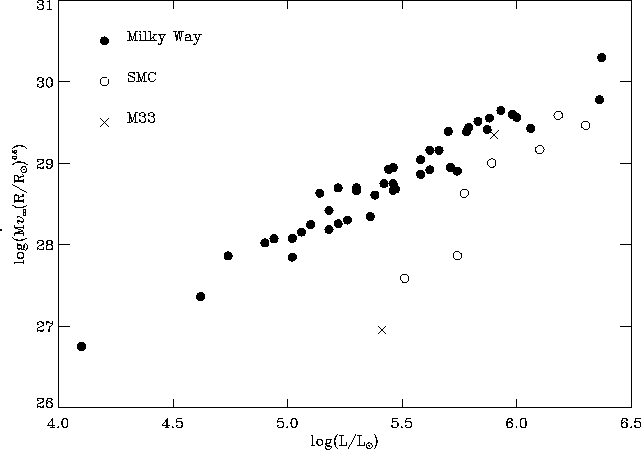
Figure: Results for wind momentum - luminosity relationships in
M33 compared to galactic results and SMC results.
Abbot, D. C. 1988, ApJ, 259, 282
Bianchi, L., Hutchings, J. B., Lamers, H. J. G. L. M., Massey, P., Kudritzki, R.-P., Herrero, A., & Lennon, D. J. 1994, A&A, 292, 213
Drissen, L., Moffat, A. F. J., Walborn, N. R., & Shara, M. M. 1995, AJ, 110, 2235
Gould, A. 1994, ApJ, 426, 542
Haser, S.M. 1995, PhD Thesis, Ludwig-Maximilians University, Munich
Haser, S. M., Lennon, D. J., Kudritzki, R.-P., Puls, J., Pauldrach, A. W. A., Bianchi, L., & Hutchings, J. B. 1995, A&A, 295, 136
Henry, R. B. C. & Howard, J. W. 1995, ApJ, 438, 170
Herrero, A., Lennon, D. J., Vilchez, J. M., Kudritzki, R.-P., & Humphreys, R. M. 1994, A&A, 287, 885
Humphreys, R. M. & Sandage, A. 1980, ApJS, 44, 319
Kennicutt, R. C., Freedman, W. L., & Mould, J. R. 1995, AJ, 110, 1476
Kudritzki, R.-P., Pauldrach, A. W. A., Puls, J., & Abbott, D. C. 1989, A&A, 219, 205
Kudritzki, R.-P., Hummer, D. G., Pauldrach, A. W. A., Puls, J., Najarro, F., & Imhoff, J. 1992, A&A, 257, 655
Kudritzki, R.-P., Lennon, D. J., & Puls, J. 1995, in Science with the VLT, eds., J.R Walsh & I.J. Danziger, Springer-Verlag, p246
Lennon, D. J., Kudritzki, R.-P., Herrero, A., Puls, J. & Haser, S. M. 1994, in 3rd CTIO/ESO Workshop on the Local Group: Comparative and Global Properties, ESO Conference and Workshop Proceedings No. 51, ESO, p251
Madore, B. F. & Freedman, W. L. 1991, PASP, 103, 933
Massey, P., Armandroff, T. E., & Conti, P. S. 1986, AJ, 92, 1303
McCarthy, J. K., Lennon, D. J., Venn, K., Kudritzki, R.-P., Puls, J. & Najarro, F. 1996, ApJ, in press
Monteverde, I., Herrero, A., Lennon, D. J., & Kudritzki, R.-P. 1996, A&A, in press
Pauldrach, A. W. A., Puls, J. & Kudritzki, R.-P. 1986, A&A, 164, 86
Puls, J., Kudritzki, R.-P., Herrero, A., Pauldrach, A. W. A., Haser, S. M., Lennon, D. J., Gabler, R., Voels, S. A., Vilchez, J. M., Wachter S., & Feldmeier A. 1996, A&A, 305, 171
Robert, C., Leitherer, C.. & Heckman, T. 1996, in From Stars to Galaxies: The Impact of Stellar Physics on Galaxy Evolution, to appear in ASAP Conf. Series
Schaerer, D., Meynet, G., Maeder, A., & Schaller, G. 1993, A&AS, 98, 523
Schaller, G., Schaerer, D., Meynet, G., & Maeder, A. 1993, A&AS, 96, 269
Smartt, S. J., Dufton, P. L., & Rolleston, W. R. J. 1996, A&A, in press
Stahl, O., Aab, O., Smolinski, J., & Wolf, B. 1991, A&A, 252, 693
Stift, M. J. 1995, A&A, 301, 776
Taresch, G., Kudritzki, R.-P., Hurwitz, M., Bowyer, S., Pauldrach, A. W. A., Puls, J., & Butler, K. 1996, A&A, submitted
Vila-Costas, M. B. & Edmunds, M. G. 1992, MNRAS, 259, 121
Vilchez, J. M., Pagel, B. E. J., Díaz, A. I., Terlevich, E., & Edmunds, M. G. 1988, MNRAS, 235, 633
Walborn, N. R., Lennon, D. J., Haser, S. M., Kudritzki, R.-P., & Voels, S. A. 1995, PASP, 107, 104
Walborn, N. R., MacKenty, J. W., Parker, J. W., Saha, A., & White, R. L. 1996, in 11th IAP Meeting on The Interplay between Massive Star Formation, the ISM, and Galaxy Evolution, in press