Diffuse Interstellar Bands in Moderate Redshift Damped Lyman-alpha Systems and Low to Moderate Redshift Starburst Galaxies


UNDER CONSTRUCTION


COLLABORATORS

Christopher W. Churchill (NMSU)
Brian A. York (UVIC)
Sara L. Ellison (UVIC)
Theodore P. Snow (Colorado)
Rachel Johnson (Oxford, UK)
Sean G. Ryan (Hertfordshire, UK)

Crystal L. Martin (UCSB)

David S. Rupke (UM College Park)
Sylvain Veilleux (UM College Park)

SUPPORT

NASA GSRP
NMSU Spacegrant


GENERAL INFO ON DIBs

The diffuse interstellar bands (DIBs) are ~300 absorption features observed from the near UV to the near IR. DIBs are ubiquitous in the Milky Way as seen towards reddened stars. They are purely interstellar in origin (Snow 2001). The largest bands are observed in the optical as seen in Figure 1 below.

Figure 1

Figure 1: Synthetic normalized DIB spectrum as seen towards the star BD+63 1964. The wavelengths of five of the more prominent DIB lines (in strength and occurence) are at 4428, 5780, 5797, 6284, and 6613 Å's. Courtesy of Pascale Ehrenfreund, Leiden University.

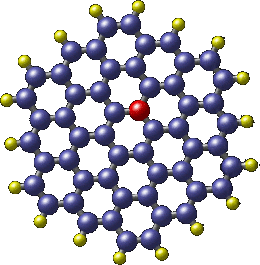
The current belief is that the DIB absorption features are caused by organic molecules known as polycyclic aromatic hydrocarbons (PAHs) and other similar carbon structures such as PANHs, carbon chains, etc in the gas phase in the ISM (see Snow 2001; Hudgins et al 2005). PAHs have structures that incorporate benzene rings [C6] with hydrogen attached along the outer edges depending on the energy density within the gas. Figure 2 below shows some typical PAHs as seen on Earth where they are abundant and a known carcinogen.

Figure 2

Figure 2: Typical structures of PAHs. The pericondensed structures are more centrally condensed allowing them to withstand higher UV fluxes. The catacondensed species of PAHs are more linear in structure and are more easily photo-dissociated. Image taken from Salama et al 1996.

It should be noted that there is no definite identification made for a particular PAH causing a particular DIB. There is a large effort underway by many laboratory chemists to do this (including my collaborator Theodore P. Snow and a group at NASA Ames).


MOTIVATION: WHY STUDY DIB'S?

Figure 3

Figure 3: Processes thought relevant in the formation of life on Earth. My research solely focuses on organics from space. This image is from Bada & Lazcano and can be found on Pascale Ehrenfreund's Astrobiology website.

How life arose on Earth is still much of a mystery let alone whether or not life arose elsewhere in the Universe. However, for the first time in history the disparate fields of science required to gain an understanding in whether or not life may or may not be ubiquitous in the Universe are coming together under the new field of astrobiology. Geologists are contemplating whether or not tectonic plates are a necessity for intelligent life. Biologists and chemists are busy attempting to understand how life may have arose on Earth in terms of the chemical and evolutionary processes necessary. Astronomers are discussing terms such as habitable zones in solar systems as well as Galactic habitable zones all while discovering a multitude of new extra-solar planets every year. Many scientists are coming together to discuss the probability of life once existing on Mars or currently existing on Europa, Titan, or Enceladus. It's no wonder that astrobiology is a fast growing sub-field of astronomy. The very nature of the field lends itself to great popular appeal and, therefore, allows avenues for funding through governmental sources such as NASA and the NSF.

Figure 4

Figure 4: Illustration of how organic molecules could have come to Earth. As the nebula condenses to form the Solar System the PAHs accrete directly onto the forming planets as well as ariving through asteroid and comet impacts much in the same way as the volatiles are thought to have been seeded on our planet. Image courtesy of Andy Christie of Slimfilms.com (for July '99 Scientific American).

Furthermore, PAHs, PANHs, and carbon chains exist throughout the Galactic ISM. Understanding the nature of the species inhabiting the ISM in terms of environmental conditions such as ionizing flux, metallicity, velocity dispersions, dust content, etc can lead astronomers to a better understanding of what conditions are necessary for organic molecules to exist. The Spitzer Space Telescope is gathering the spectra of many galaxies in the near-IR and detecting the known vibrational bands of PAHs. PAHs are in other galaxies besides the Milky Way, but there are many questions that need to be answered:


KNOWN EXTRA-GALACTIC SYSTEMS WITH DIB'S

Since my research specifically involves DIBs in extra-galactic systems, it's important to note some of the few extra-galactic systems that have known DIB absorption.


Moderate Redshift DLAs - HI Selected Sample

In the Milky Way there is a well-known trend of HI strength with several DIB strengths. Figure 5 below shows this trend with the 5780Å DIB.

Figure 5

Figure 5: EW of the 5780 Å DIB line in mÅ vs. the log column density of HI [atoms/cm²] from various lines of sight within our Galaxy. Two trend lines are extrapolated. The OLS trend line refers to an ordinary least squares procedure where weights of individual points are ignored. The York trend line refers to the method outlined in York 1966. This plot is taken from Herbig 1993.

In collaboration with Brian A. York, Sara L. Ellison, Christopher W. Churchill, Theodore P. Snow, Rachel Johnson, and Sean G. Ryan, we have used the Galactic HI-DIB relation as a marker for choosing extragalactic systems. This is precisely why we have chosen to look at damped-Lyman alpha systems (DLAs). DLAs are defined as those systems that have a minimum log column density of HI (log N(HI)) of 20.3 [atoms/cm²], and they are associated with galaxies (Chen et al. 2002). Most of the points in Figure 5 taken within our Galaxy would be classified as DLAs if they were discovered using our technique.

The technique we use to analyze our DLAs is by using the background light from QSOs. A QSO is a very active galaxy whose nucleus contains a supermassive black hole devouring tremendous quantities of gas. This infalling material into the black hole powers the QSO allowing it to output a tremendous amount of energy. QSOs are beasts of the past; they are seen at very large astronomical distances. Hence, QSOs are seen at epochs when the Universe was much younger (up to z~6). Figure 6 below shows how we use these QSOs to probe the intervening DLA.

Figure 6

Figure 6: Illustration of how we observe DLAs via QSOs. The HI gas absorbed from an intervening DLA is likely due to cloudlets in the halo of a galaxy as seen in the illustration. Taken from my collaborator Chris W. Churchill's website.

Our group has analyzed 7 DLAs that span a redshift range of z=0.09-0.52 using Keck, William Herschel Telescope (WHT), Apache Point Observatory (APO), Gemini, and the Very Large Telescope (VLT). A short synopsis of six of these DLAs are presented in Lawton 2005. A full write-up of our results is currently in progress and will be submitted shortly (Lawton et al. 2006). Preliminary results of six of our DLAs are in Figure 7 below.

Figure 7

Figure 7: (left) Measured 5780 DIB strength (upper limits) vs. "MW Predicted" 5780 DIB strength. (right) Same as left except for "Z-Scaled." Filled circle is 0738+313 for z=0.091. Open circle is 0738+313 for z=0.221. Filled square is 0827+243. Open square is 0952+197. Filled triangle is 1127-145. Open triangle is 1229-020. Taken from Lawton et al. 2005.

In none of the six DLAs in Figure 7 above have we detected DIBs; however, we do have strong limits on several of these systems. The remaining 7th DLA does have DIB detections and those results will be released shortly. To arrive at our "MW Predicted" limits for DIB strengths we use the HI-DIB correlation (see Figure 5). The results for the "MW Predicted" points are plotted in the left panel of Figure 7. Presented are observed limits on the DLA DIB strength versus expected Milky Way DIB strength for a cloud with the particular DLA NHI. Those points below the 1:1 correlation line correspond to DLAs that are deficient in the 5780 DIB based purely on Milky Way expectations. Four of our six DLAs have 5780 DIB strengths at least 0.5 dex below Milky Way strengths. Points above the 1:1 correlation line are unconstrained and additional data are required to obtain meaningful limits on the DIB strengths.

For the "Z-Scaled" DIBs, we attempt to include the effects of metallicity. We estimate the DIB strengths by the following equation:

log EW = log EWDIB + (log N(HI) - 20.3) + [Z/H] mÅ,

where EWDIB is the EW of the particular DIB line in the Milky Way at log N(HI) = 20.3, the second factor is due to the slope of the Milky Way relation between the log EW of the 5780 DIB line and the log N(HI) of the cloud, and a linear relationship with metallicity is assumed. A [Z/H] of -1 is applied when metallicity is not known (standard DLA metallicity). All of the data lie above the 1:1 correlation line in Figure 7. To find if metallicity is responsible for the DIB deficiency we require additional data to adequately constrain our limits.

These results clearly show that the HI content of a galaxy is not enough to determine the strength of the organic molecules responsible for the DIBs. These DLAs are quite different from the Milky Way. Our research is expanding in order to understand what other factors perhaps inhibit the DIB strengths in many extragalactic sources. The possible environmental factors may include metallicity (as described above), ionizing flux, dust content, and perhaps others. Also, it is possible that there are intrinsic biases when looking at different galaxies (such as viewing angle of the galactic disk/bulge). Perhaps actually seeing the DIBs requires the galaxy to be oriented in a specific way. These questions are being explored in other portions of my project that involve analyzing starburst galaxies.


REFERENCES


Spitzer SAGE Analysis of the LMC and SMC HII Regions


UNDER CONSTRUCTION


COLLABORATORS

Karl Gordon (STScI)


Spitzer LMC & SMC Analysis - Under Construction