NStars 2: Proper motion stars --- | ---
NStars 4: Activity
NStars 2: Proper motion stars --- | ---
NStars 4: Activity
 NStars 2: Proper motion stars --- | ---
NStars 4: Activity
NStars 2: Proper motion stars --- | ---
NStars 4: Activity
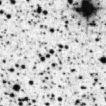
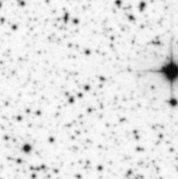 Gl 752A/VB 10
Searches for low-luminosity companions
1. Introduction
A significant fraction of hydrogen-burning stars (and stellar remnants) are found in binary or multiple star systems, rather than as isolated single stars. This immediately suggests a possible method of finding sub-stellar mass objects - look for low-luminosity companions to stars which we already know lie within the immediate Solar Neighbourhood. This maximising the chances of finding intrinsically faint star-like objects - provided they form in binary and/or multiple systems. As outlined below, this technique has been used since at least the middle of the twentieth century, and was responsible for the identification of the first unequivocal, bona-fide brown dwarf, besides a range of other objects which could lay claim to be the first not-immediately-recognised brown dwarf in a binary (since LP 944-20 is the first catalogued, but unrecognised, brown dwarf). This page provides a basic introduction to this genre; the links at the bottom of the page give access to summaries of the two major programs related to this area which we are undertaking as part of the NStars project.
The fact that stars frequently form multiple systems clearly offers a potential technique for searching for low luminosity stars: pick known nearby stars and search their vicinity for much fainter companions. Since these stars have known distances and known space motions, potential companions can be vetted based not only on photometric characteristics, but also on whether their proper motions and/or radial velocities are consistent with the bright primary. Most nearby stars have substantial proper motions, so observations spanning only a relatively small timeline are all that are required to sort out resolved companions. As a result, many common proper motion systems emerged in the course of classical photographic surveys for proper motion stars. However, a few projects can be highlighted as concentrating specifically on searching for low-luminosity binary companions.
Most of the initial brown dwarf discoveries came from looking for low-mass companions to known nearby stars - even if the exact nature of some of those companions remains ambiguous. HD 114762, for example, was one of the earliest main-sequence stars identified as having an apparently very low-mass spectroscopic companion, with M sin(i) ~ 0.011 MSun (Latham et al, 1989). However, the observed rotational velocity for the F9 primary suggested a high inclination,perhaps sufficient to raise the mass of the companion above the hydrogen-burning limit. Current estimates tend to favour a lowr mass, squarely in the brown dwarf regime.
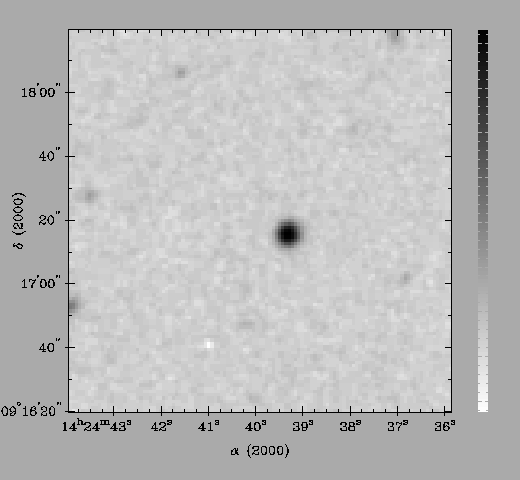
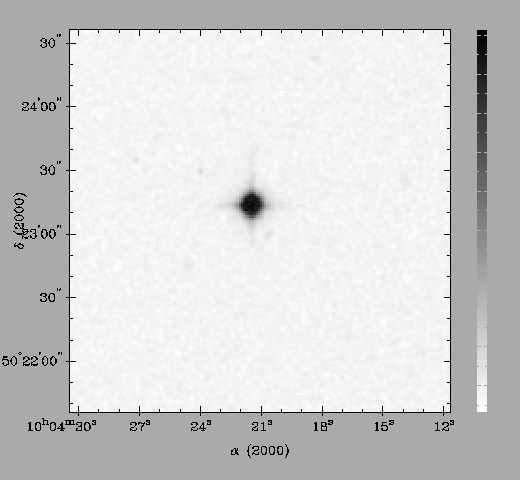
Figure 3.1a: The POSS II R-band image of the white dwarf GD 165 |
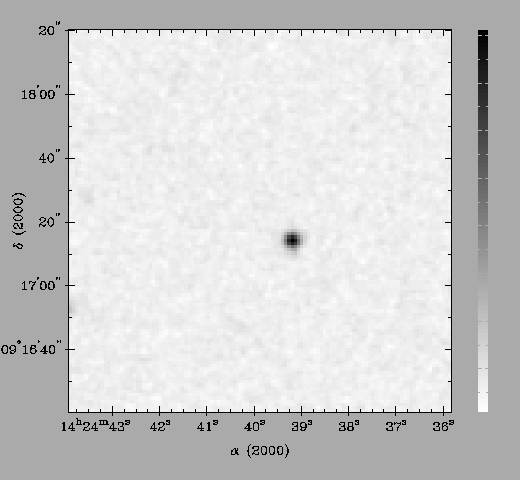
Figure 3.1b: The POSS II I-band image of GD 165; GD 165B is barely visible. |
Zuckerman & Becklin (1988) used near-infrared imaging to identify an extremely red companion to GD 165, a ZZ Ceti pulsating white dwarf at a distance of ~33 parsecs. The observations were part of a larger survey of white dwarfs,building on previous searches by those authors and by Probst (1983) for white dwarfs with near-infrared flux excess, consistent with the presence of a cool companion. One candidate had emerged prior to these observations - G 29-38, another ZZ Ceti star - but in that case the IR excess is more consistent with cold dust than a compact companion. (The origin of the dust remains unclear.) in the case of GD 165, the companion was resolved (and is barely visible on the POSS II I-band plate), leaving no room for a dusty origin. Clearly, the object was significantly fainter than any other low-temperature dwarf known at that time, and the initial spectroscopic observations indicated an unusual spectrum, but the presence of the WD companion offered potential complications in interpretation (pollution?). As a result, it was not until the mid-1990s that GD 165B was recognised as the first example of spectral class L. With a spectral type of L4 GD 165B lies on the sub-stellar boundary, and it still remains unclear whether it is a star or a brown dwarf - or even a transition object, burning hydrogen for 10-15 Gyrs before fading into obscurity.
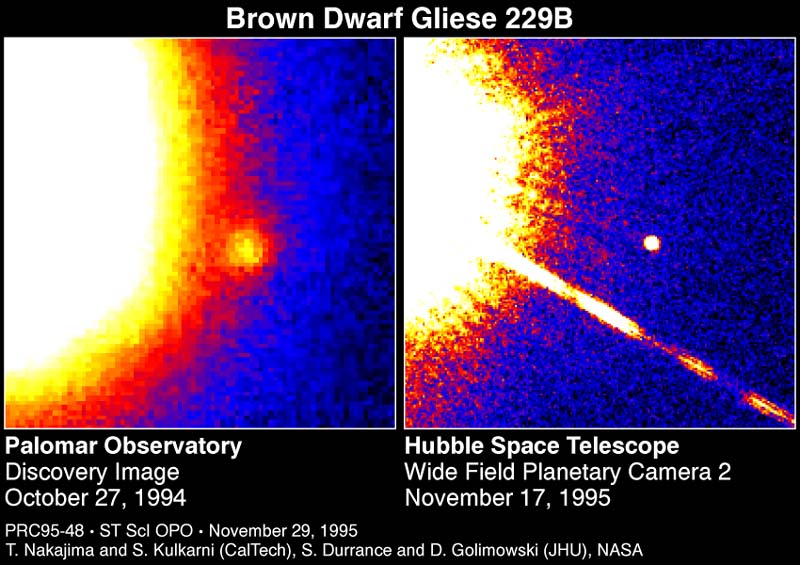
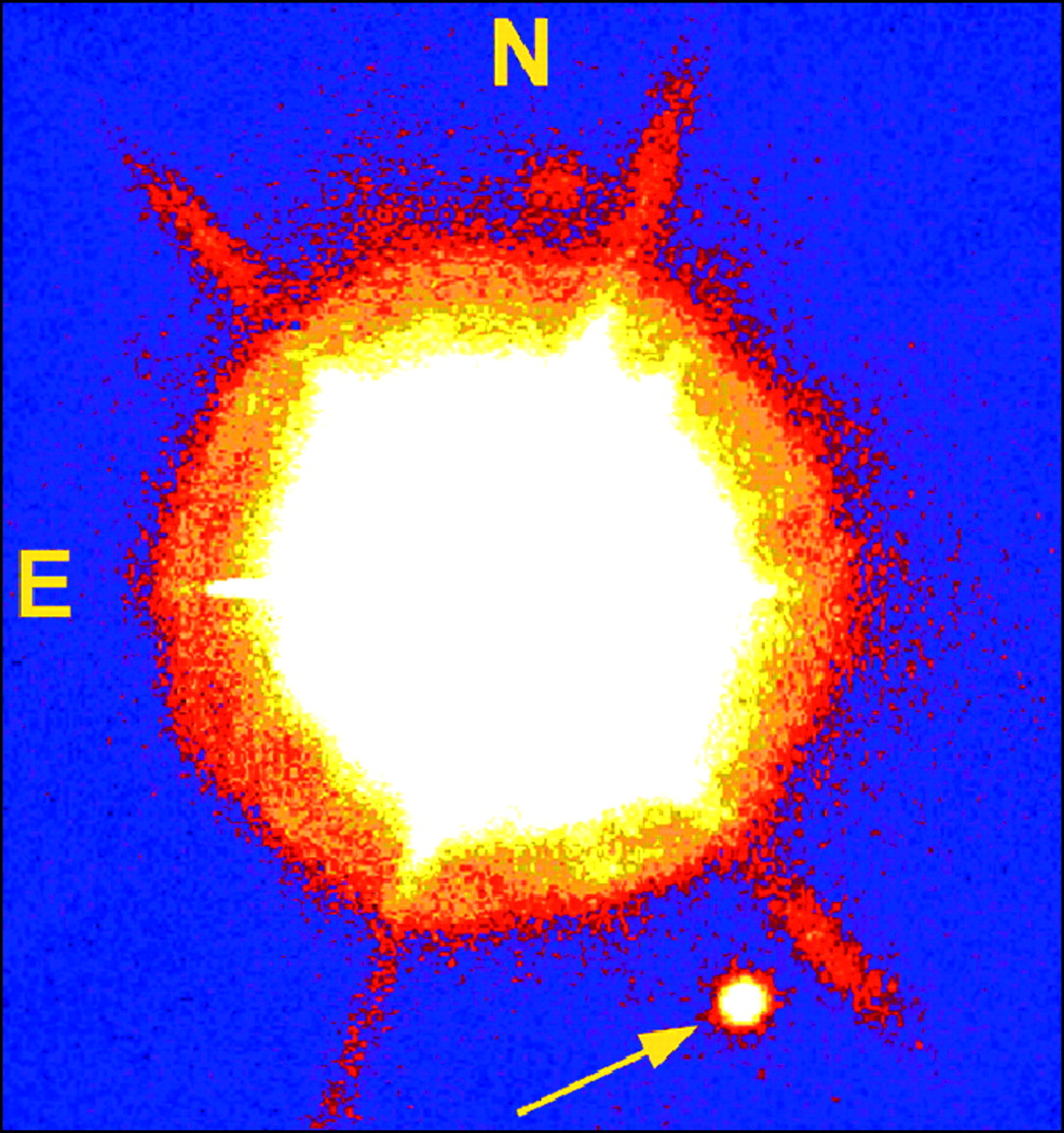
Figure 3.2: the prototypical T dwarf, Gl 229B. The left-hand panel shows an I-band image taken with the JHU coronagraph on the Palomar 60-inch; the right-hand panel is an I-band image taken with WFPC2 on HST. |
The first unequivocal brown dwarf, Gl 229B, was discovered because it is a companion to an otherwise unremarkable M0 dwarf within 6 parsecs of the Sun. Nakajima et al (1995) were undertaking a survey of the nearest stars using a coronagraphic camera built at Johns Hopkins University, with the specific intent of discovering such objects. Previous discoveries include imaging the third component in the Gl 105 system, Gl 105C (Golimowski et al, 1995). Gl 229B stood out as being over 10 magnitudes fainter than the primary at far-red wavelengths, but having surprisingly blue near-infrared colours - a feature which we now recognise as characteristic of the presence of methane absorption, and the defining characteristic of spectral class T (see the spectral classification pages). Assuming an age of at least 1 Gyr for the system (based on the absence of H-alpha emission in the M0.5 primary), Gl 229B is likely to have a mass at least fifty times that of Jupiter.
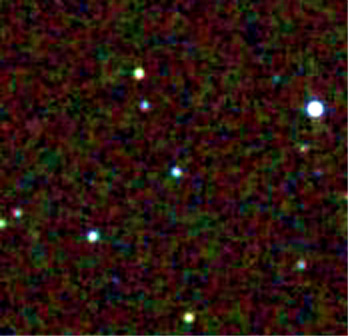
Figure 3.3: Gl 570D, the other known T dwarf within 8 parsecs of the Sun - a false-colour image, based on 2MASS JHK photometry.. |
The full Palomar/JHU coronagraphic survey includes all M dwarfs north of -350 with distances of less than 8 parsecs, and complementing Henry's high spatial-resolution survey. Gl 229B, lying 7 arcseconds from the primary, falls just outside the area covered by the latter speckle survey. As summarised by Oppenheimer et al (2001), while the Palomar/JHU survey turned up a few new stellar companions, the only other brown dwarf is Gl 570D, discovered directly from 2MASS data by Burgasser et al (2000a). Gl 570D lies more 1500 AU (258 arcseconds) from three more massive K and M dwarfs in the system.
Figure 3.4a: The POSS II I-band image of the M-dwarf/L-dwarf system, G196-3A/B. The L dwarf is barely visible to the SW of the primary. |
Figure 3.4b: An I-band image of G196-3A/B taken with the Nordic Optical telescope. |
Figure 3.4 illustrates another M-dwarf/L-dwarf binary, the proper motion star G193-3A/B. Identified by Rebolo et al. (1998), the companion is an early-type L dwarf, lying some 17 arcseconds from the M2.5 primary. G 196-3A is chromospherically active, suggesting a relatively young age (< 300 Myrs). As a consequence, the L dwarf compasnion probably has a significantly lower mass than Gl 229B, even though effective temperature is higher by ~1000K. Rebolo et al estimate ~25(+15/-10) Jupiter masses.
Figure 3.5a: The POSS II R-band image of Gl 569A. |
Figure 3.5b: An H-band image of the Gl 569a/b system - Keck AO system, (from Martin et al, 2000). |
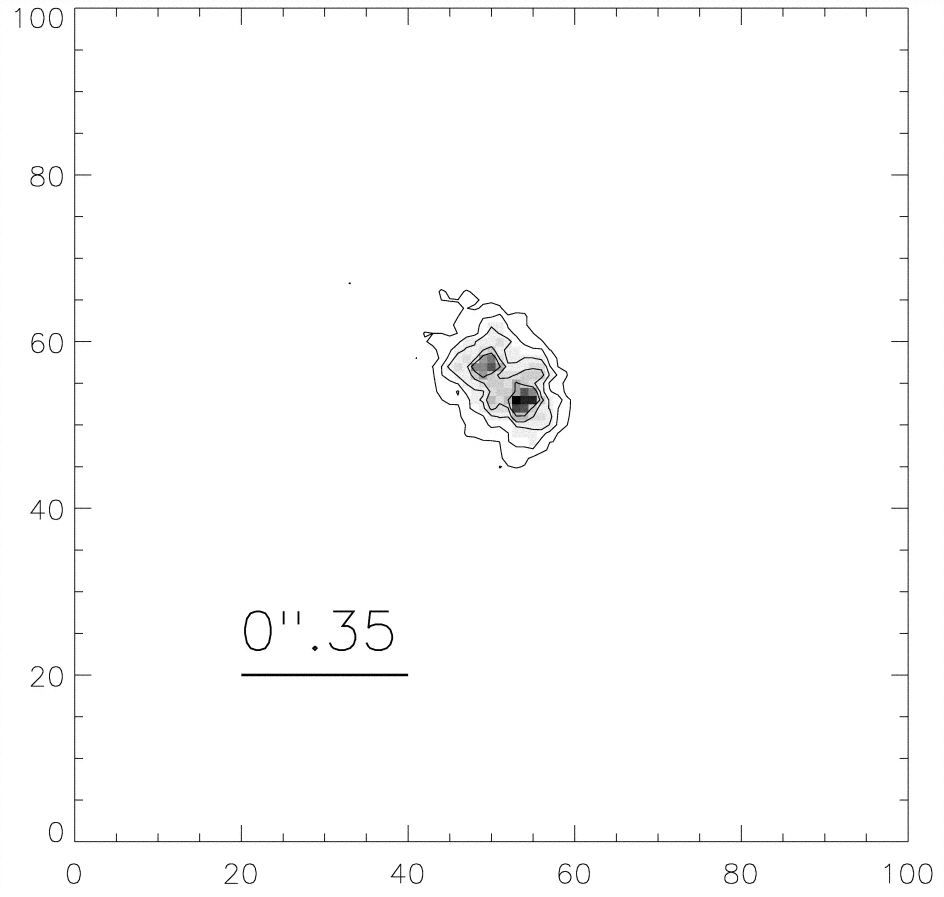
One more example - Forrest et al (1988) originally identified Gl 569B, a late-type M-dwarf cpm companion lying ~4.9 arcseconds from the M2.5 dwarf, Gl 569A. Subsequent high-resolution imaging has revealed that companion to be itself binary, Gl 569Ba and Gl 569Bb. Lane et al (2001) have used interferometric techniques to derive an astrometric orbit for the latter system, and both dwarfs prove to have masses in the vicinity of 0.07 MSun. Thus, in some respects, Gl 569Ba/b might be regarded as the first unequivocal brown dwarf to have been discovered. Of course, Luyten identified LP 944-20 (Tinney, 1998) in the 1960s....
Numerous additional low temperature companions have since been discovered using a variety of techniques, notably colour-based searches of near-infrared survey data and high-resolution direct imaging of previously-identified ultracool dwarfs. The following table provides a summary of the main properties of those systems; the two web-pages listed below provide further details.
| System | Sp. type (primary) | Sp. type (secondary) | Primary mass | Secondary mass | q | Separation (AU) | reference |
|---|---|---|---|---|---|---|---|
| PPl 15 | M6 | M6 | 0.07 | 0.06 | 0.86 | 0.03 | Basri & Martin, 1999 |
| HD 10697 | G5 | L? | 1.10 | 0.04 | 0.035 | 0.07 | Shay & Mazeh, 2000 |
| 2M0746 | L0.5 | L0.5 | >0.06 | >0.06 | 1.0 | 2.7 | Reid et al, 2001 |
| 2M0920 | L6.5 | L6.5 | 0.06-0.075 | 0.06-0.075 | 0.95 | 3.2 | Reid et al, 2001 |
| 2M0850 | L6 | L9/T0? | <0.06 | <0.06 | 0.75 | 4.4 | Reid et al, 2001 |
| DENIS 1228 | L5 | L5 | <0.06 | <0.06 | ~1 | 4.9 | Martin et al, 1999 |
| 2M1146 | L3 | L3 | <0.06 | <0.06 | ~1 | 7.6 | Koerner et al, 1999 |
| DENIS 0205 | L7 | L7 | 0.06-0.09 | 0.06-0.09 | ~1 | 9.2 | Koerner et al, 1999 |
| Gl 229B | M0.5 | T6 | 0.5 | ~0.045 | ~0.1 | 44 | Nakajima et al, 1995 |
| Gl 569Bab | M2.5 | M8.5/M8.5 | 0.35 | 0.06/0.06 | 0.3/1 | 48/1 | Lane et al, 2001 |
| TWA 5 | M1.5 | M8 | 0.4 | 0.025 | 0.06 | 100 | Lowrance et al, 1999 |
| GD 165B | DA | L4 | > 1 | <0.08 | <.08 | 110 | Becklin & Zuckerman, 1988 |
| HR 7329B | A0 | M8 | ~5 | <0.05 | <.01 | 200 | Lowrance et al,, 2000 |
| GJ 1048B | K2 | L1 | ~0.7 | <0.08 | <0.11 | 250 | Gizis et al, 2001 |
| G196-3B | M2.5 | L3 | 0.5 | ~0.025 | ~0.05 | 340 | Rebolo et al, 1998 |
| GJ 1001B | M3.5 | L4 | 0.4 | ~0.05 | ~0.13 | 180 | Goldman et al, 1999 |
| Gl 337C | G8/K1 | L8 | ~0.9/0.9 | >0.06 | ~0.04 | 881 | Wilson et al., 2001 |
| Gl 618.1C | M0 | L2.5 | 0.7 | >0.06 | ~0.1 | 1090 | Wilson et al., 2001 |
| Gl 570D | K5/M1/M | L1 | 0.7 | ~0.05 | ~0.07 | 1525 | Burgasser et al., 2000b |
| Gl 417B | G0 | L4.5 | 1.0 | ~0.035 | ~0.035 | 2000 | Kirkpatrick et al, 2001a |
| HR 4067B | F7 | L0 | 1.4 | >0.06 | ~0.05 | 2460 | Wilson et al., 2001 |
| Gl 584C | G1/G3 | L8 | 1.0 | ~0.060 | ~0.060 | 3600 | Kirkpatrick et al, 2001a |
Column 6 lists the mass ratio, M2/M1; column 7 lists the projected separation, in AU.
 Companion search index
NStars home page
INR home page