
Simulated WFIRST Observation of Andromeda Galaxy

About This Image
Caption
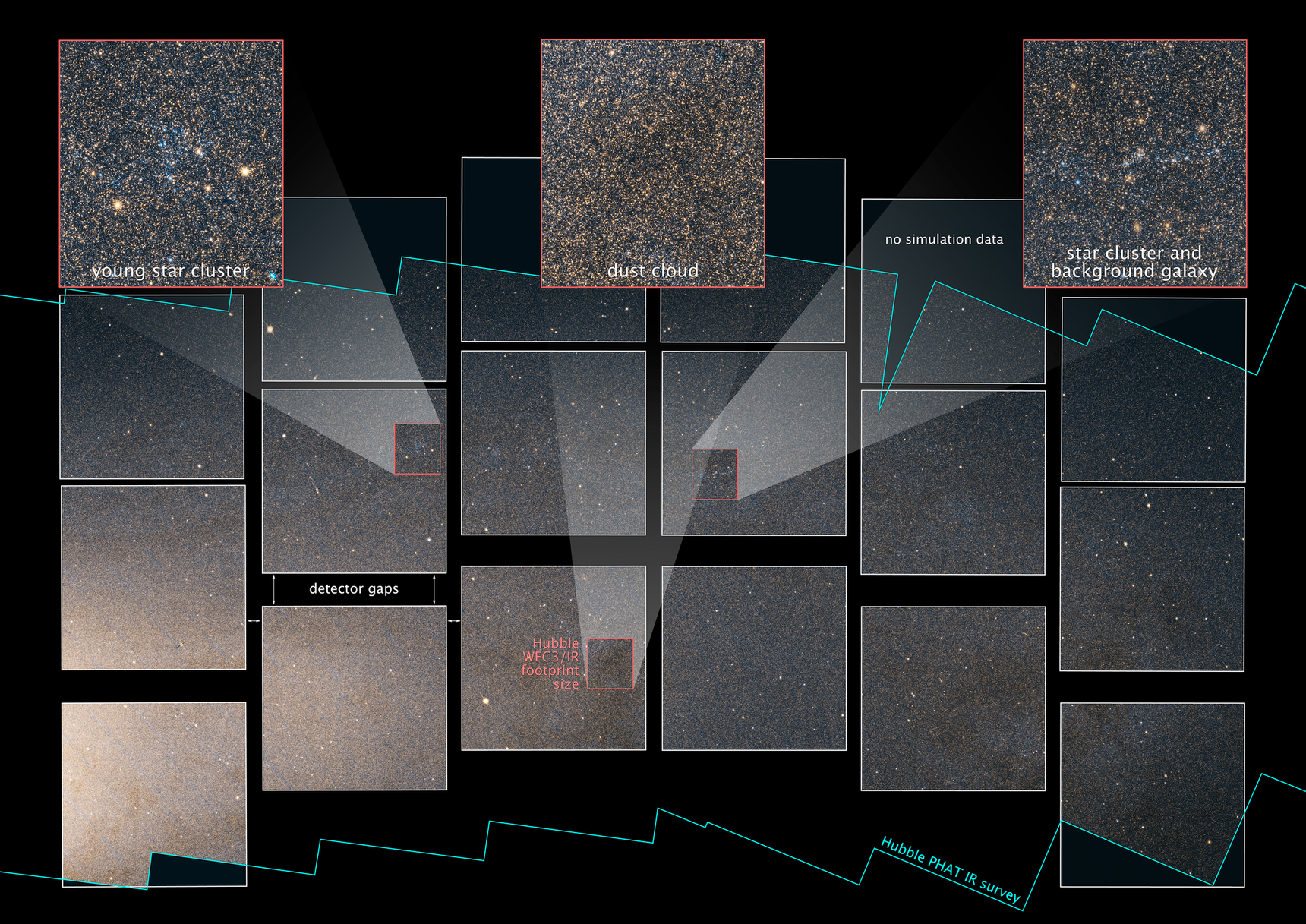
This simulated image of a portion of the Andromeda galaxy highlights the high resolution, large field of view, and unique footprint of NASA’s upcoming Wide Field Infrared Survey Telescope (WFIRST).
Made using data from the Panchromatic Hubble Andromeda Treasury (PHAT) program, the image spans approximately 34,000 light-years, or about 1/5 of the full disk of Andromeda, showcasing the red and near-infrared light of more than 50 million individual stars. Red and green represent near-infrared light, while blue represents visible red light.
The image runs from the edge of the bright core of the galaxy on the lower left, out along and across several of the galaxy’s spiral arms in the middle and right.
WFIRST’s Wide Field Instrument (WFI) consists of 18 square detectors, each with 4096 × 4096 pixels. The area imaged by each detector is outlined in white. In total, the footprint covers about 0.28 square degrees of the sky, or about 1⅓ times the area covered by the full Moon, and represents the area that will be imaged in a single pointing of WFIRST (not 18 separate pointings). For comparison, Hubble’s infrared camera covers less than 1/150th the area covered by the full Moon.
The black space between the white outlines represents chip gaps: areas between detectors where data are not recorded. When WFIRST is operating, these gaps can be filled by moving the telescope slightly and combining exposures.
The black regions within some of the detector squares are gaps in the Hubble PHAT data used to create the simulated image. In an actual WFIRST image of Andromeda, each square would be completely filled with near-infrared light from the stars, gas, and dust of the galaxy.
About The Object
- Object Name
- M31, Andromeda Galaxy, NGC 224
- Object Description
- Spiral Galaxy
- R.A. Position
- 00:42
- Dec. Position
- +41:15
- Constellation
- Andromeda
- Distance
- 2.5 million light-years
About The Data
- Data Description
- Simulated WFIRST data generated using the Space Telescope Image Product Simulator (STIPS), based on near-infrared Hubble data from the PHAT program.
- Instrument
- WFIRST Wide Field Instrument (Simulated)
About The Image
- Color Info
- This image is a composite of simulated data from three separate filters on the Wide Field Instrument on the Wide Field Infrared Survey Telescope. The color results from assigning different hues (colors) to each monochromatic (grayscale) image associated with an individual filter. In this case, the assigned colors are: • Blue: R062 (visible red light; 0.62 microns) • Green: Y106 (near-infrared light; 1.06 microns) • Red: H158 (near-infrared light; 1.58 microns)
- Compass and Scale Image
-


About The Object
- Object Name
- A name or catalog number that astronomers use to identify an astronomical object.
- Object Description
- The type of astronomical object.
- R.A. Position
- Right ascension – analogous to longitude – is one component of an object's position.
- Dec. Position
- Declination – analogous to latitude – is one component of an object's position.
- Constellation
- One of 88 recognized regions of the celestial sphere in which the object appears.
- Distance
- The physical distance from Earth to the astronomical object. Distances within our solar system are usually measured in Astronomical Units (AU). Distances between stars are usually measured in light-years. Interstellar distances can also be measured in parsecs.
About The Data
- Data Description
- Proposal: A description of the observations, their scientific justification, and the links to the data available in the science archive.
- Science Team: The astronomers who planned the observations and analyzed the data. "PI" refers to the Principal Investigator.
- Instrument
- The science instrument used to produce the data.
About The Image
- Color Info
- A brief description of the methods used to convert telescope data into the color image being presented.
- Compass and Scale Image
- An astronomical image with a scale that shows how large an object is on the sky, a compass that shows how the object is oriented on the sky, and the filters with which the image was made.
News Center Prefooter
Inbox Astronomy
Sign up to receive the latest news, images, and discoveries about the universe:
Contact our News Team
Ask the News Team