
Webb Measures Distance to Farthest Fast Radio Burst, Suggesting Origin
Summary
Record breaker dates back to just 3 billion years after the big bang.
What mysterious phenomenon is capable of creating a millisecond-long blast of radio waves so powerful that we can detect it from billions of light-years away? The origin of such events, known as fast radio bursts (FRBs), remains uncertain.
A recently discovered FRB contains a clue. The most distant one found to date, its host galaxy proved surprisingly small and young. This suggests that there is little delay between when galaxies form stars and when they become capable of generating FRBs. This indicates FRBs likely are caused by young neutron stars known as magnetars. Only the James Webb Space Telescope was able to detect and characterize the host galaxy, determining both its distance and its size.
Full Article
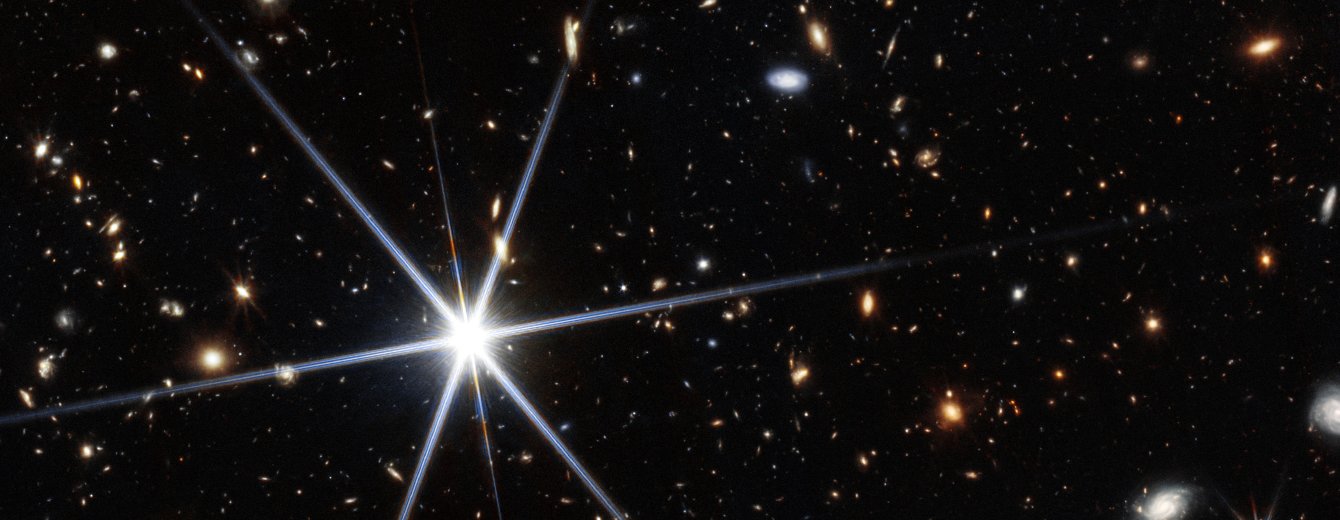
First discovered in 2007, fast radio bursts are enigmatic, millisecond-long flashes of radio emission from the distant universe. Their origin remains uncertain, particularly since most are seen once and never again. Astronomers using NASA’s James Webb Space Telescope have pinpointed the host galaxy of the most distant fast radio burst (FRB) seen to date. Their finding has implications for what kind of energetic event creates these bursts. “What makes fast radio bursts interesting is that we don't know what generates them. We have theories for what objects produce them, but we don't ...Visit NASA Science to view the full news release including article text and associated Webb imagery, graphics, scientific visualizations, videos, captions, text descriptions, and other information.
News releases highlighting the discoveries of NASA’s James Webb Space Telescope are produced for NASA by the Space Telescope Science Institute (STScI) in Baltimore, Maryland, under NASA Contract NAS5-03127. News release content is developed by the News Team in STScI’s Office of Public Outreach.
News Center Prefooter
Inbox Astronomy
Sign up to receive the latest news, images, and discoveries about the universe:
Contact our News Team
Ask the News Team