
NASA's Webb Captures Commotion From Nebula’s Stellar Jets
Summary
Webb’s infrared gaze reveals stars at various stages in their life cycles in high resolution
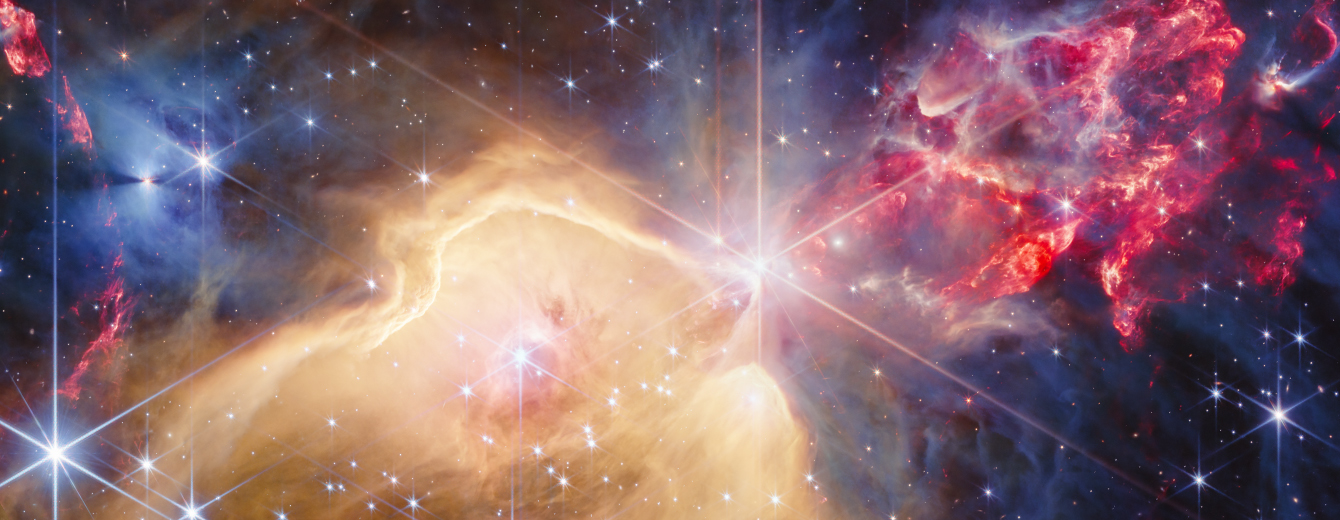
A technicolor dreamscape is revealed in this new image from NASA’s James Webb Space Telescope. It portrays a stellar nursery known as NGC 7129, a nebula that holds numerous protostars and stars within its fields of gas and dust. Webb captured infrared light, which pierces through the dense matter that scatters or absorbs other types of light. This region, rife with stellar objects in different stages of their lives, offers an opportunity to explore how stars shape their surrounding environment.
Full Article
A cauldron of cosmic creation is being revealed in a new image from NASA’s James Webb Space Telescope. Webb has unveiled numerous stars formerly hidden by clouds of dust in a stellar nursery known as NGC 7129, which resides about 3,300 light-years from Earth. Stars, the engines of elemental creation, have life cycles that begin with their birth in molecular clouds – cold, dense regions of dust and gas. Because of these dusty cocoons, young stars are often impossible to view by many telescopes, particularly those incapable of capturing infrared light. Webb, however, has a high degree ...Visit NASA Science to view the full news release including article text and associated Webb imagery, graphics, scientific visualizations, videos, captions, text descriptions, and other information.
News releases highlighting the discoveries of NASA’s James Webb Space Telescope are produced for NASA by the Space Telescope Science Institute (STScI) in Baltimore, Maryland, under NASA Contract NAS5-03127. News release content is developed by the News Team in STScI’s Office of Public Outreach.
News Center Prefooter
Inbox Astronomy
Sign up to receive the latest news, images, and discoveries about the universe:
Contact our News Team
Ask the News Team