
NASA’s Webb Provides Crash Course on Planet-Shattering Collisions
Summary
The telescope is going beyond grazing the surface of these dusty, chaotic systems.
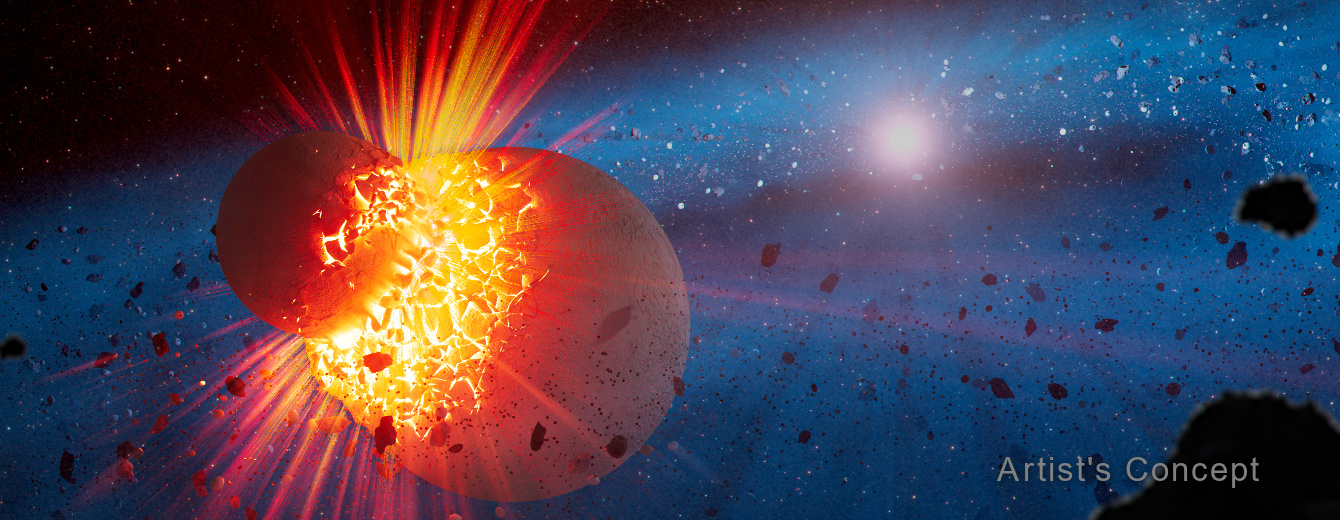
Approximately 20 years ago, the Spitzer Space Telescope uncovered an enigmatic subclass of circumstellar disks — rings of dust and rock orbiting mature stars. Now a team of astronomers has used the James Webb Space Telescope to further study these confounding environments known as extreme debris disks. Within these disks, Moon-sized and even Mars-sized objects are colliding, creating massive amounts of warm dust. With the largest survey of these disks to date, the team has enough data to begin investigating their composition, origins, and connection to planet formation and evolution — including in our own solar system.
Full Article
In the early history of our solar system, scientists theorize that a Mars-sized object called Theia smashed into the infant Earth, vaporizing massive amounts of rock and blasting it into space. Some of that material coalesced into the Moon, where NASA’s Artemis program is returning humans, preparing for Mars, and shaping the future of space exploration. That long-ago, violent collision reshaped our home planet. Astronomers have used NASA’s James Webb Space Telescope to examine a class of young stellar systems that show signs of similar upheavals, providing clues to the amount of ...Visit NASA Science to view the full news release including article text and associated Webb imagery, graphics, scientific visualizations, videos, captions, text descriptions, and other information.
News releases highlighting the discoveries of NASA’s James Webb Space Telescope are produced for NASA by the Space Telescope Science Institute (STScI) in Baltimore, Maryland, under NASA Contract NAS5-03127. News release content is developed by the News Team in STScI’s Office of Public Outreach.
News Center Prefooter
Inbox Astronomy
Sign up to receive the latest news, images, and discoveries about the universe:
Contact our News Team
Ask the News Team