STJ and TES Time & Energy Resolving Detectors:
Capabilities, Status and Prospects
Blas Cabrera
An ideal photon detector would absorb each photon while providing maximal information, including xy image position, arrival time, energy and polarization. For the past fifteen years, such detectors operated below 0.1 K have been available in the x-ray band, where the combination of high resolving power (now R~1500 at 6 keV) and high efficiency (~100% at 6 keV) make them the detectors of choice for the next generation of x-ray satellite missions such as Constellation X. These detectors are based on superconducting tunnel junctions (STJ), and on microcalorimeters which use semiconducting thermisters and more recently superconducting transition-edge sensor s (TES).
Over the past decade, the STJ and TES cryogenic technologies have been extended to access longer wavelengths in the UV, visible and near IR. These detectors count single photons, while time-stamping to better than 0.1 µs and energy resolving with an attainable R~ 100 (l/100 nm)1/2. The same single photon counting cryogenic technologies scale from the near IR to the far UV and on up to x-rays. In fact, these same technologies used with bolometric detectors, are the technology of choice at longer wavelengths for the next generation of CMB satellites such as Planck and FIRST and ground based IR cameras such as SCUBA. In the visible through UV, the detectors have an absorption efficiency above 50% and with coatings may approach 100% from the near IR through the UV.
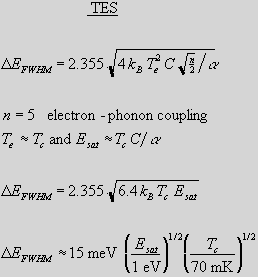
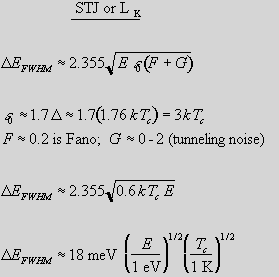
Table 1: Comparison of fundamental resolutions for TES and STJ photon detectors.
|
|
STJ’s are like semiconductor diode detectors since the signal is proportional to the number of electron like excitations produced by the photon. The difference is that the energy per excitation is less than a meV rather than about one eV, allowing a factor of ~30 improvement in the fundamental resolution. TES’s on the other hand, are calorimeters which actually measure the temperature rise in an isolated heat capacity to determine the photon energy. Their fundamental resolution is determined by the transition temperature of the superconductor and is proportional to the square root of the transition temperature. As shown in Table 1, the comparison of fundamental resolution between TESs and STJs is remarkably similar. The noise from the counting statistics for the STJs where the unit energy scale is given by kTc ends up nearly identical to the noise from the thermodynamic fluctuations of the TESs with the same energy scale given by kTc. The one difference is that for a given STJ detector, the energy resolution is proportional to the square root of the energy, so that R~Eg1/2, whereas for a given TES detector, the energy resolution is a constant given by the saturation energy, so that R~ Eg.
So ultimately the choice between STJ and TES will come down to the answers to three questions about which technology: (1) most closely approaches the fundamental energy resolution limits, (2) provides the highest manufacturing yield and ease of operation, and most importantly, (3) can instrument the largest pixel arrays. The respect to the first, both technologies have approached 0.15 eV FWHM near 1 eV (1.24 µm) and improvements of a factor of 2 or 3 are expected. Both technologies have demonstrated counting rates above 10 kHz per pixel. With respect to the second question, the critical fabrication issue is the control of Tc, which is more straightforward than the control of the tunneling barrier for STJ, but not a major advantage. Both technologies will want to operate below 100 mK, but the cryogenic x-ray and CMB missions are already working hard on satellite cryogenic systems in this temperature range. With respect to the third, currently the TES technology has an advantage because a time-domain multiplexing technique has been demonstrated which takes advantage of the SQUID-readout low noise. Recently, an interesting frequency domain multiplexing scheme has been suggested which utilizes a new low noise amplifier called the rf set (single electron tunneling). Also, a new readout scheme based on kinetic inductance in superconductors has the same fundamental resolution limits as STJ’s, but has an attractive frequency-domain multiplexing scheme which utilizes existing GHz room temperature electronics. Ultimately, large arrays will be key and the technology allowing the most straightforward path to large arrays will be chosen.
The best applications for TES or STJ detectors are fast time variable sources such as pulsard, and neutron star and black hole binaries. Already, these point-source spectrophotometers have been used in ground-based observations of the Crab pulsar as well as several white dwarf, neutron start and black hole binaries. In addition their high efficiency over a broad band make them good candidates for photon starved applications such as faint galaxies where direct redshift measurements would be possible to 28 Mv with 10 meter class telescopes. An interesting application may very well be a combined x-ray and optical-UV mission, where the cryogenics would already be provide for the x-ray detectors and simultaneous observations of point-like compact or faint objects would substantially advance the science. It is again important to note that the x-ray and CMB satellite missions where cryogenic detectors must be used will provide a space-qualified infrastructure for cooling and electronics.
Because of their broadband nature, there detectors are not intrinsically solar blind, and so do not easily replace the need for MCPs with dispersive optics. The filters required to make them solar blind, such as Wood’s filters of MgF with Na layers, have proven difficult to make with high throughput efficiency. However, lower backgrounds than MCPs may be possible and may offset the filter efficiency for some applications. Finally, a hybrid detector with a dispersive element where all orders were allowed to hit a cryogenic array, would allow order sorting using the intrinsic low resolution of the detector and broadband through the simultaneous detection of six or seven orders, each covering more than a factor of two in wavelength or energy.
With respect to arrays, the state of the art for STJs is the imaging 6 x 6 SCAM built by ESA and demonstrated at the William Herschel 6 meter telescope. An R~5 was obtained from 300 to 600 nm and was probably limited by infrared leakage. A 2 x 2 TES array has been built by Stanford/NIST and was fiber-coupled for observations at the McDonald Observatory 107” telescope. An R~20 was achieved over a broadband from 1.7 µm to 350 nm. ESA is now building an imaging 8 x 8 STJ array, and Stanford/NIST are building an imaging 8 x 4 TES array. These will be very useful for ground-based demonstrations, where the atmospheric dispersion and guiding errors for point sources are completely contained within the array and nearby background subtraction is possible. These systems are brute force in that each pixel is connected to an independent electronics channel and no multiplexing is used.
In the five to ten year timescale, we expect TES arrays in the 32 x 32 range with some multiplexing and STJ arrays utilizing one FET per pixel. These instruments will make interesting long duration balloon and sounding rocket observations and should be considered for SMEX and MIDEX missions. An interesting intermediate step to larger arrays would be a 1024 x 1024 array in which any 256 pixels could be addressed and read out continuously, much like a programmable multi-fiber spectrometer. The redshifts of a faint field such as the HDF could then be rapidly determined. Such an instrument would attach many of the fabrication issues for larger arrays, including buried wiring layers and high efficiency. We do not yet know how to build 256 x 256 or larger arrays, but there are a number of interesting ideas which will be developed. In addition to the SQUID-based time-domain multiplexing, these include frequency-domain multiplexing with rf set amplifiers for STJs and a new kinetic inductance readout scheme.
In the long term, we find that superconducting detectors, like the Superconducting Tunneling Junctions, and the Transition Edge Sensors, will be important detectors for space astrophysics applications, because they provide simultaneous broad-band imaging, time tagging, and low resolution spectroscopy.