
WFPC2 Instrument Handbook for Cycle 10
 |
 |
 |
 |
|
| WFPC2 Instrument Handbook for Cycle 10 | |||
|
Dithering with WFPC2
Dithering is the technique of displacing the telescope between observations either on integral pixel scales (to assist in removing chip blemishes such as hot pixels) or on sub-pixel scales (to improve sampling and thus produce a higher-quality final image). Here we briefly discuss observation and data analysis for dithered data.
Dither Strategies
There is no single observing strategy that is entirely satisfactory in all circumstances for WFPC2. One must consider cosmic rays, hot pixels (i.e. pixels with high, time variable dark count), spatial undersampling of the image, and large-scale irregularities such as the few arcsecond wide region where the CCDs adjoin. One strategy that can be used to minimize the effects of undersampling and to reduce the effects of hot pixels and imperfect flat fields is to dither, that is, to offset the telescope by either integer-pixel or sub-pixel steps. The best choice for the number and size of the dithers depends on the amount of time available and the goals of the project. In the following we will address a few issues related to dithering:
- Undersampling: Individual images taken with sub-pixel offsets can be combined to form an image with higher spatial resolution than that of the original images. A single dither from the original pixel position -- call it (0,0) -- to one offset by half a pixel in both x and y, (0.5,0.5) will produce a substantial gain in spatial information. On the other hand very little extra information is gained from obtaining more than four positions, if the standard four point dither is used, and if the telescope has successfully executed the dither. Therefore the recommended number of sub-pixel dither positions is between 2 and 4.
- Hot Pixels: There are three ways to deal with hot pixels: correct using "dark frames" that bracket the observation, dither by an integer amount of pixels, or use a task such as "WARMPIX" within STSDAS to filter out the known hot pixels. Note that the integer dither strategy would ideally use six images, i.e. two CR-SPLIT images at each of three different dither positions. This is because in addition to hot pixels, low or "cold" pixels1 can be present and simple strategies selecting the minimum of two pixel values can fail. However, even four images (two each at two dither positions) will greatly aid in eliminating hot pixel artifacts.
- Cosmic Rays: Although dithering naturally provides many images of the same field, it is better to take several images at each single pointing in order to remove cosmic rays. In principle, it should be possible to remove cosmic rays using only sub-pixel dithered data, and the ditherII package has been developed for this purpose (see further below). At present, however, the package has not yet been tested on a wide variety of data. Hence a conservative recommendation would involve obtaining two or more images (i.e. CR-SPLITing) at each position in the dithered sequence. For very long integrations it is convenient to split the exposure into more than two separate images. As an example, for two 2000s exposures, about 1000 pixels per chip will be hit in both images and will therefore be unrecoverable. Moreover, since CR events typically affect 7 pixels per event, these pixels will not be independently placed, but rather will frequently be adjacent to other unrecoverable pixels.
- Accuracy of dithering: We do not yet have detailed statistics on the accuracy of HST dither offsets. The telescope pointing accuracy is typically better than 10 mas, but on occasion can deviate by much more, depending on the quality of the guide stars. For example, during the Hubble Deep Field, nearly all dithers were placed to within 10 mas (during ±1.3" offsets and returns separated by multiple days), although in a few cases the dither was off by more than 25 mas, and on one occasion (out of 107 reacquisitions) the telescope locked on a secondary FGS peak causing the pointing to be off by approximately 1" as well as a field rotation of about 4 arcminutes. The STSDAS "drizzle" software (initially developed by Fruchter and Hook for the Hubble Deep Field, and now used generally for many other programs) is able to reconstruct images even for these non-optimal dithers, still gaining in resolution over non-dithered data. The Richardson-Lucy-Hook non-linear deconvolution technique (STSDAS task ACOADD) can also use non-optimal dithers.
The simplest way to schedule dithers is to use the options DITHER-TYPE=LINE (e.g. for two-point diagonal dithers) or DITHER-TYPE=BOX (for four-point dithers). Alternative approaches are to specify a spatial scan or to use POS TARGs. Note that when the WF3 is specified as an aperture, the POS TARG axes run exactly along the WF3 rows and columns. For the other chips, they only run approximately along the rows and columns due to the small amount of rotation between CCDs. For small dithers (less than a few pixels) these rotations are unimportant.
Some specific offsets allow one to shift by convenient amounts both the PC and the WFC chips. For instance an offset of 0.5" is equivalent to 5 WFC pixels and 11 PC pixels. Likewise, the default DITHER-LINE spacing of 0.3535" along the diagonal is equivalent to shifts of (2.5,2.5) pixels for the WFC and (5.5,5.5) pixels for the PC.
Dithers larger than a few pixels will incur errors due to the camera geometric distortion which increases toward the CCD corners and alters the image scale by about 2% at the corners. Hence a 1.993" offset will be 20.3 WF pixels at the field center, but suffer a 0.4 pixel error at the CCD corners. Large dithers may also occasionally require a different set of guide stars for each pointing, thus greatly reducing the expected pointing accuracy (accuracy only ~1" due to guide star catalogue). One set of software presently available to handle the reduction of large dithers (which show the effects of geometric distortion) is the Fruchter-Hook code developed for reduction of the Hubble Deep Field images.
The most up-to-date information about dither strategies and related issues can be found on the general WFPC2 drizzling web page:
Analysis of Dithered Data
The software we recommend for combining dithered data is known as "drizzle", and is based on the "variable pixel linear reconstruction" algorithm (Fruchter and Hook 1997). This method has been developed into a number of tasks, incorporated into the IRAF/STSDAS dither package, which allow effective cosmic ray removal from singly dithered data (i.e., only one image per pointing). The dither package is part of the standard STSDAS distribution. An additional package, ditherII, has been developed for the specific purpose of removing cosmic rays from singly-dithered data, and can be downloaded via the WFPC2 webpages:
However, the ditherII package is also being incorporated into the next STSDAS distribution (summer 2000). With this software, it is now practical to obtain high-quality images via dithering even when the available time does not permit obtaining a CR-split at each pointing, and dithering is recommended under most circumstances (subject to the cautions further below). However, ditherII has not yet been tested on a wide variety of data, thus as a conservative approach we would still suggest obtaining at least two CR-SPLIT exposures at each dither pointing unless the available observing time is extremely limited (e.g., less than a few orbits).
Further information on the software in development to process dithered data can be found in two papers in the 1997 HST Calibration Workshop Proceedings: "A Package for the Reduction of Dithered Undersampled Images," by Fruchter et al. (1997), and "Dithered WFPC2 Images--A Demonstration," by Mutchler and Fruchter (1997).
In order to help users reduce dithered images, we have prepared the Drizzling Cookbook (Gonzaga et al. 1998), also available from the WFPC2 drizzle website. This document gives a general outline of the reduction of dithered images and provides step-by-step instructions for six real-life examples that cover a range of characteristics users might encounter in their observations. The data and scripts needed to reproduce the examples are also available via the same URL.
Despite all the improvements in the combination of dithered images, users should be mindful of the following cautionary notes:
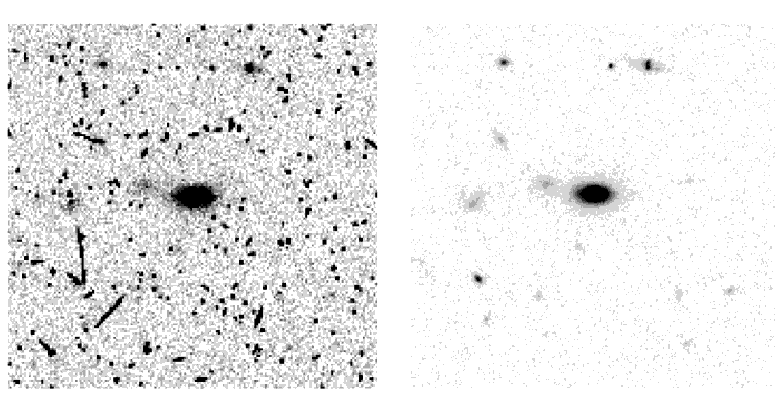
Figure 7.8: On the left, a single 2400s F814W WF2 image taken from the HST archive. On the right, the drizzled combination of twelve such images, each taken at a different dither position.
- Processing singly dithered images can require substantially more work (and more CPU cycles) than processing data with a number of images per pointing.
- Removing cosmic rays from singly dithered WFPC2 data requires good sub-pixel sampling; therefore one should probably not consider attempting this method with WFPC2 using fewer than four images and preferably no fewer than six to eight if the exposures are longer than a few minutes and thus subject to significant cosmic ray flux.
- It is particularly difficult to correct stellar images for cosmic rays, due to the undersampling of the WFPC2 (particularly in the WF images). Therefore, in cases where stellar photometry to better than a few percent is required, the user should take CR-split images, or be prepared to use the combined image only to find sources, and then extract the photometry from the individual images, rejecting entire stars where cosmic ray contamination has occurred.
1 Cold pixels usually result from hot pixels in the dark calibration file which do not actually appear in the science data.
- Offsets between dithered images must be determined accurately. The jitter files, which contain guiding information, cannot always be relied upon to provide accurate shifts. Therefore, the images should be deep enough for the offsets to be measured directly from the images themselves (typically via cross-correlation). In many cases, the observer would be wise to consider taking at least two images per dither position to allow a first-pass removal of cosmic rays for position determination.
- Finally, and perhaps most importantly, dithering will provide little additional spatial information unless the objects under investigation will have a signal-to-noise per pixel of at least a few at each dither position. In cases where the signal-to-noise of the image will be low, one need only dither enough to remove detector defects.
|
Space Telescope Science Institute http://www.stsci.edu Voice: (410) 338-1082 help@stsci.edu |
| |
|
|
|