Press Release Listing

Use the filter bar below to search by specific press release criteria including Mission, Year, and/or Keyword. Click the Apply button to generate the query. 

Filter Releases

(1647 total)

Filter Results

  1. NASA’s Hubble Uncovers Case of Missing Oxygen in Nearby Dwarf Galaxies

    November 02, 2026Release ID: 2026-024 Missions: Hubble

    Study reveals that dwarf galaxies retain only a small fraction of the oxygen made by their stars  
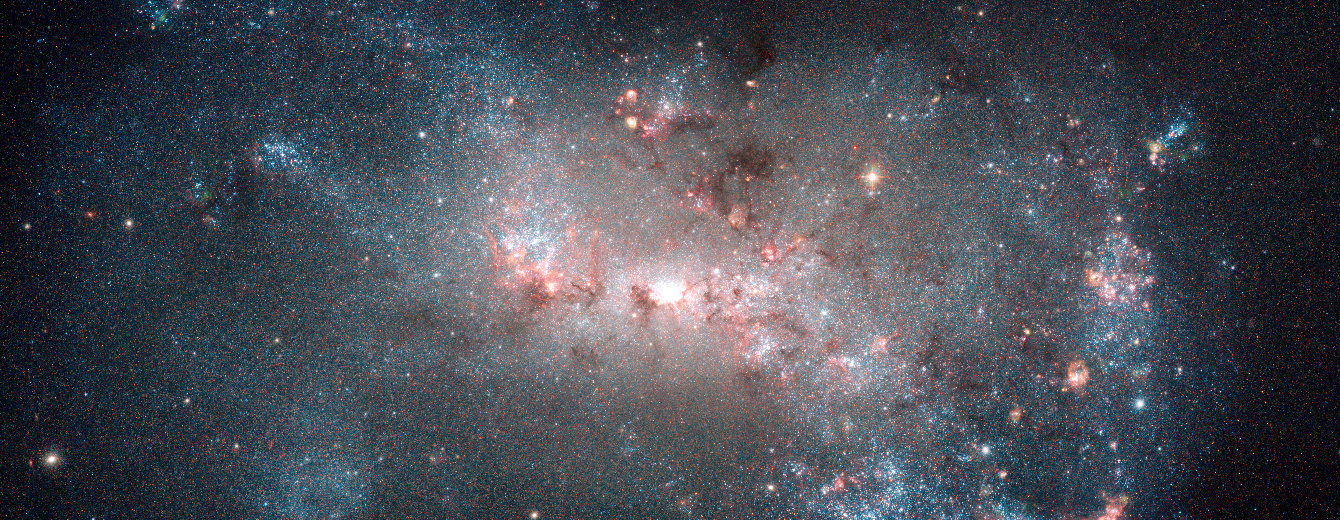
    Clumpy, irregular, cloud-like dwarf galaxy in a roughly rectangular shape is speckled with small, bright, blue points of light and larger, light pink patches throughout. Dark brown and milky white areas are also smudged throughout the center of the galaxy. The galaxy appears against a mostly black background lightly dotted with tiny white, blue and red stars and galaxies.
  2. Ghostly Cat’s Head Nebula Lurks Within Sight of NASA’s Hubble, Webb

    October 29, 2026Release ID: 2026-025 Missions: Hubble, Webb

    The star-forming region bewitches in visible and infrared light.
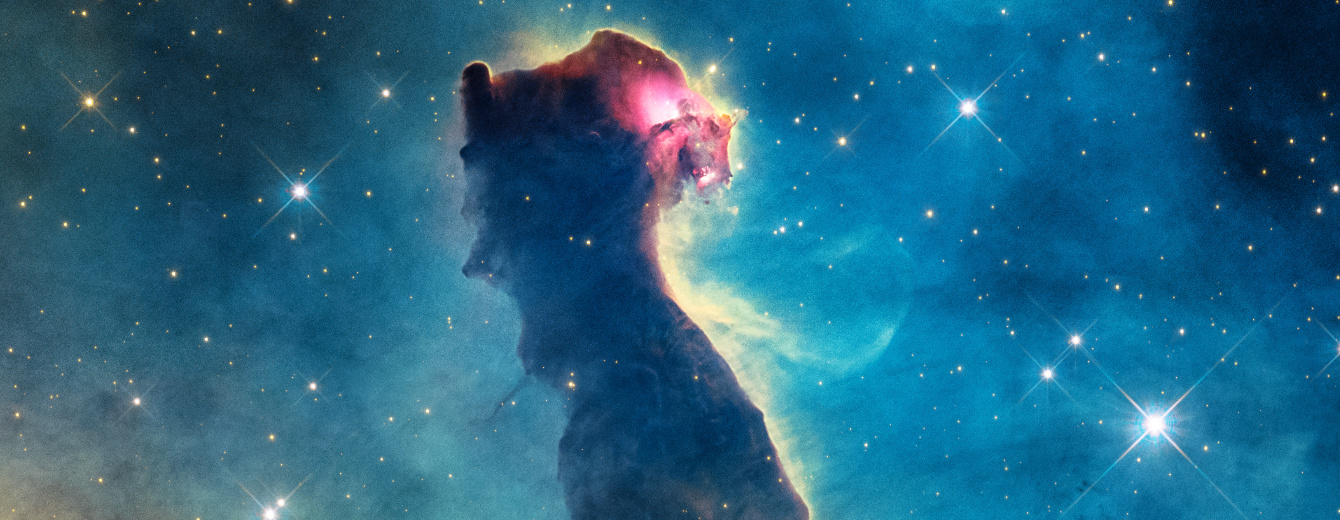
    Visible-light image of the Cat’s Head Nebula by the Hubble Space Telescope. A dark brown, opaque filament of dust is in the center, stretching from the bottom to almost the very top. It has a narrow, irregular shape that resembles a cat sitting with its back toward the viewer and a tail extending downward. The cat’s head is turned toward the right, revealing a red glowing eye. The top half of the background is bright blue. Approximately halfway down, cutting diagonally across the frame, the background color changes from blue to yellow, orange, and finally red near the bottom. The image is dotted with many small stars. Some larger stars with the telescope’s characteristic four-point diffraction spikes are scattered in the background and foreground.
  3. Webb Measures Distance to Farthest Fast Radio Burst, Suggesting Origin

    October 08, 2026Release ID: 2026-106 Missions: Webb

    Record breaker dates back to just 3 billion years after the big bang.
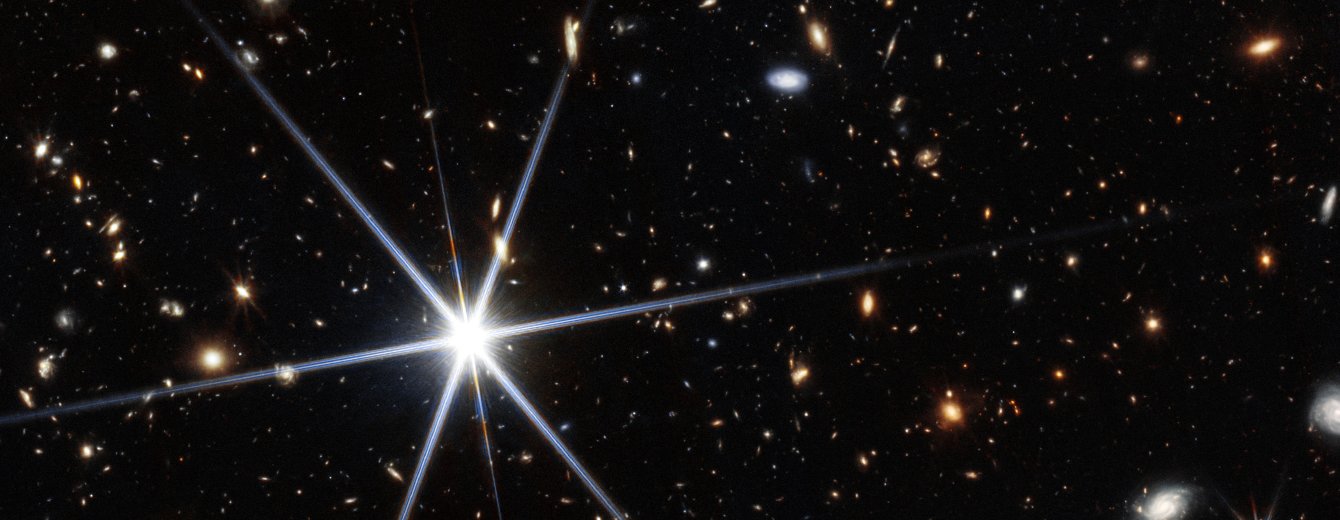
    A field full of small galaxies of all shapes against the blackness of space. A few bright white stars show 8 prominent diffraction spikes. A small galaxy at lower right is highlighted with a white box. A shaded triangle extends upward to the corners of a larger box showing a zoom in of the region. Two fuzzy, light blue blobs are at center, with a larger and brighter one at top. Just above the top blob is a white crosshair showing the location where a fast radio burst was detected.
  4. NASA's Webb Captures Commotion From Nebula’s Stellar Jets

    October 06, 2026Release ID: 2026-129 Missions: Webb

    Webb’s infrared gaze reveals stars at various stages in their life cycles in high resolution
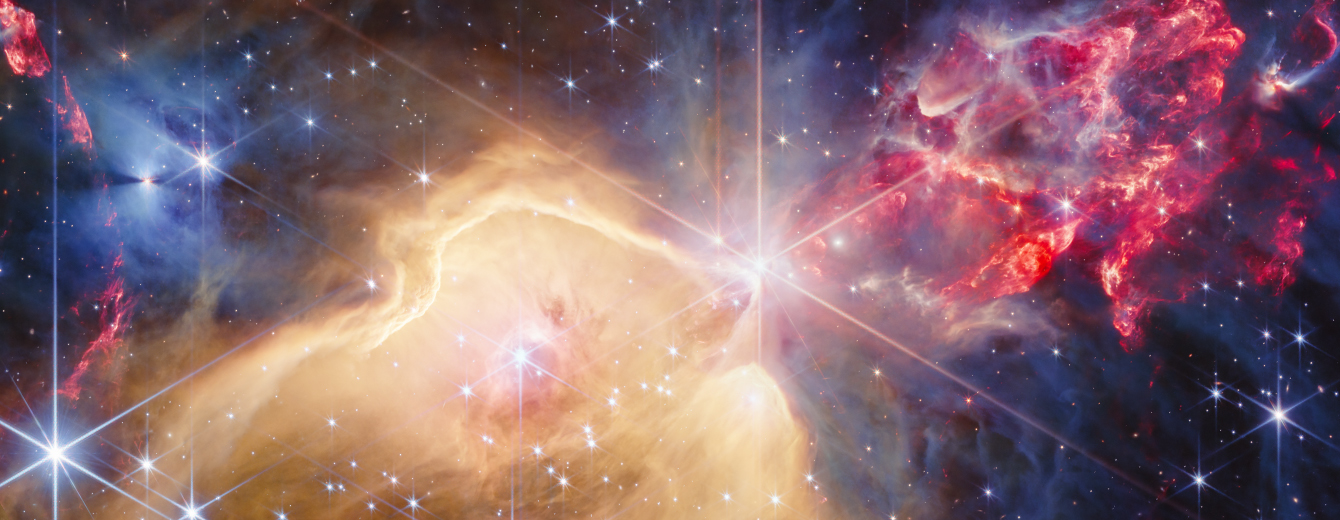
    A young star cluster filled with many stars that display Webb’s unique eight-pronged diffraction pattern. At its center is a yellow star that sports the largest diffraction pattern. To its left, there is a region filled with yellow dust and gas that extends from the star to the left and the bottom, covering about two-thirds of the frame. The yellow region has several embedded blue stars of different sizes. The top third, which lies outside the yellow region, has a few bright protostars, within dense gray gas. These stars illuminate the gas, making it appear blue. A few red outflows from other protostars are visible above this grayish-blue region. To the right of the central star, there is a clumpy, flame-like plume of red dust and gas with protostars that emit a soft white light within. The plume is surrounded by more dense gray gas and dust. It is about one third the size of the yellow region. There are several background galaxies strewn throughout.
  5. Suspected Second-generation Planet Solves NASA Hubble Cold Case

    October 05, 2026Release ID: 2026-020 Missions: Hubble

    New analysis of archival Hubble data points to the possibility of "dead" white dwarf stars hosting second-generation planetary systems
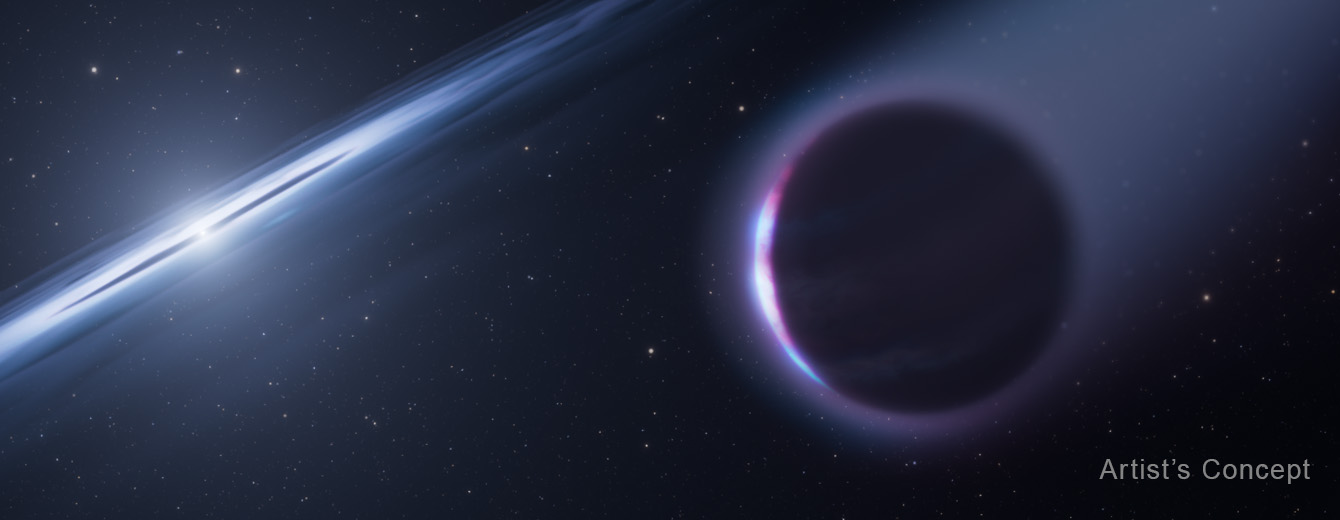
    A gaseous planet in the right foreground, seen mostly in silhouette, orbits a small, white star in the background at left. The star is surrounded by a thin, bright white disk tilted from lower left to upper right. A semi-transparent tail of material comes off the planet toward upper right. Distant stars dot the black background of space.
  6. NASA’s Webb Provides Crash Course on Planet-Shattering Collisions

    October 01, 2026Release ID: 2026-131 Missions: Webb

    The telescope is going beyond grazing the surface of these dusty, chaotic systems.
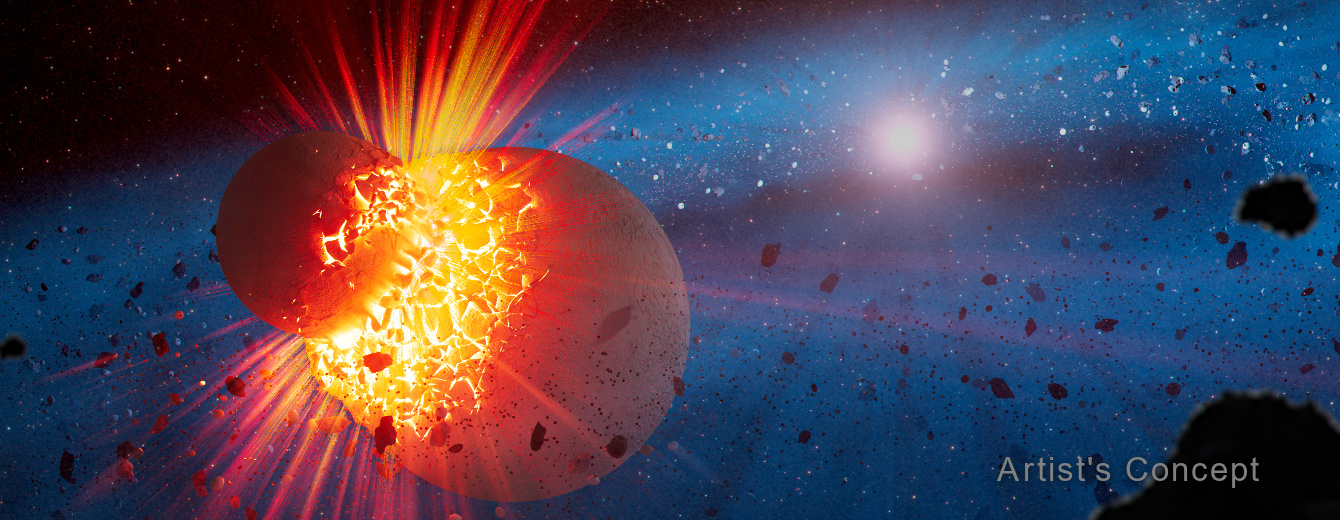
    Artist’s concept of a star and its debris disk against the black background of space. The star is in the background, right of center, and depicted as a small, luminous sphere. The debris disk is a large blue ring that encircles the star. The debris disk is angled toward the viewer, so that the portion nearest to the viewer extends beyond the bottom frame of the illustration. Many dark, rocky fragments are scattered throughout the debris disk. In the foreground, toward the left, is a small planetary embryo colliding into the left side of a larger spherical object. The impact site glows bright yellow and orange and has a mottled appearance, as though chunks of both colliding bodies are breaking up and being destroyed. Orange-yellow streams of vapor extend outward from the collision area. Behind the debris disk and its star are many small stars in the background. A label in the bottom right corner reads “Artist’s Concept.”
  7. STScI Scientists Part of Collaboration Receiving 2027 Berkeley Prize

    September 17, 2026Release ID: 2026-407 Missions: STScI

    UNCOVER project revealed JWST’s “little red dots” as mysterious, dusty black holes in the early universe.
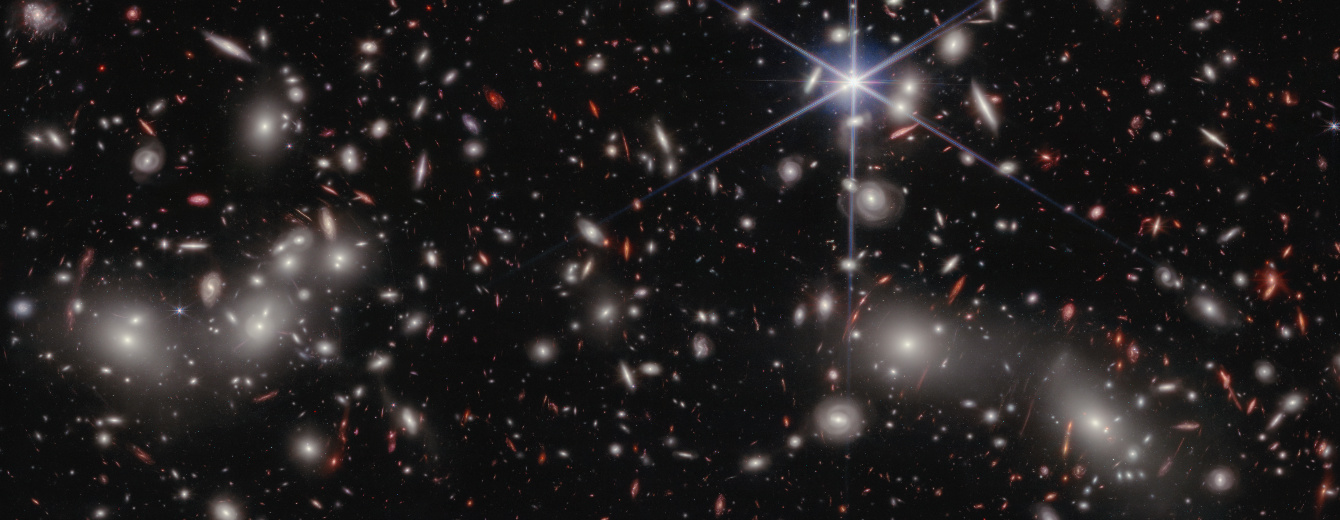
    A crowded galaxy field on a black background, with one large star dominating the image just right of center. Three areas are concentrated with larger white hazy blobs on the left, lower right, and upper right above the single star. Scattered between these areas are many smaller sources of light; some also have a hazy white glow, while many other are red or orange. Even without zooming in, different galaxy shapes are detectable, like spirals, ovals, and arcs.
  8. NASA’s Webb Reveals Dynamic Panorama of Star Formation

    September 15, 2026Release ID: 2026-130 Missions: Webb

    One of the largest Webb images released to date
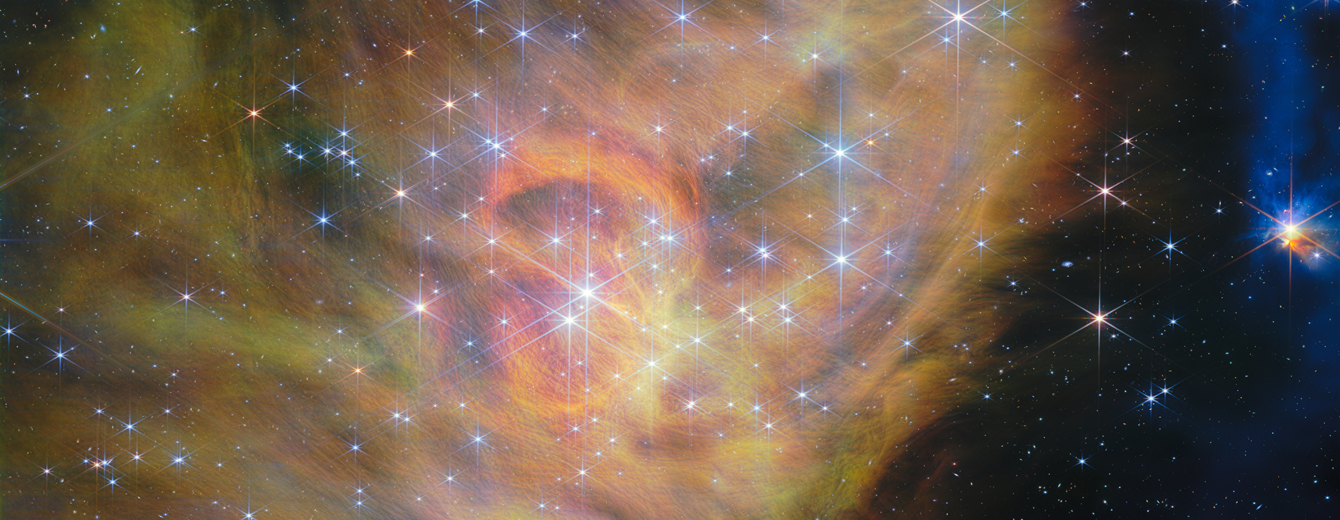

    A star-forming region. The left two thirds of the image is blanketed in thick clouds of green and yellow gas and dust that form swirling patterns. Some of the gas is spread into thin, thready wisps. The right third of the image is the black background speckled with stars and multi-colored dots that represent distant galaxies. Bright stars are scattered throughout the clouds, with the densest cluster situated in the center of the scene. Each is crowned with six long spikes and two shorter spikes created by the optics of the telescope’s mirrors. In the upper right, a couple of hidden stars blast out long, glowing jets of material that glow in blue.
  9. NASA’s Hubble, Webb Find Far-out Solar System Objects ‘Remember’ Past

    September 08, 2026Release ID: 2026-018 Missions: Hubble, Webb

    These telescopes offer best view yet into early stage of planet-building
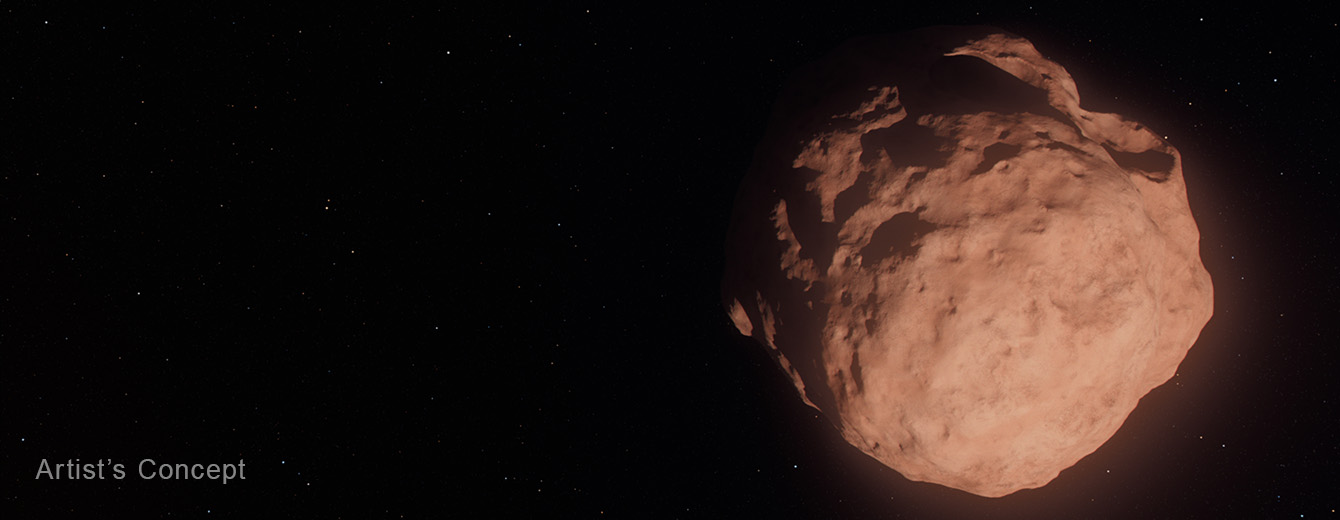
    An illustration of a roughly spherical, rocky object against a black background speckled with distant, white stars. The object is the color of red clay and is pockmarked with craters and other geological scars. At the bottom left corner of the illustration in gray lettering is the label “Artist’s Concept.”
  10. NASA's Hubble Tracks New Decagon Encircling Saturn’s South Pole

    September 02, 2026Release ID: 2026-022 Missions: Hubble

    10-sided wave appears to strengthen in year-over-year Hubble observations
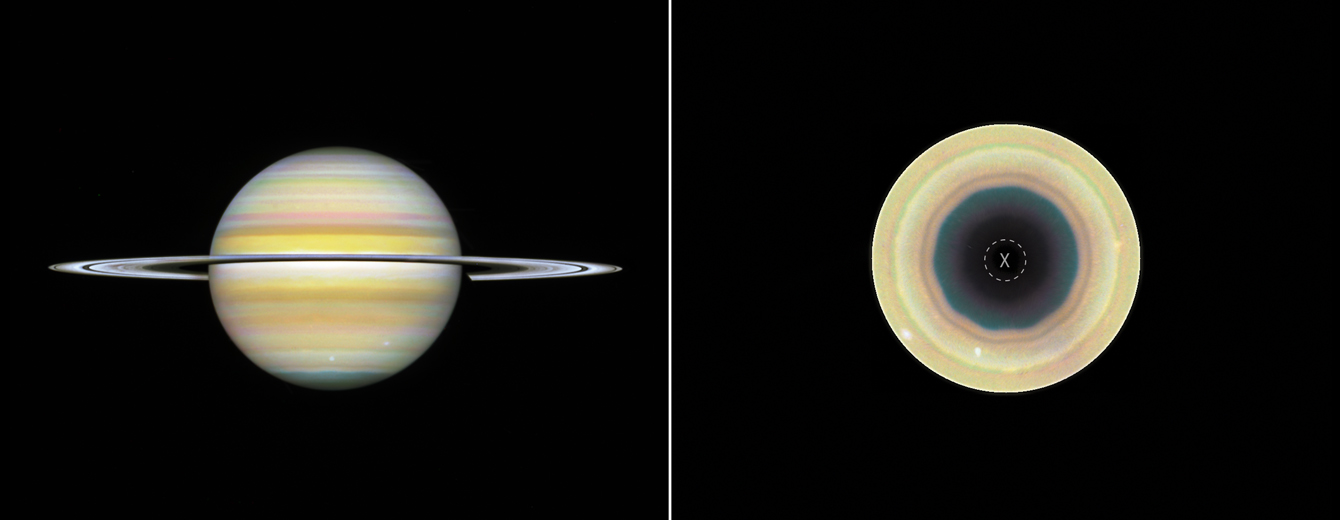
    Side-by-side comparison of two views of the gas giant Saturn, labeled “August 29, 2025” at the top left corner. At left is a straight-on view of Saturn, a globe with pale yellow horizontal bands at the equator and orange and pink at the mid-latitudes. Some bands towards the north and south pole have a light blue hue. There are prominent horizontal rings circling at the equator. At right, labeled “Saturn’s south pole,” the south-polar view of Saturn shows concentric bands in its atmosphere, mostly tan and orange, surrounding a dark central region that has a 10-sided outline. A small, dashed circle at the very center of the pole with an “X” inside denotes missing data.
  11. Hubble Solves Merger Mystery From Milky Way’s Early Years

    August 17, 2026Release ID: 2026-015 Missions: Hubble

    Astronomers find strong evidence for a massive merger 1.8 billion years earlier than the oldest previously known significant merger.
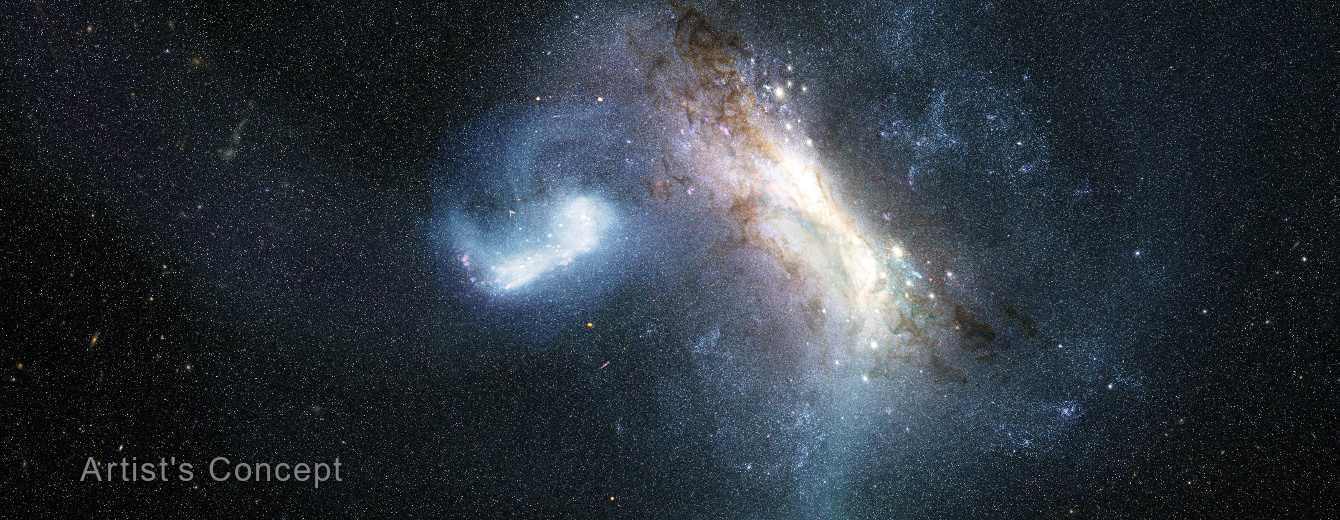
    An illustration of two galaxies in the midst of a collision against a dark, star-filled background.  The collision takes up the middle third of the illustration. On the right, a larger galaxy is viewed at an angle from 11 o’clock to 4 o’clock, with a white-yellow core surrounded by mottled brown dust lanes and faint bluish spiral arms. To the left, a smaller, bright blue-white galaxy is stretched into a curved, hook-like shape as gravity distorts it. A broad, glowing bridge of pale blue gas and stars extends off the galaxy at the left, while wispy streams extend above and below the larger galaxy at the right. The words “Artist’s Concept” appear in the lower left corner.
  12. Lion Nebula Roars to Life With NASA’s Webb

    August 10, 2026Release ID: 2026-127 Missions: Webb

    It’s the circle of life and it moves us all — even stars.
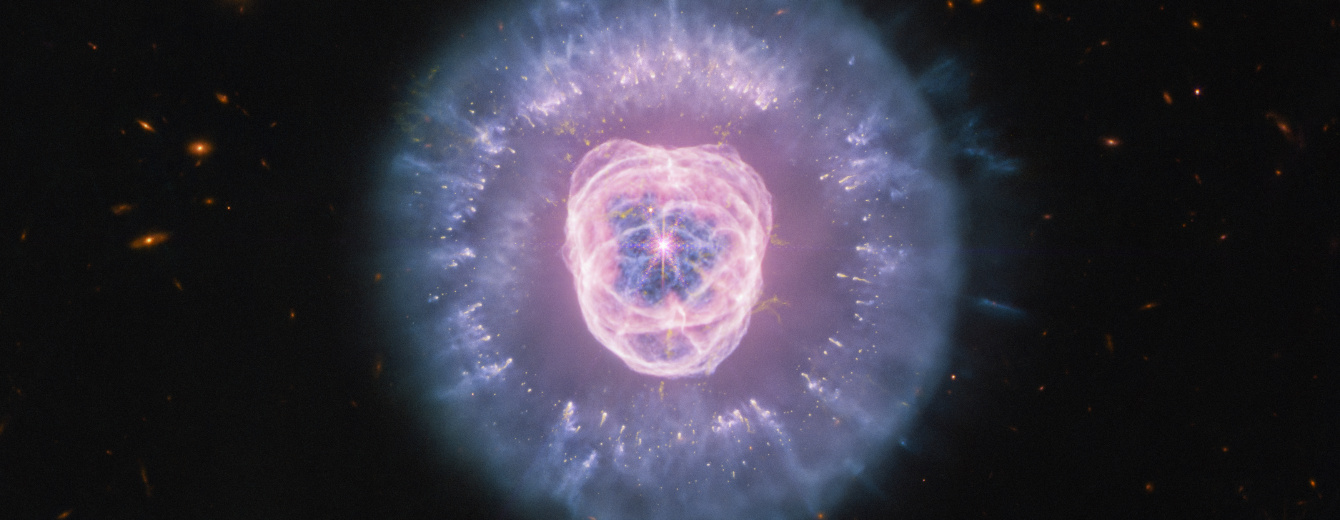
    JWST’s Near Infrared Camera and Mid Infrared Instrument combined image of planetary nebula NGC 2392, the Lion Nebula, against the black background of space. The nebula is at center, circular in shape, and looks like a male lion’s head. In the center is a small, pinkish-white circle with eight-point diffraction spikes, a white dwarf star. Surrounding the star are purple-pink cavernous bubbles and shell-like rings. The bubbles and shells collectively form an oval with two small, wide arcs near the top, reminiscent of a lion’s face and its ears. What appears to be extended outward from the lion’s face is a thick ring of purple-blue material. The width of the ring is consistent throughout and resembles a mane. The area closest to the lion’s face looks cloudy, while the edges of the mane look like there are clumps of dust with comet-like tails. In the background are distant galaxies and stars. Some galaxies are yellow and orange points of light and others have spiral structures. Some stars have diffraction spikes.
  13. NASA Webb Explores Family Tree of Newly Discovered Distant Objects

    July 29, 2026Release ID: 2026-109 Missions: Webb, Hubble

    What do little red dots become as the universe ages?

    A rectangular image with thousands of galaxies of various shapes and colors on the black background of space. Some are noticeably spirals, either face-on or edge-on, while others are blobby ellipticals. Many are too small to discern any structure. One prominent foreground star at top center features Webb’s signature 8-point diffraction spikes. At upper right, a box shows a zoomed in portion of the image. The pullout features a spiral galaxy labeled “WISEA J123635.56+621424.2.” The galaxy has a bright yellow center and faint brown arms speckled with regions of blue that appear to wind clockwise around the galaxy’s core.
  14. NASA's Hubble Shows Star Formation in Andromeda Galaxy Winding Down

    July 27, 2026Release ID: 2026-019 Missions: Hubble

    Most of the decline is within a prominent star-forming ring 32,000 light-years from the galaxy’s center.

    The left half of the disk of the Andromeda galaxy, with a jagged outer edge at the top and bottom on a black background. At right, the galaxy’s center is a horizontal yellow oval extending across about a third of the image. Two crescent shaped clumpy, dark dust lanes with abundant stars throughout extend out from the center. The galaxy becomes bluer as you move outward. At top middle, the satellite galaxy M32 appears as a small, fuzzy yellow oval. Within the disk of Andromeda, two regions at upper right and lower middle are outlined in small white boxes labeled 1 and 2, respectively. At the left side of the image, those two regions are enlarged in pullouts. Both contain a dense, grainy-appearing field of thousands of stars. Region 1 is noticeably bluer than region 2 and contains blue star-forming clumps.
  15. NASA's Webb Discovers Hidden Planet in Famous Star System

    July 15, 2026Release ID: 2026-126 Missions: Webb

    Planet found through its atmospheric fingerprint opens new way to uncover worlds hidden in starlight

    Artist's concept of the Beta Pictoris planetary system. One edge of a smooth, dusty disk that looks like cloud wisps extends across the upper third of the image at an angle from 9 o’clock to 2 o’clock. Just below that, in the left third of the image, the star glows white and is small. Just to the left of the star there is a tiny white dot, planet Beta Pictoris c. To the right of the star, about twice the distance between Beta Pictoris c and the star is another bright dot, representing planet Beta Pictoris b. A third planet, Beta Pictoris d is larger than the other two, and appears in the right third of the illustration. The planet has subtle orange cloud bands, and the side facing the star is illuminated. Below this planet, the other wispy edge of the dusty disk that circles the star crosses the bottom right corner of the illustration below Beta Pictoris d from 4 o’clock to 7 o’clock. The black background of space is speckled with distant stars. The words "Artist's Concept" appears at the lower left corner.

Share This Page

This site is protected by reCAPTCHA and the Google

Contact our News Team