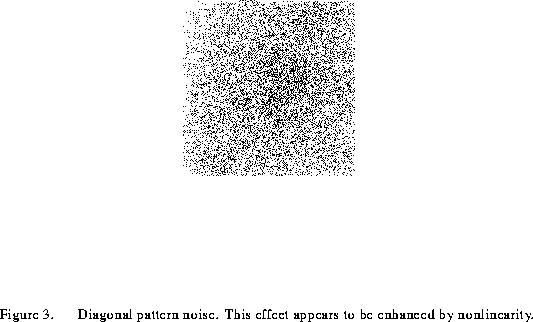
Nonlinearity is probably one of the most insidious problems associated with the FOC, primarily because, until the detector becomes saturated, it is not immediately obvious to the researcher. I do not intend to discuss this in detail here, but instead refer interested parties to available documentation (Nota et al. 1993, Jedrzejewski 1993, Greenfield 1993, Baxter 1993). The FOC detectors, apart from the 8-bit wrap-over mentioned earlier, are essentially count rate limited - nonlinearity and saturation are not governed by the number of photons that can be accumulated, but by the rate at which they arrive and their small scale distribution, within the time taken for a single complete scan of the image. The response of the detectors differs considerably depending on whether the small scale distribution is extended or point-like. [There is also evidence that there may be a small dependence of the point source response on pixel type (zoomed or normal), however this is not certain and, for the moment will be ignored.]
As an example, if we consider the largest format (5121024
zoomed), and specify that nonlinearity less than 10%is acceptable in our
data (90%of the photons arriving at the target are registered by the
detection logic), then we find that for extended sources (which include the PSF
halo), the maximum acceptable count rate is 0.04 counts/pixel/sec, or 40
counts in 1000 seconds (and this with
10%nonlinearity).
For point-like distributions
the response is somewhat better: for <10%nonlinearity within a 5
pixel diameter aperture centered on the star, a peak count rate
(brightest pixel) of about 0.5 counts/pixel/sec is acceptable (we must
also be aware of the halo, however, which is approaching significant levels of
nonlinearity for this peak count rate).
As a general rule-of-thumb these numbers scale inversely with the format area.
If we change from a large format (with normal pixels) to a smaller one
(with only 25%of the area) we get an improvement in the acceptable count
rates of about a factor of 4. If the larger format is a zoomed format, and
the smaller is normal, we do even better since the change from zoomed pixels to
normal pixels gives a further factor of 1.75. For a change from
512
1024 (zoom) to 512
512 (normal) we get a total improvement in the
linearity characteristics of a factor of 7.
As mentioned above, even high levels of nonlinearity (>50%), are not necessarily immediately apparent when examining data visually. The only true indication is to actually check this by examining the countrates (allowing for the structure present). Saturation is sometimes even more ambiguous since, although it begins to occur when nonlinearity reaches 60%, it may not be detectable visibly (particularly for the inexperienced, examining extended sources) until the nonlinearity reaches 75-80%. When point sources saturate they begin to develop a hole slightly downstream from the peak in the scan direction (to the right of the peak), increasing in size and depth (maximum depth of zero counts) as saturation gets worse. For moderate levels of nonlinearity, (40%), a correction is possible (see references earlier in this section), however for higher levels, and for data which is saturated, it is not.
I will not elaborate on the effects of nonlinearity with respect to image restoration except to note that nonlinearity changes the shape of the PSF, particularly in the core, and therefore ignoring its presence can only have a detrimental effect on any restoration. Also, since nonlinearity is a detector characteristic, it will not be significantly affected by the installation of COSTAR except that, with the core of the PSF containing 4-5 times the power as is current, even more care will have to be taken when calculating filter combinations.