


Pixel-to-pixel sensitivity variations of the detectors are routinely removed by flat field calibration, that is, by dividing the raw data by exposures of a uniformly illuminated target. This procedure is often imperfect, however, due to a number of effects, including time-variable contamination inside the cameras and errors in the calibration flats themselves.
For the WFPC, an important source of flat fielding error is the
``persistent measles.'' Low volatility contaminants collect on the
cold camera windows 6 mm in front of the focal plane. These
particle-like contaminants cause diffractive scattering of light,
resulting in patterns of concentric bright and dark circles with total
scale sizes of 3 to 10 pixels. These can have adverse effects on
deconvolution, since their size is close to that of the PSF core.
The amplitude and number of the measles are different in different camera
channels. In the WFC and most of PC6, the errors are about 1%in
intensity. Larger errors of 2 to 5%are seen some of PC6, and
much of the other PC CCDs. An example of measles is shown in Fig. 6.
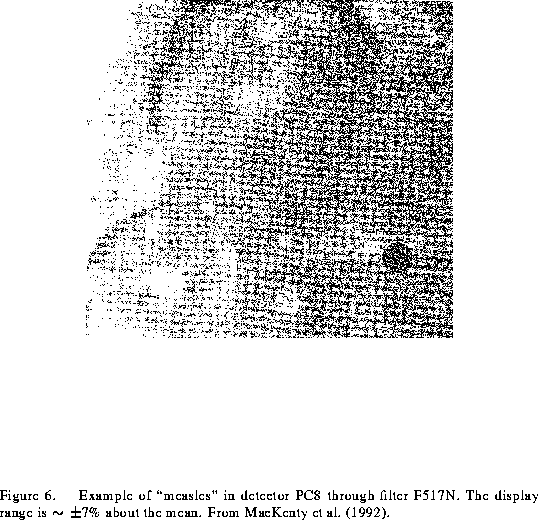
While corrections (called DELTAFLATS) are available, they are only partially successful since the measle pattern depends on the illumination pattern and spectral properties of the target. These errors tend to be larger at short wavelengths, where diffractive effects are stronger. Great care was taken to reduce contaminant levels during the manufacture of WFPC 2, so it is unlikely to suffer these problems.
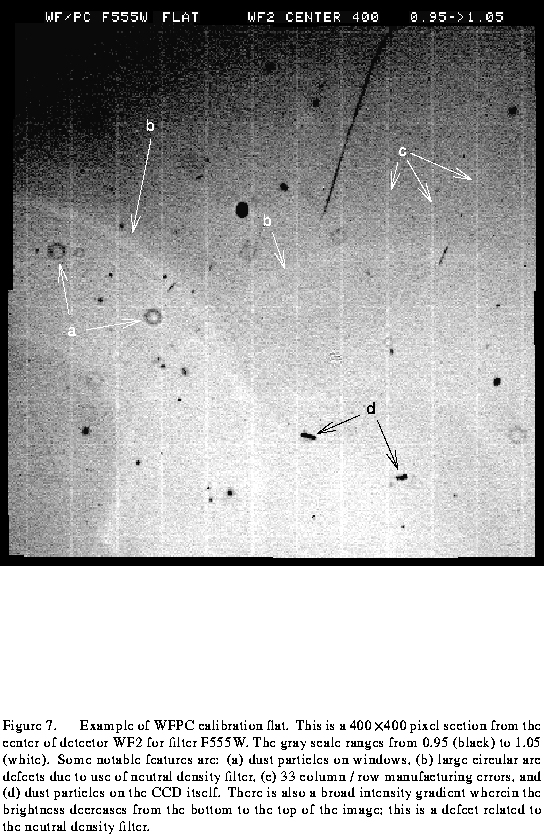
Both WFPC and WFPC 2 are liable to have errors or defects in the calibration flats. This is certainly true for the current WFPC calibration flats. At small spatial scales (<10 pixels) there are often errors of a few percent, usually in the form of long, narrow streaks. In some cases these errors are as large as 10 to 15%. These streaks originate from observations of the bright earth which are used to generate the calibration flats; earth features together with spacecraft motion cause streaks in the raw images, which are not completely removed during calculation of the calibration flats. On larger scales (>100 pixels) there are sometimes errors up to about 15%; these are caused by the use of neutral density filters when observing the broad-band flats. We plan to deliver new calibration flats early in 1994, in which these errors should be greatly reduced. These problems should be unimportant for WFPC 2, due to its special internal calibration channel.
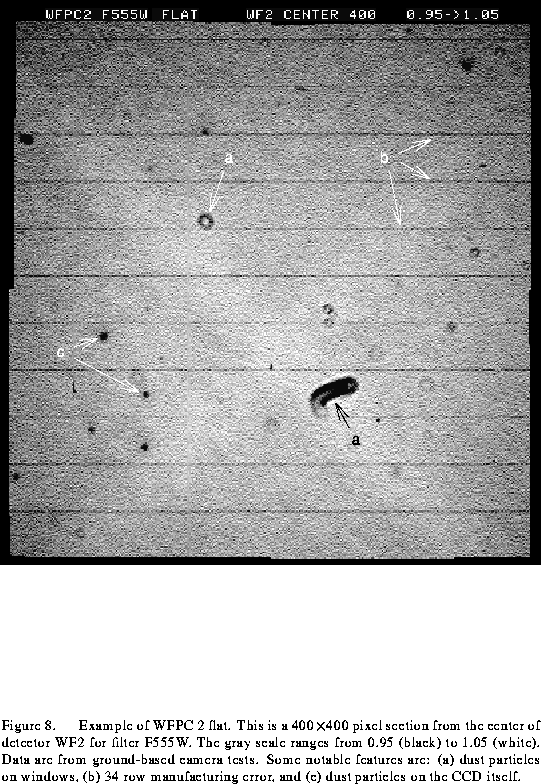
The CCDs in both the new and old cameras have manufacturing defects in the form
of pixel rows or columns which are too narrow or wide. In WFPC 2 every
34th row is about 3%too narrow. The standard flat field calibration
is based on the assumption that all pixels have the same size, so these
anomalous rows will not be properly calibrated. In particular, stellar
targets falling on these rows with standard calibration will have 3%too many
counts. These rows also cause a geometric distortion for PSFs falling on
them. The old WFPC camera has a similar effect, with every 33 row and
column being slightly too wide.
Figs. 7 and 8 show 400400 pixel areas from the centers
of the WF2 calibration flats for WFPC and WFPC 2, respectively, and illustrate
some of the features discussed above.
Cosmic rays cause artifacts in images for both cameras. These pass through the CCD detectors depositing large amounts of charge (typically >100 electrons per pixel). In WFPC most cosmic ray hits involve only 1 or 2 pixels, and it is easy to distinguish weak cosmic rays from aberrated stars. In WFPC 2, however, the cosmic rays are expected to involve more pixels per hit since the CCD is thicker. Because the cosmic ray hits will be larger, and the PSFs smaller, it is expected to be more difficult to distinguish cosmic rays from stars in WFPC 2. For both cameras, cosmic rays can be eliminated by combining several exposures of the same field with rejection of anomalously high pixels. The elimination of cosmic rays from images which are poorly aligned (i.e. having displacements less than 1 pixel) is an important topic requiring further study.
Hot pixels affect images in both WFPC and WFPC 2. These are single pixels
whose dark current is anomalously high (>0.01 DN sec). They cause a
pattern of single pixel bright spots in long-exposure images; the pattern is
more-or-less constant on time-scales of hours, but varies on time-scales of
months. Each CCD has several hundred of these hot pixels, and careful
calibration can significantly reduce their numbers and intensity, but cannot
eliminate them completely. One solution is to take several exposures with the
target on slightly different regions of the detector, so that ``real'' objects
can be easily distinguished from these detector artifacts.
Acknowledgments
I am grateful to J. Krist and C. Burrows for helpful discussions regarding WFPC 2 characteristics and anomalies.