


As sketched in Fig. 3, registered images are influenced by fractions of the original signal from outside the domain of measured data. We distinguish three characteristic regions:
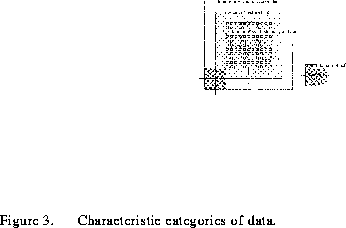
If the region of the restoration covers only the inner region, it is assumed implicitly that the original signal has a region of support which is equal to the support of the restored data. But in reality the underlying original signal (the whole sky in astronomy) has an unlimited region of support. Therefore the assumption of a limitation can lead to inconsistencies and to oscillations at the boundaries of the region of the restoration.
A reduction of the boundary problem is possible by suitable pre-processing
of the measured data, e.g., by even continuation (Yaroslavsky 1985). A
rigorous solution which completely avoids the boundary problem is the
extension of the region of restoration by the extent of the point spread
function. If the extent of the measured data is 512512 and the
extent of the point spread function is 256
256, the extent of
the region of the restoration should be (512 + 256)
(512 + 256) =
768
768. In this way the measured data are not influenced at all by
original data from outside the region of restoration and no inconsistencies
can occur. Basically this means that the measured data are padded with
zeroes up to the extent of the real measured data plus twice the extent of
the point spread function. The extent of the region of virtual measured
data should be (512 + 256 + 256)
(512 + 256 + 256) = 1024
1024.
The concentration on the real measured data is obtained by means of the
weighting function
outside the region of real
measured data. We would obtain the same effect if all the padded data were
available with infinite variance of the noise outside the region of real
measured data.
A fact which first appears to be peculiar is that the domain of restored data must be larger than the domain of available measured data!
The weighting function can also be used to incorporate
resampling on a finer grid directly into the restoration process. The
measured data are again padded with zeroes, but now the zeroes are positioned
between the real data points (see Fig. 3). Again we assume that the variance
of the noise tends to infinity where we do not have measured data. Of course
this kind of resampling is only possible if the point spread function is
known completely on the finer grid. Basically it should even be possible to
incorporate an interpolation directly into the restoration process if the
measured data are given on a non-uniform and/or a non-rectangular grid.