


We have built a set of model elliptical galaxies spanning a wide range of brightness profiles, ellipticity, position angle of the major axis, and isophotal shape. In order to study the effects of the aberrated HST PSF, each model has been convolved with a PSF appropriate for chip 6 of the PC and filter F555W (all of our galaxies have been observed with this instrumental configuration). Poisson noise and read out noise have been added to the convolved, or aberrated, image. The models have been built in order to give a signal-to-noise ratio between 20 and 30 at the galaxy center after convolution with the HST PSF. Finally, the aberrated image has been deconvolved using the Richardson-Lucy (RL) algorithm. The RL iterations converge to the maximum likelihood solution for Poisson statistics, and are therefore well suited for deconvolving HST PC data. In addition, the RL deconvolved data is forced to be positive and the deconvolved image has good photometric linearity (White 1993). The PSFs used for convolution and deconvolution have been created using the Tiny TIM software (Krist 1992), which is able to model variation in the PSF due to the instrumental configuration (for example, camera and filters), position on the PC chip, spectral shape of the point source, and jitter due to the HST pointing.
In the following sections we will discuss the effects on the results of deconvolution due to:
We have considered four different forms for the brightness profile, three with one component only, and one with two separate components, covering a wide range in shape and steepness in the crucial (as far as convolution and deconvolution are concerned) inner 5 arcsec: a de Vaucouleurs law
where is along the major axis of the galaxy,
DN and
arcsec; a Hubble law
with DN and
arcsec;
an exponential profile
with DN and
arcsec;
an exponential profile plus a central Gaussian component
with DN,
arcsec,
,
arcsec.
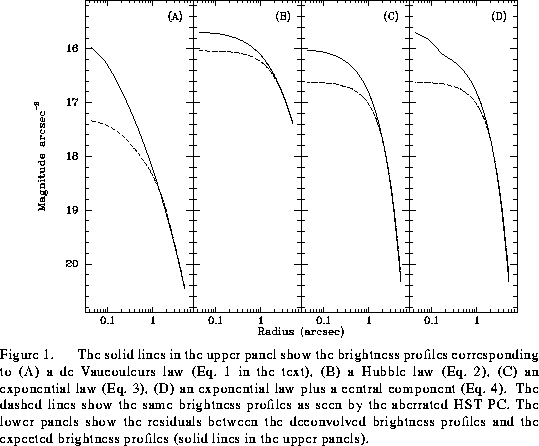
The brightness profiles described by Eqs. 1 to 4 are sketched
as solid lines in the upper panels of Fig. 1 for an elliptical galaxy
with constant position angle and mild ellipticity ( = 0.2),
and located in the Virgo cluster. In the same figure, the dashed lines
represent the same, but now aberrated, brightness profiles, derived by
convolving the model images with an HST PSF and adding noise. As can be
seen, substantial differences are present in the inner 2 arcsec, the
aberrated profile being lower and flatter than the unaberrated one. As
in the case of images blurred by atmospheric seeing, light is removed
from the innermost part of a galaxy and pushed to intermediate radii,
while the surface brightness at large radii remains undisturbed. In
contrast with the seeing PSF, however, the HST PSF is very stable and
very accurately known, and this allows the successful use of
deconvolution techniques which are inapplicable in the case of seeing
convolved images. The process of convolving model galaxies with an HST
PSF has been carried out using several HST PSFs, differing one from the
other for the position on the chip, the spectral shape, or the amount
of jitter. The results show that the aberrated image does not change
significantly due to variation of the PSF.
At this stage, the RL algorithm was employed in order to determine if
and how differences in steepness and curvature of the brightness
profile influence the results of deconvolution. In Fig. 2 we show
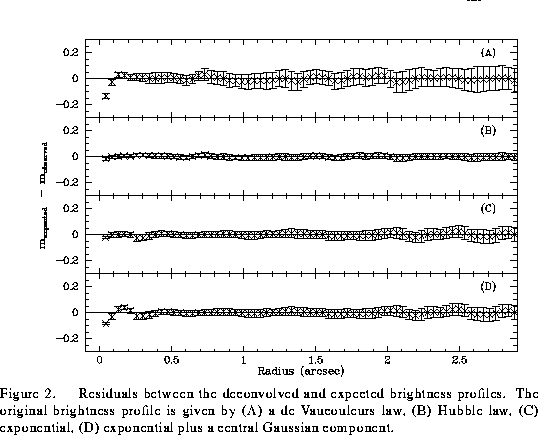
the difference between the
unaberrated brightness profile shown in Fig. 1 as solid line
and the deconvolved brightness profile obtained from the aberrated
images after 100 RL iterations. The PSF used for the
deconvolution was the same as the one used for the initial convolution.
The original brightness profile is
reproduced by RL deconvolution with accuracy higher than 0.05
magnitudes arcsec at radii larger than 0.2 arcsec and accuracy
higher than 0.15 magnitudes arcsec
at smaller radii.
We have also determined whether the accuracy of the deconvolution
techniques depends on other surface brightness parameters, such as
ellipticity, position angle and departure of the isophotes from pure
ellipses. Fig. 3 shows the difference between unaberrated brightness
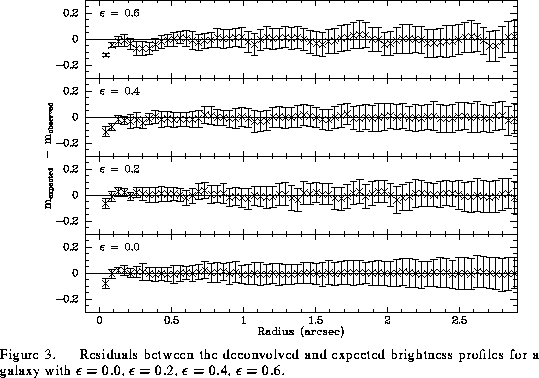
profile and deconvolved brightness profiles (after 100 RL iterations)
in the case of four elliptical galaxies with a de Vaucouleurs profile
(Eq. 1), constant position angle, but different ellipticities,
,
,
,
. The same PSF has been used
for convolution and deconvolution. From the figure, it is apparent that
deconvolution performs slightly better at lower ellipticities,
nevertheless, as in the case presented in Fig. 2, we find that
deviations in the inner 0.2 arcsec are not higher than 0.15 magnitudes
arcsec
.
In the same way, we found that the results of deconvolution are not affected by variations of the major axis position angle (models were built with position angle varying up to 90 degrees in a 4 arcsec range) or by deviations of the isophotes from pure ellipses (models were built with fourth cosine Fourier coefficient as high as 0.05 in absolute value).
Finally, we have studied the effects of small variation in the PSF on the results of deconvolution. The detailed PSF shape depends on the position on the chip, on the spectral shape of the point source, and on jitter due to the HST pointing. The following PSFs have been considered:
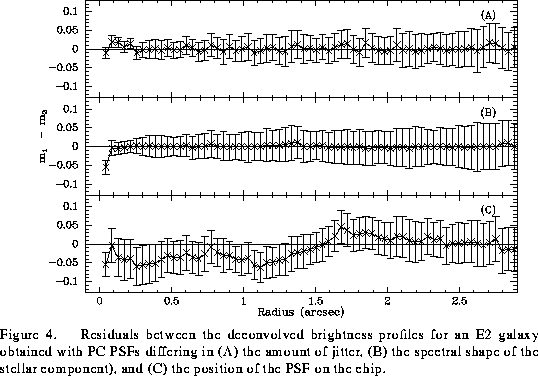
profiles of a model galaxy (de Vaucouleurs profile, )
deconvolved using different PSFs, in particular:
Fig. 4A shows the difference between the brightness profiles obtained
by deconvolving with PSF 1 and PSF 2, differing in the amount of
jitter, 0 mas in one case and 30 mas in the second case (30 mas is
likely to be the highest jitter that can occur, at least in fine lock mode);
Fig. 4B shows the difference between the brightness profiles obtained by
deconvolving with PSF 1 and PSF 3, differing in the spectral shape of the
point source (K and O stars, respectively);
Fig. 4C shows the difference between the brightness profiles obtained by
deconvolving with PSF 1 and PSF 4, differing in the position of the PSF
on the chip.
The largest errors are due to variations of the PSF with position in the
chip (Fig. 4C), which can cause deviations up to 0.1 magnitudes in the
inner 1.5-2 arcsec. The case presented in the figure is quite extreme,
since the two PSFs used have been modeled for positions far apart one from
the other and close to the edge of the chip, where asymmetries in the PSF
shape are larger. Our models shows that if the PSF used for deconvolution
is modeled for the position corresponding to the center of the galaxy, the
deconvolved brightness profile deviates from the original by less than
0.05 magnitudes arcsec, and these deviations are limited in the
inner 0.2 arcsec.