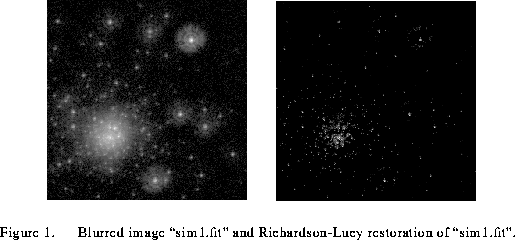
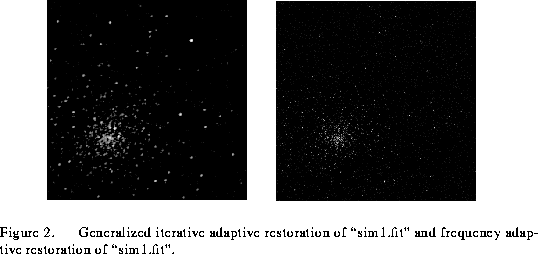
All of the results presented here use the test data prepared by ST ScI and obtained from the directory software/stsdas/restore at the stsci.edu Internet site. Using the image ``sim1.fit'', which represents a star cluster with a globular cluster-like luminosity function, with the point spread function (PSF) ``mpsf12.fit'', we generated restored images using the two iterative algorithms presented in this paper. The image ``sim1.fit'' simulates a monochromatic observation from the Wide Field Camera with a space invariant blur. For comparison purposes, we utilized an implementation of the modified Richardson-Lucy algorithm developed at ST ScI. This algorithm has modifications which address the constant readout noise problem. Fig. 1 shows the original blurred image and the Richardson-Lucy restoration. Fig. 2 shows the restored result using the generalized iterative adaptive algorithm and the frequency adaptive algorithm. For all cases where we have used the generalized iterative adaptive algorithm in this paper, we have taken the weighting matrices in Eq. (11) to be equal to identity, although a spatially adaptive approach may easily be employed as well.
For all of the iterative algorithms, we set the maximum number of
iterations to be 300. In addition, each algorithm used another
termination criterion. For the Richardson-Lucy algorithm, the
convergence criteria was that the value of between the data
and the blurred model was equal to unity per degree of freedom (Lucy
1974). For the other two algorithms, a convergence criteria based on
the
norm of the residual was used. In this case, we used a
measure of the normalized error at each iteration, defined as
. The
Richardson-Lucy algorithm reached 300 iterations before the parameter
was equal to 1, but the value of
was changing
very slowly at this point, such that further iterations resulted in
little change in the restored image. The generalized iterative
adaptive method took 292 iterations while the frequency adaptive
method required only 39 iterations. The form of the iterations are
somewhat different for the Richardson-Lucy algorithm and the two
algorithms presented here, so a direct comparison in terms of
iteration counts is not completely straightforward. However, each
iteration of the three algorithms requires approximately the same
amount of time, so it can be seen that the frequency adaptive
algorithm provides a very fast solution. The mean square error (MSE)
was measured for each of these results after normalizing the restored
images to the maximum value of the observed image in order to account
for any linear scaling present in the different algorithms. The
Richardson-Lucy algorithm had an MSE of 1083.69. The generalized
iterative adaptive algorithm had an MSE of 1177.41, and the frequency
adaptive algorithm had an MSE of 26.27. The MSEs were measured in
terms of the 470 stars in the truth list.
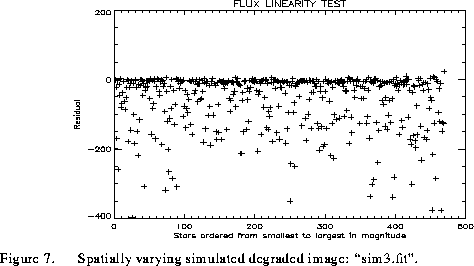
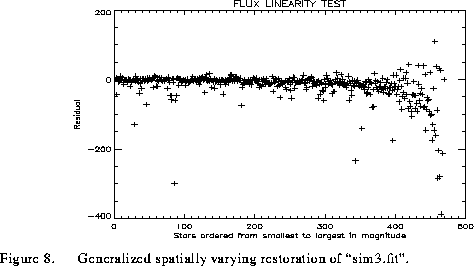
For images having a spatially varying PSF, it is possible to apply the generalized iterative adaptive algorithm as well. We have applied the spatially varying implementation of this algorithm to the synthetic image ``sim3.fit'' which represents a star field with a spatially varying blur. For this image the PSF changed between 25 different PSFs at various positions in the image. The varying PSF is easily represented by a full degradation matrix in Eq. (1)., as opposed to a block circulant. For the restored image, the MSE was equal to 3316.3.
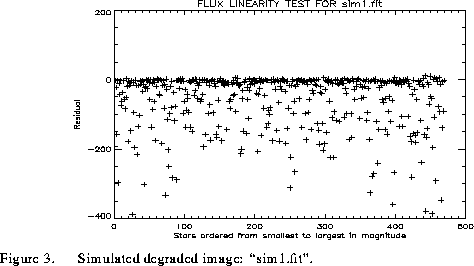
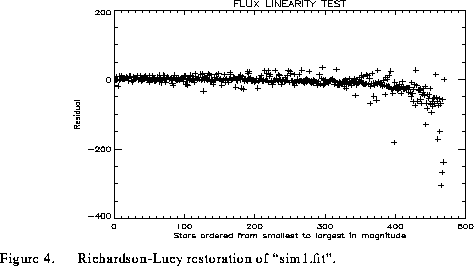
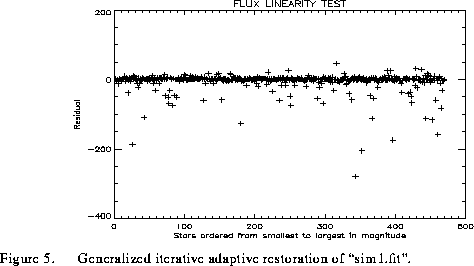
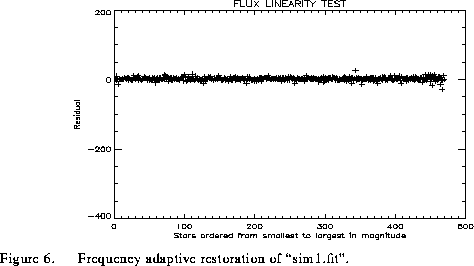
These simulated star field images provide the best data for testing the flux linearity of the restoration algorithms. We have evaluated the flux linearity of these three results according to the following method. The linearity was measured by taking the residual (measured as: original (truth) image - restored image) for each star in the truth image. The results are displayed by ordering the 470 stars in this image by increasing magnitude. So, the faintest stars are at the left, and the brightest stars are at the right. The flux linearity of the blurred image is shown in Fig. 3. The graph for the Richardson-Lucy implementation is seen in Fig. 4, the spatial iterative adaptive algorithm's graph is seen in Fig. 5, and the frequency adaptive algorithm's is seen in Fig. 6. The frequency adaptive algorithm produces the most linear curve for this test, with a very noticeable reduction in the number of outlying stars having a large error. The flux linearity results for spatially varying PSF case (``sim3.fit'') are shown in Figs. 7 and 8.
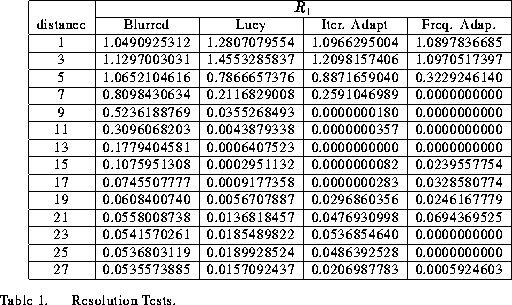
For testing the resolution enhancement properties of our algorithm, we
generated a synthetic image containing points of equal intensity
separated by progressively increasing distances. These points
represent simulated neighboring stars. This image was then blurred
with the Gaussian point spread function having a variance of 9, and a
support of 50x50 pixels. Using this PSF allows us to test the
resolution enhancement for binary pairs of stars which are poorly
resolved in the blurred image. The minimum separation between a pair
of points in the synthetic image was one pixel, and we measured the
resolution of each pair according to the modified Rayleigh criterion
(Wu, in Hanisch 1993). Table 1 shows the numerical values of the
measured resolution criterion for the blurred image, the
Richardson-Lucy algorithm, the generalized iterative adaptive
algorithm, and the frequency domain adaptive algorithms. All stars in
our simulated image were chosen to be of intensity value (100). The
distance separating each pair of stars (in pixels) is given in the first
column. Neighboring pairs were all separated by a large distance, so
that the PSF never covered more than one pair at a time. The measure
expressed here is where
and
are the peak intensities of the stars in the pair, and
is the intensity at the middle point between them.
These resolution tests show that the frequency adaptive algorithm
performed quite well in terms of peak resolution enhancement. It
performed better than the Richardson-Lucy algorithm for most pairs.
Although the generalized iterative adaptive algorithm and frequency
adaptive algorithms did not perform better than the Richardson-Lucy
algorithm for all pairs, the amount of resolution enhancement provided
by them was significantly better than that of Richardson-Lucy for a
large number of the pairs. It should be noted that the Richardson-Lucy
algorithm requires more a priori knowledge than the other two
iterative algorithms, again making a direct comparison somewhat
difficult. The characteristic of the last two iterative algorithms
which causes the large number of zero values in columns 4 and 5 stems
from the fact that these algorithms exhibit a ringing which is not
present in the Richardson-Lucy algorithm. Because of the positivity
constraint, a number of the center values between pairs of stars are
actually negative values which have been clipped to have a value of
zero, resulting in . These results are, however, much
sharper than the Richardson-Lucy results.
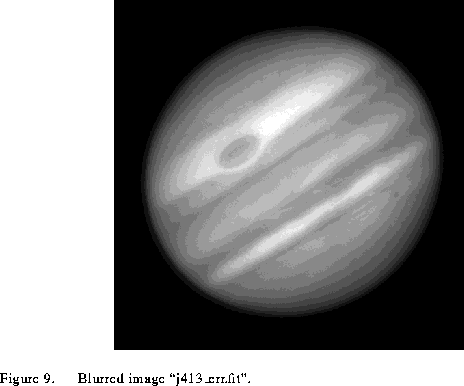
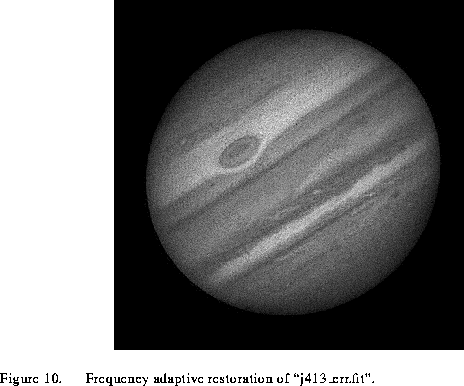
Based on our analysis, we have found that the frequency adaptive iterative algorithm provides an optimal choice for restoring HST data. We have applied this algorithm to some of the real Hubble data as well. One of the real images we have tested with this algorithm is the ``j413_crr.fit'' image of Jupiter, seen in Fig. 9. The restoration of this image using the frequency adaptive algorithm is shown in Fig. 10.