


The results of a simple trial for sample shifting section are now reported. The
one-dimensional image range was normalized (i.e., the image existed for ). A sample space-variant ``impulse response'' used as a test on the
system was
is not a true impulse response, since it is not normalized. But
provides a smooth function which possesses a clearly defined
transformation,
. Then
, allowing the
minimization to concern itself with finding only the sample positions, and not
the multipliers
and
. The image plane was uniformly sampled at
11 points, 10 points inside the image and one point outside the right boundary
of the image (
,
,
, and
).
was then
minimized for two cases: when
and
(greatly restricting the
range of the PSF used for calculating
), and again for
and
(which maximizes the range of the PSF). For the greatly restricted trial
(
), the algorithm came upon a number of local minima but was eventually
was able to find a global minimum. For the unrestricted trial (
), the
global minimum was found directly. Both trials were run for 100 iterations.
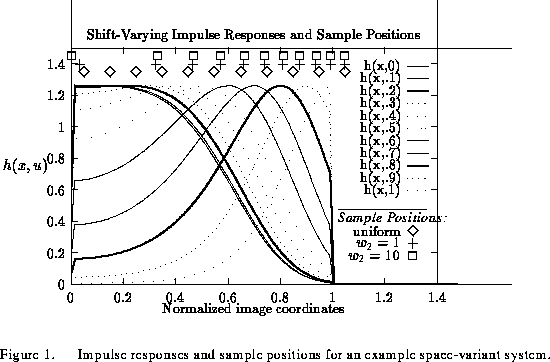
Fig. 1 shows examples of the impulse responses of
Eq. 9 for different object positions, the uniformly spaced
sample positions used as an initial estimate of the sample positions, and the
sample positions which resulted from both the greatly and lightly restricted
applications of the algorithm.
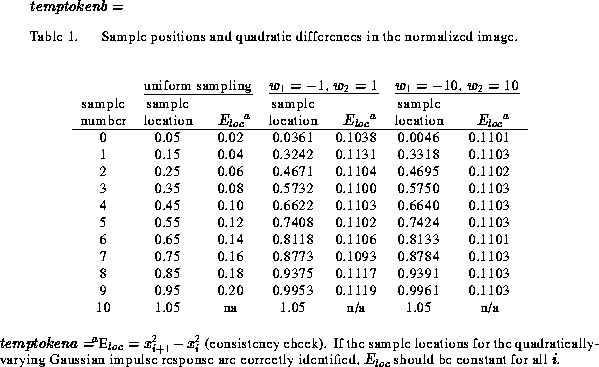
Table 1 lists the sample positions and , which
should be constant for ideal sampling in this case. In the unrestricted trial,
the ideal sample locations were found after 100 iterations with negligible
error, as expected. But, even for the greatly restricted trial, the sample
locations were were found to a good approximation. The advantage of the
restriction was a substantially decreased computing time per iteration. The
difficulty with the restricted trial was the abundance of local minima which
needed to be negotiated.