Two experiments were performed to demonstrate the RCGV stopping rule. The first was done with artificial data, and the second with HST data.
For the first experiment, an image was created that simulates a scene that
might be typical for the wide-field planetary camera (see Fig. 1).
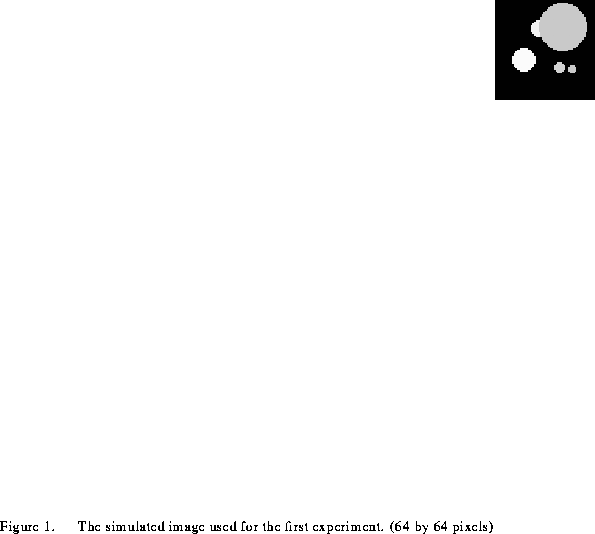
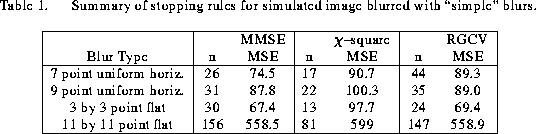
The image was then blurred using various ``simple'' blurs, and Poisson noise
was added using an ADU gain of 8.0 e-/DN. Read-out noise was neglected to
simplify the problem. The R-L algorithm was performed, and the RGCV stopping
rule was computed. The mean-square error between the estimate and the original
was also computed at each iteration. Finally, the -square measure was
computed for further comparison. The results are summarized in
Table 1.
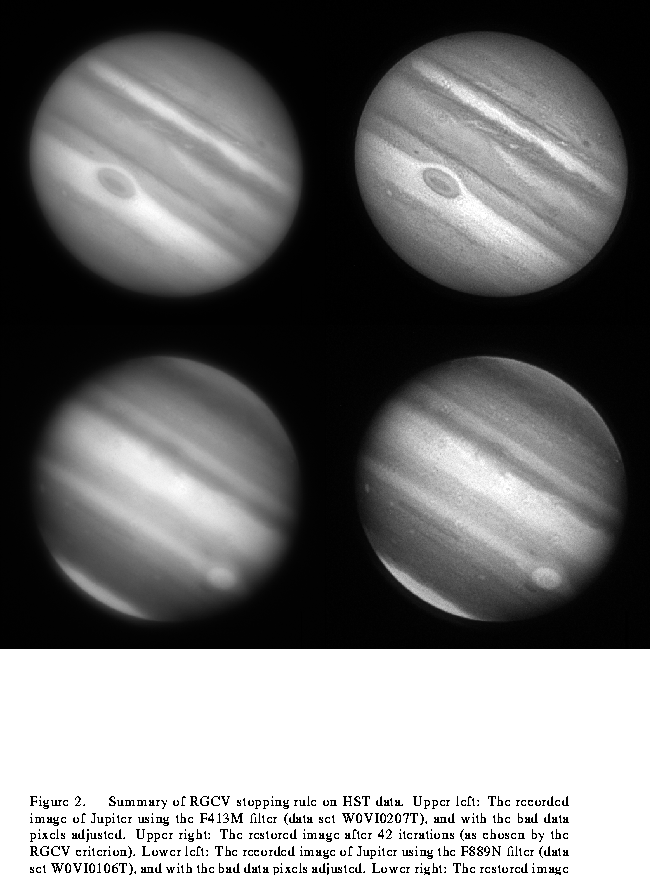
The second group of experiments used the HST data for images of Jupiter,
which are part of the simulation data available from the Space Telescope
Science Institute database. The R-L algorithm was performed with the RGCV
stopping rule. The results are shown in Fig. 2.