Tunable Terahertz Source
Rolf A. Wyss, Suzanne C.
Martin, Barbara J. Nakamura, Andrea Neto, and Peter H. Siegel
Jet Propulsion Laboratory, California Institute of Technology, Pasadena, CA 91109
Christoph Kadow and Arthur C.
Gossard
Materials Department, University of
California, Santa Barbara, CA 93106
Geoffrey A. Blake
Division of Geological and Planetary Sciences,
California Institute of Technology, Pasadena, CA 91125
ABSTRACT
Several future NASA and ESA missions have observational targets that require heterodyne receivers operating in the submillimeter frequency regime (300 GHz to 3 THz). Very capable low-noise heterodyne mixers have been identified for many of these applications, but the current lack of solid-state local oscillator sources prohibits compact instrument implementations at present. A promising technique, submillimeter-wave generation by means of optical-heterodyne mixing, known as photomixing, has been pursued for a number of years. This approach is capable of achieving output power levels on the order of hundreds of nanowatts over an extremely wide frequency range. While this power level is as yet insufficient for use as a THz local oscillator drive, the potential is enormous.
We have initiated a development effort at JPL, in collaboration with UCSB and Caltech, to pursue a new class of photomixers that alleviates some of the key shortcomings of earlier designs. The primary focus of our activity is in the following areas:
- Introduce a distributed gain region and low-loss GaAs (or possibly InP) membrane/planar antenna technology to increase the output power of the device above 1 THz.
- Synthesize novel material structures (ErAs islands in GaAs, InGaAs and InAlAs) which can be used at longer IR wavelengths (1.06 to 1.55 mm), thus taking advantage of a wide range of commercial fiber-optic components.
We will present our ongoing research in this field, and its future directions.
1. INTRODUCTION
Implementation of an all solid-state heterodyne receivers for frequencies above 1 THz has been hindered by the unavailability of suitable frequency sources. Fig. 1(a) shows that a multitude of very capable heterodyne detectors are available in the 1 to 3 THz region. In contrast, Fig. 1(b) shows the best presently demonstrated sources (fundamental sources followed by Schottky diode multiplier chains and photomixers). The graph illustrates that the present photomixer performance level is inferior below 1 THz when compared with the multiplier chains. Above that threshold, however, these photonic type devices remain the only demonstrated sources.
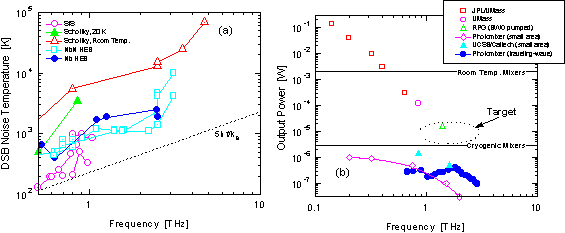 |
| Figure 1.(a) |
Our goal is to pursue improved photomixer designs, which would increase the output powers by an order of magnitude above current levels and thus make these devices useful as local oscillator sources.
2. BACKGROUND
Recently, we demonstrated that a traveling-wave photomixer design is capable of generating an order of magnitude more power than earlier small-area designs above 1.5 THz1. This is because the RC-time constant associated with the interdigitated electrode structure is eliminated2.
 |
 |
| (a) | (b) |
| Figure 2.(a) | |
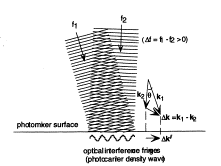
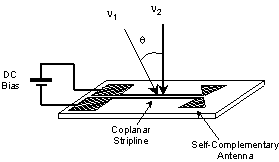
Fig. 2(a) illustrates the traveling-wave concept. The two optical pump beams must be incident at a slight angle, such that the velocity of the optical interference fringe matches the group velocity of the generated RF wave along the photomixer surface. By careful adjustment, the angle can be set to obtain optimal phase-matching. In the experimental setup, shown in Fig. 2(b), we first assured perfect mode-matching of the pump lasers by seeding a single optical amplifier with two laser diodes. The wavelengths are then split using a grating. Separate mirrors control the final incident angles.
3. CONCEPT
The primary focus of our activity is in the following areas:
3.1. Membrane photomixer
The experimentally measured loss along the coplanar stripline of the present traveling-wave device increases dramatically above 1 THz. Coupling the RF power into substrate modes of the GaAs wafer/Silicon lens causes the loss, on the order of several 10’s of dB/mm. This loss mechanism is eliminated when reducing the thickness of the GaAs substrate3. When the photoconductive layer and support wafer is only a few micrometers thick, all substrate modes will be cut off. This completely eliminates the radiation losses present in the previous design.
3.2. Novel materials
The low-temperature-grown GaAs material has been predominantly used in the past to make photomixer devices. This photoconductive material displays several undesirable properties, e.g. it is difficult to control carrier lifetime accurately, the material properties are susceptible to changes when subjected to elevated temperatures, displays a reduced thermal conductivity compared to bulk GaAs, and the mobility of electrons is dramatically reduced mobility (~200 cm2/Vs). We are in the process of synthesizing novel material structures (ErAs islands in GaAs, InGaAs and InAlAs) which address many of the above shortcomings4,5. Most desirable, these smaller bandgap materials, compared with 1.42 eV~0.87 mm for GaAs, may be usable at longer IR wavelengths (1.06 to 1.55 mm) and thus can take advantage of a wide range of commercial fiber-optic components.
3.3. Device RF Circuit Topology
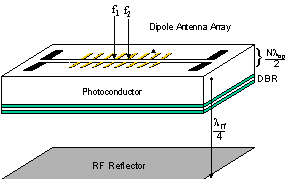
Fig. 3(a) and (b) shows our next generation traveling-wave photomixer design. The device consists of a thin membrane photoconductive material, which forms a resonant cavity at the optical input wavelength. The distributed Bragg reflector (DBR) at the bottom of the cavity assures a second pass of the laser beams. As indicated, the laser beams are incident from the top and cause the excitation of two oppositely traveling waves at the difference frequency along the coplanar stripline (CPS). The CPS is periodically loaded with dipole antennas to couple the radiation into free space. A back-reflector is used to steer all emitted radiation in one direction (upward).
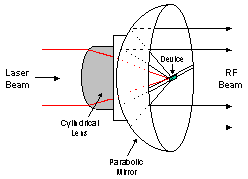
The device is mounted at the focus of a parabolic mirror by a support strut suspended across the opening. A cylindrical lens focuses the laser beams into the gap of the CPS through a small hole in the mirror. The emitted radiation is collected and collimated by the mirror. Since the opening of the mirror is easily made larger than several 10’s of lRF, the exiting beam will be highly collimated.
 |
 |
| (a) | (b) |
| Figure 3.(a) | |
4. SUMMARY
We are pursuing a photomixer design that is both capable of very high frequency operation and accomplishes efficient coupling of the RF radiation into free space. The adherence to phase-matching, as was needed with the original traveling-wave photomixer design, is no longer as critical since an array of l/2-spaced dipole antennas is used. This eliminates the difficult task of careful angle adjustment of the pump lasers. Further, the elimination of the Si lens, and hence the losses associated with reflections and excitation of substrate modes, will result in higher output powers. In the coming year, JPL, UCSB and Caltech will actively pursue demonstration of the concepts presented.
REFERENCES
1. Appl. Phys. Lett. 74, 2872 (1999).
2. Appl. Phys. Lett. 67, 3844 (1995).
3. IEEE Trans. Microwave Theory Tech. MTT-47 (5), 596 (1999).
4. J. Vac. Sci. Technol. B, in print.
5. Appl. Phys. Lett. 75, 3548 (1999).