

Gravitational Lens Massmap Reconstruction
Yielding Exact Reproduction of All Multiple Images
LensPerfect method paper (full color version, 3.3M zipped)
Coe et al. (2008) ApJ 681, 814
(previously astro-ph/0803.1199)
(And stay tuned for the Abell 1689 analysis paper.)
Software (beta version) available upon request.
Please e-mail me at coe(at)caltech.edu for a copy.
LensPerfect is a new approach to the massmap reconstruction
of strong gravitational lenses.
Conventional methods iterate over possible lens models
which reproduce the observed multiple image positions well but not exactly.
LensPerfect only produces solutions which fit all of the data exactly.
Magnifications and shears of the multiple images
can also be perfectly constrained to match observations.
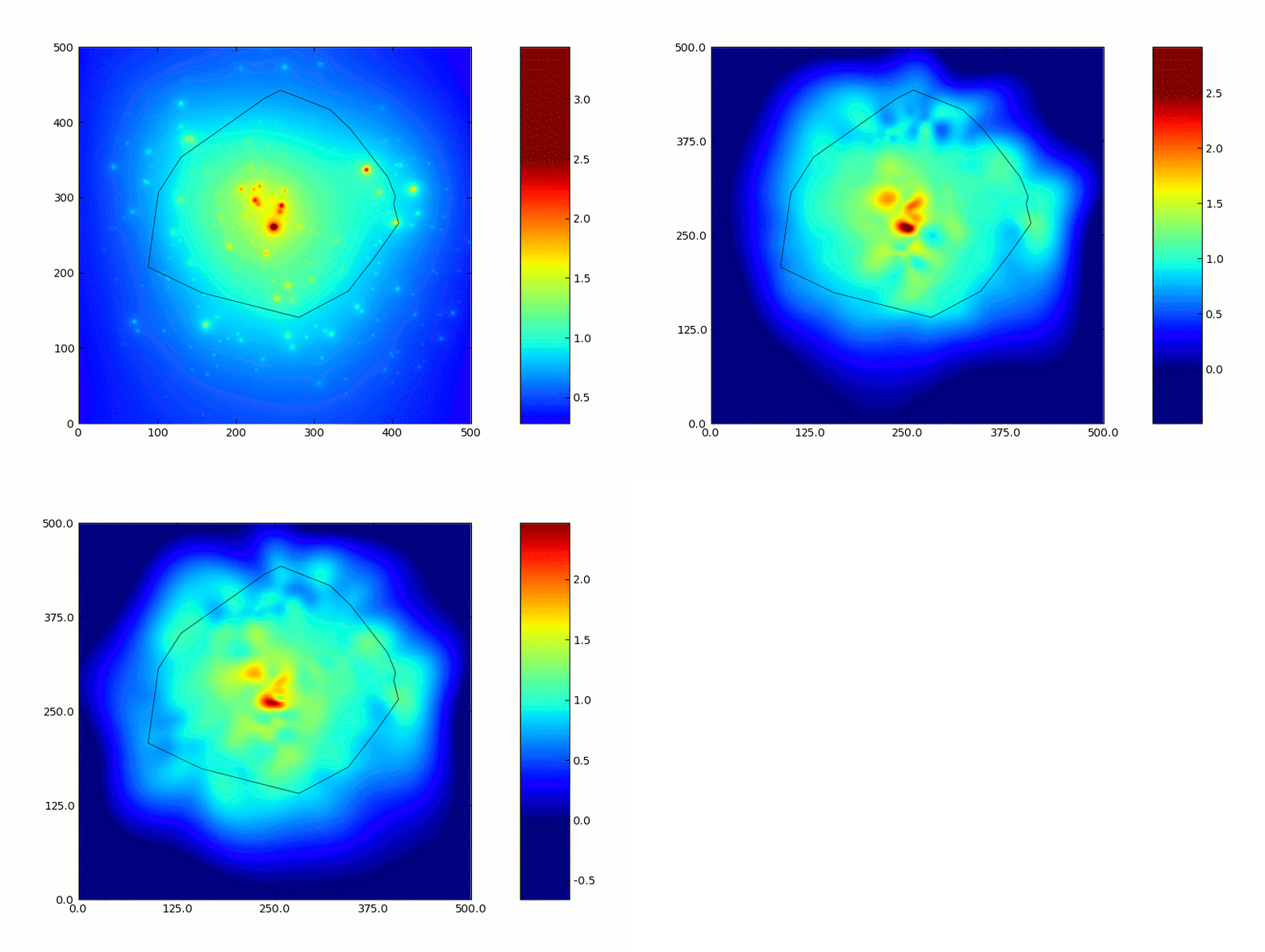
In the example below, we recover a known input massmap
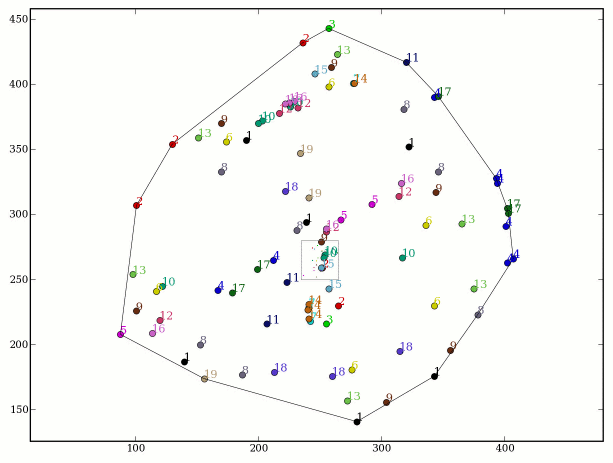
given 93 simulated multiple images of 19 artificial galaxies.
Our solutions reproduce the main features of the input massmap
down to about the resolution of the density of multiple images.
Note our solution is only constrained well within the black contour
which traces the outermost image positions.
Two solutions are shown.
The first solution is obtained given knowledge of the "source" (actual) positions
of the lensed galaxies.
But these actual positions cannot be determined in Nature
(gravitational lenses cannot be temporarily "moved out of the way").
Thus we present a second solution
which is obtained without knowledge of the source positions.
In this case, we iterate over different sets of possible source positions
and select that which gives the most "physical" massmap,
without making any restrictive assumptions.
Massmap solutions obtained given the input massmap,
with and without knowledge of the source positions:
93 simulated multiple images of 19 artificial galaxies
used to recover the input massmap.
(The source positions are the colored specks in the small gray box.):
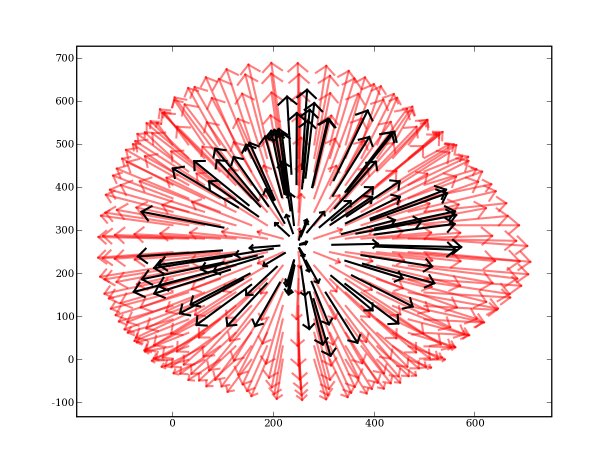
This new method is made possible by a recent
advance in mathematics developed by Eddie Fuselier
that allows for curl-free interpolation of a vector field (here, the
image deflection) given at scattered data points (the image
positions).
Black -- Deflections of the 93 images
all scaled to a common source redshift of infinity
and with the arrow tails moved out to the image positions.
Red -- Curl-free interpolation/extrapolation
which exactly matches the vectors at the given data points:
And if we someday detect 1,000 multiple images due to a lens,
our massmap accuracy could be something like this:

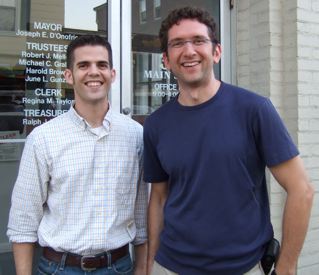
Eddie and I meet in Highland Falls, NY 9/1/07:
Questions? Comments? Please e-mail Dan Coe at coe(at)caltech.edu
Seattle AAS poster (Winter '07): PDF (20M) gif (3M) jpg (1.4M) jpg (480K)