SExSeg vs. SExtractor: UDF NIC3
Thompson et al. released a catalog and segmentation map for the UDF NIC3 J & H images.
We downloaded these from http://www.stsci.edu/hst/udf/.
Then, using Thompson's segmentation map, we ran SExSeg on the NIC3 images, and compared our J & H photometry to Thompson's (SExtractor) catalog:
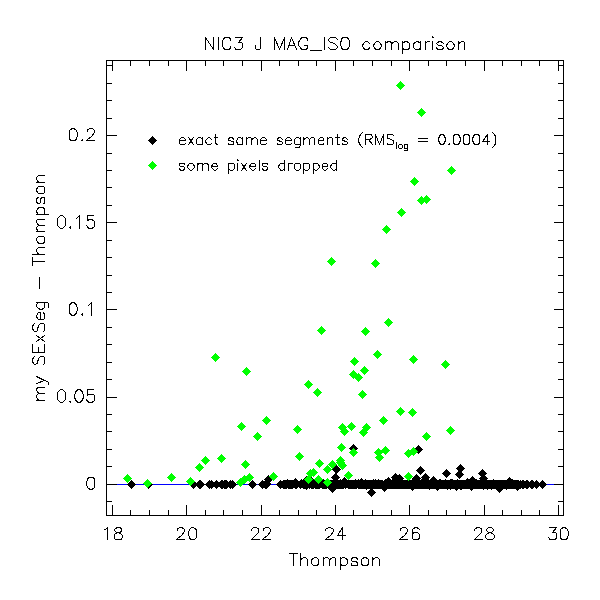
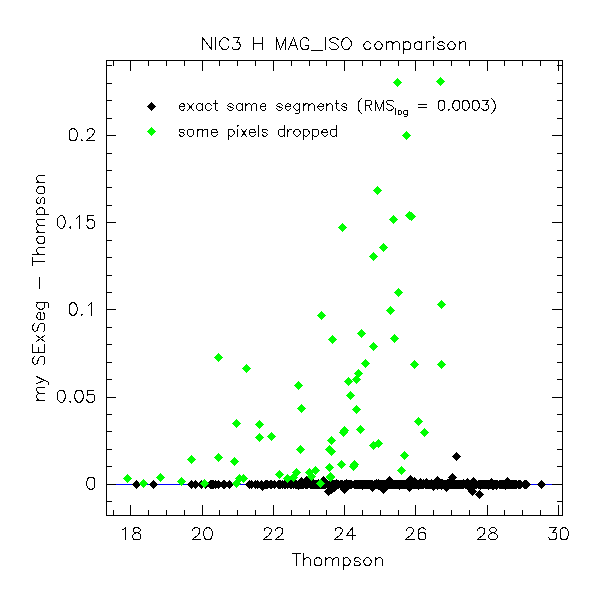
When the segments are unaltered (black points), the photometry is always identical or nearly so. But sometimes SExSeg inserts gaps in the segments to separate objects. In these cases some pixels are discarded, and as a result some flux is lost. For these objects (green points), our magnitudes are slightly higher. However, these aperture alterations are consistently applied to every image (here J & H), so that the colors may be slightly different, but they are no less accurate. (We verify this in simulations (not shown)).

Again, the exact shapes of the apertures are not as important as their consistent use across images of equal seeing. For example, circular apertures yield colors that are (almost) just as accurate as the isophotal apertures used here. MAG_AUTO apertures ...not so much (see simulations in Benitez '03 "Faint Counts"). For each of our objects, SExSeg uses the exact same aperture in every filter.