Spiral Disk Opacity
The disks of spiral galaxies are not only made up of stars but a complex interstellar medium as well. Apart form hydrogen gas, dust is an important component. The latter strongly influences how and how much light escapes from the disk. By measuring how well we can see through spiral disks, we can find the cloud cover ad dust content of spirals.
This research was the subject of my thesis and Holwerda et al (2005a,b,c,d,e) using calibrated counts of distant galaxies as the probe for disk opacity.

Research Interests
Dust disk temperature and geometry
Many of the galaxies in my thesis were also observed in the SINGS survey with Spitzer. This provided a good opportunity to compare extinction and emission characteristics in spiral disks.
I am working on these papers (Holwerda 2006a,b)
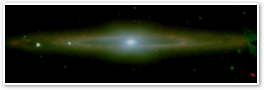
Spitzer’s view on Edge-on galaxies
R. de Jong has an Spitzer program to observe edge-on spirals with IRAC and MIPS. This project is now well underway with both new and archival observations.
We hope to address many aspects of spiral disks:
1. ISM stability (scales and flares)
2. Warps
3. Disk Truncation
4. Small scale ISM structure
5. Bulges: box, peanuts and x-orbits
6. Haloes and stellar streams
7. Thick disks.
At present the reduction is complete for 30-some galaxies but with some more on the way.



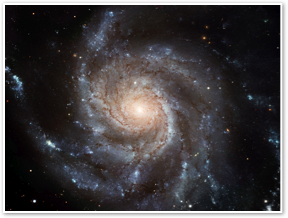
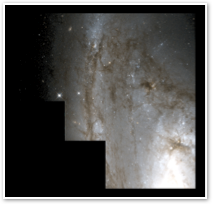
Distant Galaxy Counts in M101 and M51
In my thesis, the HST/ACS campaigns on M101 and M51 were already identified as the ideal data-sets to determine disk opacity from counts of galaxies.
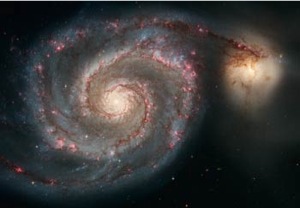
Clustering of starlight in M51
R. Chandar has a project for me to work on the clustering of star formation in M51. With the beautiful HST/ACS data available, this is one of many applications for it. I have just started to explore this project but it promises to be interesting.


Stellar Streams
Looking for the remains of dwarf galaxies around other galaxies. This is an ongoing large project by R. de Jong, A. Seth and others. Currently I am working on the datareduction of the MMT/Megacam data of N4244, M81 and N2403 to loop for these streams of stars.

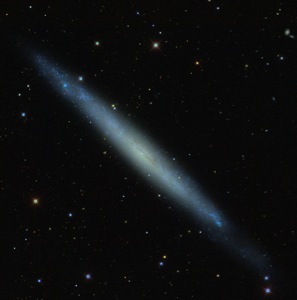

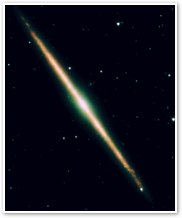
SDSS image of ngc4244.
ngc891
As a general rule, my interests is galaxies. Most of my current work is on nearby galaxies, mostly optical and IR data. However, since I counted distant galaxies in my thesis-work, these are of definite interest to me as well. With the advances in large surveys with HST and Spitzer, it looks like we can do many of the analyses for nearby galaxies on z~1 objects as well.
So it looks like many more categories will be added here in the future.