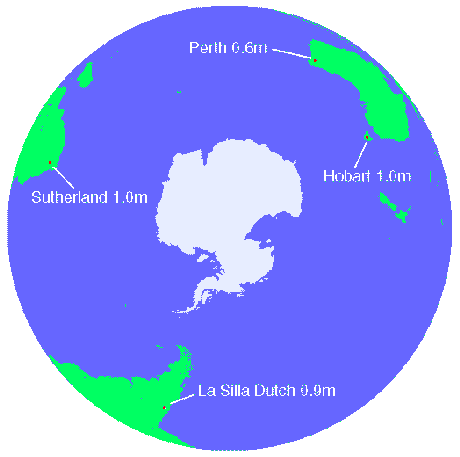
PLANET (Probing Lensing Anomalies NETwork) is a worldwide collaboration formed in the spring of 1995 to meet the challenge of microlensing monitoring. Its primary goal is the study of microlensing anomalies - departures from an achromatic point-source - through rapidly-sampled, multi-band, photometry. Such departures are expected due to blends along the line-of-sight, sources and/or lenses with complex geometries (e.g., binary lenses and sources), resolution of the source star, and complicated relative motion within the lens system (e.g., parallex effects). In particular, microlensing monitoring is a powerful means of searching for extra-solar planets: the caustic patterns arising from the complicated lens geometry of a planetary system could induce sharp peaks in the light curve with durations of a few hours to a few days. Depending on the planetary masses and orbital radii, a significant fraction of detectable caustic crossings are expected, and in principle, even earth-size planets can be detected in this way.
The telescopes used by PLANET are Dutch, South African, and Australian telescopes which are widely separated in longitude giving the possibility of nearly continuous monitoring. The four participating telescopes are the Dutch/ESO 0.9m, SAAO 1.0m, Perth 0.6m, and Hobart 1.0m. Light curves are typically sampled every 1-2 hours and monitoring is done in the V and I bands.
Some of the future prospects of PLANET are:
 Maintained by Stephen Kane (skane@stsci.edu)
last modified: December 10th 1996
 Return to PLANET home page