Binary Star Evolution
Recent studies have shown that at least 50% of the stars in our Galaxy are part of binary or multiple systems and that a fair fraction of these stars will interact with each other at some point of their life. The outcomes of such binary interactions are various and unique, so a better understanding of how such systems interact and evolve can tell us more on the conditions under which they first formed. As a whole, exotic stellar populations can therefore be used to probe the initial conditions of stars clusters and galaxies.
In particular, I am interested in:
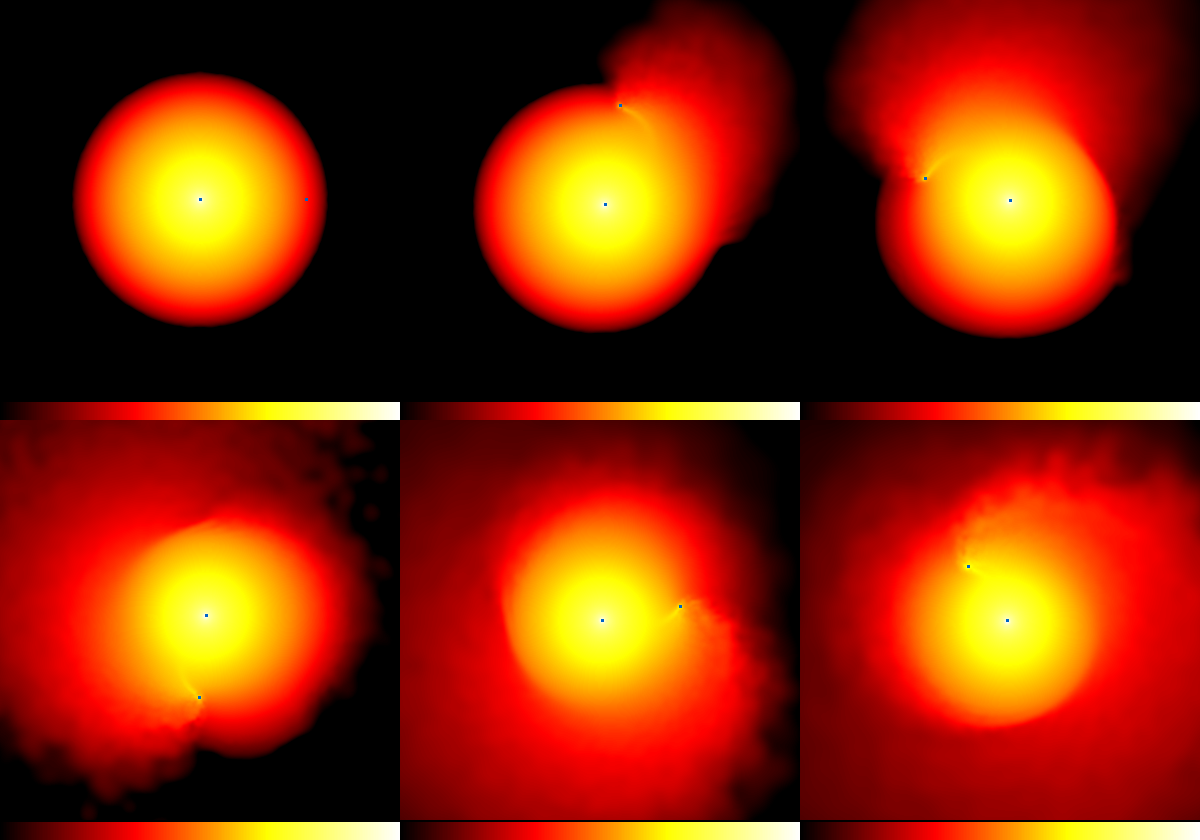
- Detailed mass transfer in binary systems using Smoothed Particle Hydrodynamics (see first movie);
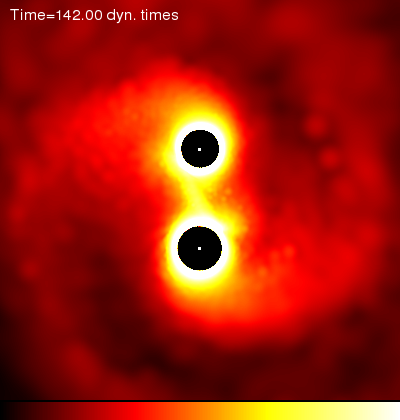
- Mass transfer in main-sequence binaries using SPH and new boundary conditions (see also this page):
- Evolution of mass-accreting object and/or merged object; blue stragglers, exotic objects;
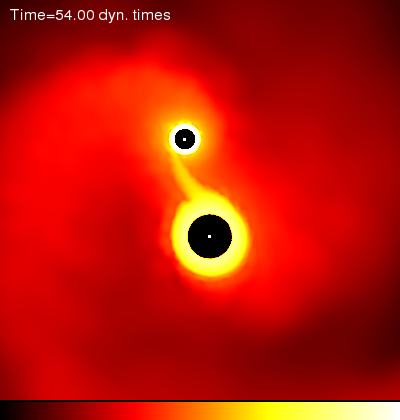
- Binary white dwarfs evolution; Double Degenerates as Type Ia supernovae progenitors, low-mass white dwarfs (see Common Envelope movie).
| 1.50Msun + 1.40Msun | 0.80Msun + 0.48Msun | ||
 |
 |