Black Holes: Gravity's Relentless Pull


OBJECT: Sun
DISTANCE: 93 million miles (8.3 lightminutes)
BLACK HOLE? No
Our solar system consists of the Sun and everything that orbits around it. The Sun is at the center and contains 99.9 percent of the mass. It is the
closest star to Earth (the next nearest star, Proxima Centauri, is 270,000 times further away). A fairly typical medium-sized star, the Sun is 330,000 times
heavier than the Earth, and has 110 times its size.
Stars do not have a solid surface, but consist entirely of hot gas. Like all stars, the Sun was born when a gas cloud contracted and became so hot that atomic nuclei began fusing together. In the Sun, nuclear fusion occurs in the core at 27 million degrees Fahrenheit. The core contains 60 percent of the solar mass, but occupies only 2 percent of its volume. The fusion of hydrogen into helium has already sustained the enormous energy output of the Sun for the past 4.6 billion years. After another 5 billion years it will run out of nuclear fuel and will ultimately fade to obscurity. Stars like our Sun do not become black holes when they die.
The Sun is the only star that can be observed in detail. The visible light image shows the outer layers that shine at 9,900 degrees Fahrenheit. The radio image highlights somewhat cooler regions in these layers, known as sunspots. These spots come and go regularly every 11 years. The X-ray image shows violent magnetic activity on the Sun. It also shows the gaseous envelope known as the corona, which glows in X-rays at 4 million degrees Fahrenheit.
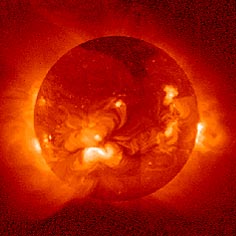
The tenuous gas of the corona around the Sun reveals itself in X-rays. Sun spots on the solar disk emit X-rays as well.


