Black Holes: Gravity's Relentless Pull


OBJECT: Andromeda (Spiral galaxy)
DISTANCE: 2.5 million lightyears
BLACK HOLE? Yes (supermassive)
The Andromeda galaxy, named after the constellation in which it resides, is the nearest galaxy to us that is similar in size to our own Milky Way galaxy. Its main
body has the shape of a flat circular disk, which appears elongated to us because we view it from the side. The central region of the galaxy has a more rounded shape
and is called, cleverly, the bulge.
The visible light image shows that the distribution of stars resembles a spiral pattern. Andromeda therefore belongs to the class of spiral galaxies. Some of the stars reside in binary systems that emit X-rays. These binaries show up as points in the X-ray image. The galaxy disk also contains cold dust and hydrogen gas. The dust obscures some of the starlight and produces the dark bands in the visible light image. The cold hydrogen gas glows in radio waves, shown in the radio image.
We know from measurements of the velocities of stars that there is a supermassive black hole in the galaxy center, 30 million times heavier than the Sun. The black hole is called quiescent because it does not show up in radio and X-ray images as a source of particularly energetic activity. This contrasts with the active black holes in some other galaxies, which are avidly consuming material and producing bright radio waves and X-rays. Most large galaxies have a supermassive black hole in their center, and most of them are quiescent. Galaxies with bigger bulges have heavier black holes.
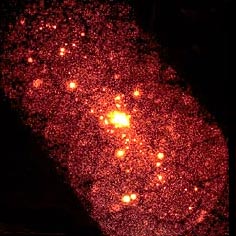
Most stars in a galaxy cannot be detected in X-rays. The dots in the image are due to a small number of X-ray binary systems.


