CURRICULUM VITAE
Massimo ROBBERTO
Date of Birth June 27th, 1958
Nationality Italian
Address Space Telescope Science
Institute (STScI)
3700 San Martin Drive
Baltimore MD 21218,
United States
Phone +1 (410) 338-4382
Fax +1 (410) 338-4796
E-mail robberto@stsci.edu
Web-page http://www.stsci.edu/~mrobberto
Languages English, French, German,
Italian (mother tongue)
Education PhD in Physics 1989
Thesis: Astronomical
Imaging in the Thermal Infrared:
the TIRCAM
project
Advisors: Prof. G. Silvestro and A. Ferrari,
Università di Torino, Italy
Laurea in Physics (cum laude) 1984
Thesis: Millimetric and Infrared
emission of the Giant Molecular
Cloud NGC6334
Advisor: Prof. G. Silvestro, Università di Torino, Italy
Positions: 1999-date Associate Astronomer
European Space Agency (ESA), on duty at the Space Telescope
Science Institute
1995-1999 Staff
Astronomer
Max Planck Institute für Astronomie (MPIA), Heidelberg
1995-1999 Research Astronomer [on leave]
Osservatorio Astronomico di Torino (OATo)
1987-1995 Research
Astronomer, OATo
Current function WFC3 Instrument Scientist (STScI)
WFC3 Infrared Group Lead
(STScI)
WFC3 Infrared Detector Scientist (NASA)
Areas of
Interest
Scientific: Star
formation in the Trapezium cluster; mid-IR emission of circumstellar disks;
HST/UV studies of mass accretion in Pre-Main-Sequence objects; new mission
concept.
Technical: Design, construction, and commissioning of ground and space-based instrumentation; development and testing of new detectors; ground and on-orbit calibration strategies for HST instrumentation; JWST; LBT and VLTI/MIDI interferometers. Project management.
SYNOPSIS
Since
I always wanted to be an astronomer, I was highly motivated when in 1986 I was
admitted to the graduate school in Physics, the first graduate student ever in Astrophysics
at my alma mater, the University of Torino. For my PhD thesis93
(1986-1989) I pioneered TIRCAM7,35, one of the first 10μm cameras built outside the US,
based on a 10×64 Si:Ga detector. I did the feasibility study, contributed to
the control SW and readout electronics, and participated to the commissioning
runs at the 1.5m TIRGO telescope. In the meantime, in 1987, I won the national
competition for a Research Astronomer
position at the Torino Astronomical Observatory. To foster my scientific research
I became involved in a number of science projects mostly based on data I took
at La Silla1,5,44,52,54, obtained with the IRAS satellite2,53,
or both3,47,49. My range of interests extended to the theoretical
studies of physical processes in the circumstellar medium42,43,45,48,51,
polarimetry and CCD imaging55,56, and even on new methods to
estimate the cosmic distance ladder with the SN1987A event46.
In 1989 I established the new technology group of the
Torino Observatory, building from scratch an optical and cryogenic laboratory
and contributing to the hiring process. With a small, highly motivated team I
started in 1990 to devote most of my time to the development of new infrared
instrumentation, in particular the ambitious TC-MIRC (Two Channels - Mid InfraRed
Camera), for the TIRGO telescope26,28,36. TC-MIRC was the first instrument
to cover with a single imager the entire 1-14μm wavelength range using an
InSb device for the 1-5μm
channel and a Si:Ga device for the 8-14μm channel. Both channels were simultaneously observing the same
field, each with two independent, user-selectable, magnifications. The 10K
cryogenic system has been the first entirely based on a closed-cycle-cooler for
low-cost operations and easy maintenance at the remote site. As instrument PI,
I developed the concept and the optical design, I negotiated the detector
acquisition and export licenses, I followed the cryo-mechanical construction in
Tucson, and wrote the graphic-user-interface and data analysis SW. First light
occurred in 1994, then the instrument was offered to the public and has
produced science data published on referred journals. TC-MIRC has given me a
unique technical and managerial experience. Unfortunately, severe budget
restrictions and staff departures delayed the construction. When other teams developed new instruments
based on IR detectors more advanced that our early, and noisy, 58×62 detectors,
and developed them at 5 m class telescopes, the TC-MIRC/TIRGO combination
became obsolete. It is therefore not surprising that after this experience my
next mid-IR camera, MAX, was built at MPIA, but with a schedule that went from
the concept to the deployment at the UKIRT telescope in only 9 months.
In 1991 I established a fruitful collaboration with F.Paresce and M.Clampin, at that time both at the STScI, to build a new type of optical coronograph27,37,38 for alt-azimuthal telescopes, characterized by a de-rotating pupil mask. We successfully operated the coronograph in several runs at the NTT and WHT telescopes9,58,59,62. My main technical contribution was the development of the control system, especially complex for the real-time control of the rotation of the apodizer (in practice, a compact telescope pointing model to calculate the parallactic angle). The collaboration with F. Paresce extended to the use of his previous coronograph at the 2.2m Calar Alto telescope. In addition to being extremely fruitful scientifically4,6,8,57,60,64, this activity put me for the first time in contact with the MPIA team in Heidelberg.
In 1992 I contacted R. Lenzen at MPIA to partner in a team to respond to the first call for proposals for VLT instrumentation. I lead my Torino group in the CONICA collaboration, with responsibility for the detector electronics. We were the first Italian team to participate in the development of VLT instrumentation. As a co-investigator, I strengthened my ties with the MPIA while struggling to keep Torino in the project despite the lack of adequate national, non-capital, funding (most of the national resources were allocated to the Galileo telescope). In view of repeated failures to secure the necessary funds, I decided to leave Italy and in 1995 I moved to Heidelberg.
At MPIA I was appointed as scientific and technical
leader of the MAX camera29,40, a superb thermal infrared
camera for UKIRT. MAX was based on a Rockwell 128×128 Si:As BIB detector
tailored for high flux, low noise performance. The MAX design presented many
advanced features, including all-reflective, aspheric, diffraction limited optics
oversized to easily accommodate larger arrays, a hybrid (liquid helium plus
closed cycle cooler) cryogenic system, and a powerful read-out electronics
based on a VME-bus system and a Super-Sparc work station. I lead the construction of MAX, from
the concept to the design and construction phase, working on issues such as
stray-light rejection, filter specifications, optical alignment strategy, and
the data acquisition SW, rapidly developed from the version used on the other
MPIA near-IR cameras. The commissioning and acceptance tests in Tucson were
completed 8 days before the first night on UKIRT, in November 1995. In the very
first night MAX provided excellent images with an unprecedented combination of
sensitivity and spatial resolution. As soon as we got MAX in focus and the
pupil aligned, Alpha Tau showed a spectacular diffraction pattern and I counted
up to the 11th diffraction ring, a moment that I cannot forget.
After the completion of the telescope upgrade program in August 1996 with the
tip-tilt secondary mirror, MAX routinely reached diffraction and
background limited imaging between 5
and 25μm, with astonishing sensitivity. Between 1995 and 2000 I have spent
a significant fraction of my time on Mauna Kea, and more than 120 nights at the
telescope, gaining a unique experience on IR observations and on the operations
of a major facility. My
duties ranged from scheduling to proposal evaluation, calibration, general user
support on data reduction, dewar maintenance, installation and alignment at the
telescope, major electronics repair at the 4200m of the summit, even solving,
with a redesign of the original LHe vessel, a complex cryogenic problem with
thermoacustic oscillations triggered when the camera was oriented in given
directions. To contribute to the safety of my coworkers on the summit and
increase schedule flexibility I toke a CPR certification. Almost every night I
also operated the other UKIRT instruments (CGS4, IRCAM3, UFTI), as service
observing for a great variety of scientific programs.
The
MAX/UKIRT combination has set the state-of-the-art in ground-based mid-IR
astronomy. The advent of mid-IR cameras at 8-10m class telescopes, however,
makes mid-IR astronomy with 4m class telescopes much less attractive, due the
enormous gain of observing efficiency with larger telescope diameters (~D4)
for instrument operating in diffraction and background limited conditions. For
this reason, MAX was decommissioned in early 2001, when it still was in perfect
operating conditions. The technical legacy of MAX can be found in the mid-IR
instruments built by C. Telesco at the University of Florida.
MAX has been scientifically very productive, with many papers published on referred journals by various teams. In Heidelberg I started to collaborate scientifically with S. Beckwith, thus my research with MAX concentrated on dust disks in pre-main sequence stars, and more recently on the Orion Cluster (for details see the “Research Accomplishments” section).
In Heidelberg I also contributed to the ISOPHOT
calibration, exploring the
behavior of the internal Fine Calibration Source(s) (FCS) with respect to
various parameters like temperature, orbital position, and filters. For the P1
detector (1-16μm) I found the first evidence for a significant increase of
the detector responsivity at the lowest flux levels, an unexpected effect which
since then has been carefully studied by the ISOPHOT team. The necessary
correction is now part of the standard ISOPHOT data reduction pipeline.
Finally, in Heidelberg I also contributed to the definition studies of the LBT and VLTI/MIDI interferometers, and I am still part of the MIDI science working group.
In 1999 I took an ESA position and moved to the STScI in
Baltimore. I joined the HST project as Instrument Scientist for WFC3,
with main responsibility for the newly approved IR channel with its new type of
HgCdTe detectors. A panchromatic
two-channel camera covering from the UV to the near-IR, WFC3 will be installed
during the next Servicing Mission 4 onboard the HST31. The IR channel
is equipped with a new type of 1K×1K infrared detector, dubbed WFC3-1R,
developed by Rockwell Science Center. It has an unusually high operating
temperature, T=150K, and long cutoff wavelength at 1.7μm to keep the dark
current low.
As a WFC3 Instrument Scientist I have worked on a variety
of topics. For example, on the estimate of the thermal background at the focal
plane of the IR channel (a crucial parameter to define the maximum tolerable
dark current, and therefore the detector band-gap), revising the previous
estimates of the HST background as measured with NICMOS32. My analysis led to a new model for the HST emissivity
budget (basically I find that the dust on the primary mirror has a poor thermal
coupling with the mirror surface), and solved a longstanding discrepancy
between models and NICMOS measures. Recent post-refurbishment NICMOS data are
in excellent agreement with my predictions and the new model is now part of the
latest generation of exposure time calculators. I also worked on CCDs, contributing
mostly to the definition of unusual operating modes, such as the implementation
of the charge injection, that we expect to use late in the emission to recover
the losses of charge transfer efficiency due to radiation damage. Part of this
and other work is documented in a number of WFC3 Instrument Science Reports73-84.
However, for four years my main duty has been to direct (at
STScI) or advise (at NASA/Goddard) a team of about 20 scientists doing laboratory
activity on the selection and characterization of flight detectors. We have tested several tens of prototypes and
candidate flight parts, both for performance and for reliability under thermal,
mechanical and radiation effects in space environment. The
work organization and schedule of the activities has been one of my top
priorities. Our main goal in this phase was to obtain the most rapid and
reliable estimate of the performances, to provide Rockwell with the immediate
feedback needed for further optimizations. Our operations were constrained by
various requirements, e.g. all test procedures had to be defined in observance
of the NASA rules for the handling of flight parts, as well as work orders, log
keeping, etc. A significant amount of my time has been also devoted to the
management of the human resources, especially in what concerns the
harmonization of the STScI and NASA/Goddard teams, in more than one occasion at
the edge between collaboration and competition. Also the different nature of my
official role within the two groups forced me to be extremely flexible and use
a variety of managerial styles, namely assertive and nurturing with my STScI
people, strategic with the Goddard staff.
The long days spent at Goddard have given me a unique opportunity
to become familiar with the development methods of NASA. In addition, the
collaboration with industry, Rockwell
Science Center for the detector production and Ball Aerospace for the
construction of the optical bench, has been extremely interesting. The
participation to a large number of internal meetings with a variety of goals
(technical, status review, planning, contract, advisory, etc…) has refined my
understanding of the issues typical of business-oriented organizations, and
exposed me to a variety of managerial styles and ways to approach and solve
problems. To be part of these environments is uncommon for a non-US citizen,
and I had to obtain special permissions from the US State Department.
The production of suitable flight parts matching the
original specifications has turned out to be much harder than Rockwell
originally expected. This has been the highest risk factor in the entire 85M$ WFC3 project. My program
had therefore the highest visibility and scrutiny from NASA headquarters, also
because the SNAP mission, a proposed space telescope of 2 m diameter with
ultra-wide field aimed to the discovery of a large number of cosmological Type
1a supernovae, is planning to use the same detectors. I routinely presented the
results of the program to the WFC3 Scientific Oversight Committee, to members
of NASA headquarters, and to the international community33,34. This experience has greatly helped me refine my ability
to deliver authoritative speeches and perform under stress and heavy exposure.
The two flight parts, prime and spare, have finally been down-selected on May,
keeping the instrument within budget and schedule. This activity has been
explicitly commended by NASA in the last evaluation of the STScI performance,
and gained me the 2002 Excellence Prize from STScI.
I regard the experience on WFC3 as a large step ahead compared to my previous work, which was more focused on planning, building, commissioning, and using new instruments in small, university level, teams. Working on WFC3 has given me a unique experience on the construction and test of Hubble instrumentation, new detector development, space qualification processes, etc. Moreover, the complexity of the task, the variety of environments and different organizations has exposed me to much higher levels of responsibility, and greatly refined my own project management skills and capabilities as team leader.
At the STScI I have the privilege of contributing to one of the most successful projects of modern Astronomy, in an extremely demanding and rewarding scientific environment. Having successfully accomplished my major milestones, I am willing to consider new challenging opportunities at your institution.
SCIENTIFIC
ACCOMPLISHMENTS
My
scientific activity combines my two historical interests: construction and use
of novel instrumentation and a longstanding curiosity about the interaction
between stars and their circumstellar medium. I focussed most recently on star
formation, in particular on the Orion Nebula and the Trapezium cluster.
Previously I worked on a variety of related subjects, e.g. luminous blue
variables and planetary nebulae, which I investigated with different
observational techniques, or even theoretically.
In the following I will highlight relevant science themes that I have investigated. The research on the Orion Nebula is still ongoing and I intend to remain active in this field for the foreseeable future.
1. Research on the Orion
Nebula
Our understanding of massive star formation is critically based on the nearest active region, the Orion Nebula (ON) and its associated stellar Cluster (ONC). According to the current paradigm, dense, rich clusters dominated by a few massive OB stars represent the most prolific Galactic star-forming environment. The ON is a harsh environment, characterized by winds and ionizing radiation, multiple outflows, close dynamical encounters and substantial X-ray emission. The canonical scenario developed in the last two decades for isolated low mass stars forming in sparse clusters like Taurus-Auriga may not adequately describe crucial aspects of the early stellar evolution. Disk evolution and planet formation processes, in particular, may be strongly affected in these conditions, with major implications on the probability of forming planets able to support life.
 1.1)
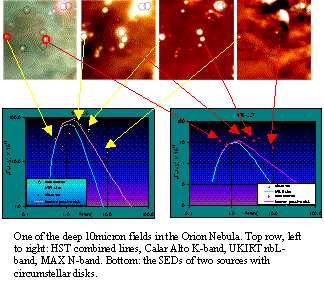
Mid-IR survey of proplyds (Ref. 67,69)
1.1)
Mid-IR survey of proplyds (Ref. 67,69)
I started working on the Orion Region in 1997, using the MAX camera that I developed for the UKIRT telescope. The exquisite sensitivity of this instrument allowed me, in collaboration with Beckwith and Herbst, to perform the first mid-IR imaging survey of the Orion Nebula at 5 and 10 μm, that we complemented with 3.5 μm data taken with the UKIRT facility instrument IRCAM-3. In sub-arcsecond seeing conditions we probed 9 fields centered on prominent dark silhouette or externally photoionized (“proplyd”) sources, detecting thermal emission from a large fraction of all the catalogued objects falling within our fields. Absolute photometry indicates that mid-IR emission is generally in excess with respect to the stellar photosphere, allowing us to estimate a fraction of circumstellar disks in the Trapezium cluster larger than 80%, in agreement with the most recent estimates. We also found that standard disk models cannot explain, in several cases, the strong 10 μm excess that we observe, forcing us to consider new scenarios for the origin of the mid-IR emission.
1.2) Modeling the
IR emission of disks in Orion (Ref.17)
To understand the cause of the strong mid-IR excess, in collaboration with Beckwith and Panagia, I modeled the infrared SED of circumstellar disks embedded in a HII region and photoevaporated by the external ultraviolet radiation.
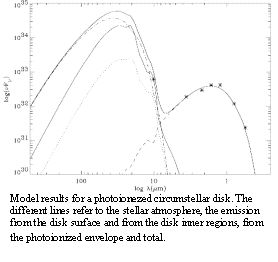 First,
we calculated the IR emission of a pre-main-sequence star surrounded by a dusty
globule immersed within an HII region. We assumed the globule to be spherical,
homogeneous, optically thin at IR wavelengths, and photoevaporated according to
the classic Dyson model. Second, we considered the IR emission of a passive
(non accreting) disk directly exposed to the same nebular environment, using
and improving Chiang & Goldreich (1997) model. In the presence of a strong
ionizing source, the opposite disk sides receive different amounts of
radiation, therefore the flaring angle and the surface temperature
distributions are different, resulting in well-distinct SEDs for the two disk
faces. Finally, we consistently combined the globule and disk models to estimate
the total IR emission of proplyds. The energy input from the central star and the
nebular environment increases the disk flaring angle, and, therefore, also the
amount of stellar radiation intercepted by the disk. In practice, the relative
intensity of the disk vs. envelope emission varies with the tilt angle relative
to the directions to θ1 Ori C and the Earth. We then explored
the dependence of the SEDs upon the tilt angle with respect to the Earth, the
distance from θ1 Ori C, the size of the envelope, the inner
disk radius, and the temperature of the central star. The resulting SEDs are
characterized by a broad peak of emission at 30-60 μm and are in general
significantly different from those of isolated disks in low-mass starforming
regions like Taurus-Auriga. Our model can account for the strong mid-IR excess
we detected at 10 μm, and indicates that in the presence of an external
radiation field, these relatively evolved Class 2 objects may display a SED
peaking at mid-IR and far-IR wavelengths.
First,
we calculated the IR emission of a pre-main-sequence star surrounded by a dusty
globule immersed within an HII region. We assumed the globule to be spherical,
homogeneous, optically thin at IR wavelengths, and photoevaporated according to
the classic Dyson model. Second, we considered the IR emission of a passive
(non accreting) disk directly exposed to the same nebular environment, using
and improving Chiang & Goldreich (1997) model. In the presence of a strong
ionizing source, the opposite disk sides receive different amounts of
radiation, therefore the flaring angle and the surface temperature
distributions are different, resulting in well-distinct SEDs for the two disk
faces. Finally, we consistently combined the globule and disk models to estimate
the total IR emission of proplyds. The energy input from the central star and the
nebular environment increases the disk flaring angle, and, therefore, also the
amount of stellar radiation intercepted by the disk. In practice, the relative
intensity of the disk vs. envelope emission varies with the tilt angle relative
to the directions to θ1 Ori C and the Earth. We then explored
the dependence of the SEDs upon the tilt angle with respect to the Earth, the
distance from θ1 Ori C, the size of the envelope, the inner
disk radius, and the temperature of the central star. The resulting SEDs are
characterized by a broad peak of emission at 30-60 μm and are in general
significantly different from those of isolated disks in low-mass starforming
regions like Taurus-Auriga. Our model can account for the strong mid-IR excess
we detected at 10 μm, and indicates that in the presence of an external
radiation field, these relatively evolved Class 2 objects may display a SED
peaking at mid-IR and far-IR wavelengths.
1.3) Mapping the Orion Nebula in the mid-IR (Ref. 71,72)
With MAX on UKIRT I started a second, major project
aimed at building a map of the Orion Nebula core at 10 and 20μm with
sub-arcsecond resolution. At these 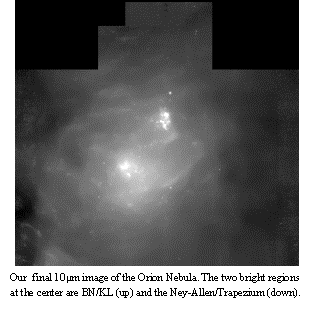 wavelengths
the region remains largely unexplored, as previous investigations concentrated
on the BN/KL and Trapezium/Ney Allen objects. Using standard chopping and
nodding technique, we
covered at both wavelengths an area ~5×3.5arcmin2 centered on the Trapezium region, scanning for four nights
the field both in RA and DEC with different chopping amplitudes. Given the
brightness of the region, chop/nod techniques with throw<30arcsec (the
maximum allowed by the UKIRT secondary) produce images affected by strong
artifacts. To recover the information, a new image reconstruction method had to
be developed, as described in the next point. Our images reveal for the first
time the detailed structure of the Orion Nebula in the mid-IR. Together with
the Ney-Allen and BN/KL regions, we detect a variety of large scale features
(filaments, knots, arcs…) tracing the overall structure of this blister-type
HII region. We also detect approximately 170 point sources, most of them for
the first time at mid-IR wavelengths, including sources with extremely red
colors. These may represent a population of pre-main sequence stars, or even
protostars more deeply embedded in the underlying OMC-1 molecular cloud. The
availability of data taken at different epochs also allows us to find evidence
of significant variability at 10μm.
wavelengths
the region remains largely unexplored, as previous investigations concentrated
on the BN/KL and Trapezium/Ney Allen objects. Using standard chopping and
nodding technique, we
covered at both wavelengths an area ~5×3.5arcmin2 centered on the Trapezium region, scanning for four nights
the field both in RA and DEC with different chopping amplitudes. Given the
brightness of the region, chop/nod techniques with throw<30arcsec (the
maximum allowed by the UKIRT secondary) produce images affected by strong
artifacts. To recover the information, a new image reconstruction method had to
be developed, as described in the next point. Our images reveal for the first
time the detailed structure of the Orion Nebula in the mid-IR. Together with
the Ney-Allen and BN/KL regions, we detect a variety of large scale features
(filaments, knots, arcs…) tracing the overall structure of this blister-type
HII region. We also detect approximately 170 point sources, most of them for
the first time at mid-IR wavelengths, including sources with extremely red
colors. These may represent a population of pre-main sequence stars, or even
protostars more deeply embedded in the underlying OMC-1 molecular cloud. The
availability of data taken at different epochs also allows us to find evidence
of significant variability at 10μm.
1.4) Inversion
methods for mid-IR imaging (Ref. 14,16,18, 21, 30, 41)
Working on the map of the Orion Nebula, I realized
that an image restoration method for mid-IR images would have a major impact on
wide-field imaging at these wavelengths. With Prof M. Bertero, an expert of image reconstruction and
inversion problems at the University of Genova (Italy), we envisioned and
developed an iterative reconstruction 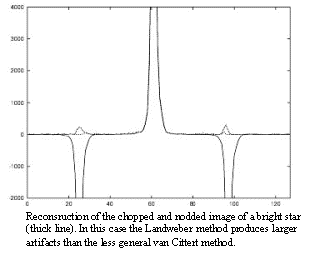 algorithm based on the projected
Landweber method that computes, in the proper metric space, the smallest
solution subjected to the constraint of positivity (real astronomical signals
are always positive). The restored images exhibit artifacts related to the
chopping amplitude and detector size, and we found that their nature and
location can be predicted by analyzing the mathematical structure of the
problem. We then performed a complete investigation of the performance, and limits, of this restoration algorithm
using real chopped and nodded images, thus developing the data acquisition and
data reduction strategy I finally used for the wide-field imaging of the Orion
Nebula.
algorithm based on the projected
Landweber method that computes, in the proper metric space, the smallest
solution subjected to the constraint of positivity (real astronomical signals
are always positive). The restored images exhibit artifacts related to the
chopping amplitude and detector size, and we found that their nature and
location can be predicted by analyzing the mathematical structure of the
problem. We then performed a complete investigation of the performance, and limits, of this restoration algorithm
using real chopped and nodded images, thus developing the data acquisition and
data reduction strategy I finally used for the wide-field imaging of the Orion
Nebula.
We
have then extended our investigation to the case of targets surrounded by a
suitable region of empty sky, a condition that in principle can always be met
by mosaicing adjacent images up to the field edges. In this situation, the
problem can be treated with Fourier-based techniques and a different iterative
method can be used, namely a relaxed and projected version of the van Cittert
method. Our most recent study shows that the same problem can be reduced to the
inversion of a non-singular positive definite matrix whose eigenvalues and
eigenvectors can be explicitely calculated, allowing to implement an iterative
algorithm converging to the unique non-negative least-square solution.
1.5) HST study of the mass accretion rates in Trapezium Cluster (Ref. 91)
The relevance of accretion
processes in the Trapezium Cluster has not yet been explored. Using the
Wide Field Planetary Camera 2 onboard the Hubble Space Telescope I have
observed the core of the Orion Nebula in the U- and B-bands. A preliminary
analysis of isolated single stars (thus neglecting binaries and extended proplyd
sources for which more 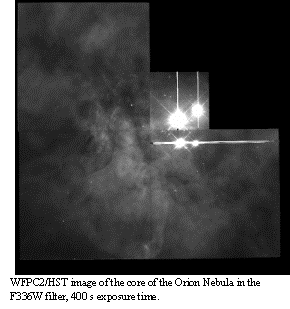 refined
PSF photometry is needed) allowed to obtain aperture photometry for 91 stars in
the U-band (F336W) and 71 stars in the B-band (F439W). With my collaborators, I
also searched the archive of WFPC2 images for complementary V-band (F547M) and
I-band (F791W) photometry. We then extracted a primary sample made of 12
sources having complete WFPC2 UBVI photometry and known spectral type between
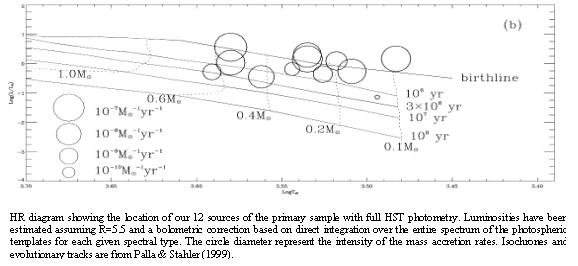
K8 and M5.5 from Hillenbrand (1997). We located each star on the HR diagram
considering both the standard ISM reddening law with RV=3.1 and the
``anomalous'' reddening law with RV=5.5, which is more appropriate for the Orion Nebula, together with two
different bolometric corrections, given the uncertainties at these spectral
types. We find that the RV=5.5 reddening law provides the smallest
scatter in age and a HR diagram nicely compatible with Palla and Stahler model.
With one possible exception, all sources show excess luminosity in the U-band,
that we attribute to mass accretion. The known correlation between the U-band
excess and the total accretion luminosity, recalibrated to our photometric
system, allows us to estimate the mass accretion rates, which are found to be in the range 10-7-10-10M8y-1. Four stars lying
on the 10-5
M8y-1 birth line of Palla &
Stahler show mass accretion rates ~10-7M8y-1, indicating that
the main accretion phase has been recently terminated. This relatively low mass
accretion rate may be related to the development of the HII region generated by
the Trapezium OB stars. If this is the case, the Initial Mass Function is
affected by the evolution of the most massive cluster's stars, thus inducing an
increment of low mass, “accretion aborted”, stars. This would be in
agreement with the recent findings that the Orion Nebula presents a fraction of
low mass stars and brown dwarfs that is roughly twice as high as that measured
in Taurus- Auriga. Within
our small primary sample, the mass accretion rates appear to decrease with the
stellar age. We also find indication of a trend between the mass accretion rate
and the stellar mass.
refined
PSF photometry is needed) allowed to obtain aperture photometry for 91 stars in
the U-band (F336W) and 71 stars in the B-band (F439W). With my collaborators, I
also searched the archive of WFPC2 images for complementary V-band (F547M) and
I-band (F791W) photometry. We then extracted a primary sample made of 12
sources having complete WFPC2 UBVI photometry and known spectral type between
K8 and M5.5 from Hillenbrand (1997). We located each star on the HR diagram
considering both the standard ISM reddening law with RV=3.1 and the
``anomalous'' reddening law with RV=5.5, which is more appropriate for the Orion Nebula, together with two
different bolometric corrections, given the uncertainties at these spectral
types. We find that the RV=5.5 reddening law provides the smallest
scatter in age and a HR diagram nicely compatible with Palla and Stahler model.
With one possible exception, all sources show excess luminosity in the U-band,
that we attribute to mass accretion. The known correlation between the U-band
excess and the total accretion luminosity, recalibrated to our photometric
system, allows us to estimate the mass accretion rates, which are found to be in the range 10-7-10-10M8y-1. Four stars lying
on the 10-5
M8y-1 birth line of Palla &
Stahler show mass accretion rates ~10-7M8y-1, indicating that
the main accretion phase has been recently terminated. This relatively low mass
accretion rate may be related to the development of the HII region generated by
the Trapezium OB stars. If this is the case, the Initial Mass Function is
affected by the evolution of the most massive cluster's stars, thus inducing an
increment of low mass, “accretion aborted”, stars. This would be in
agreement with the recent findings that the Orion Nebula presents a fraction of
low mass stars and brown dwarfs that is roughly twice as high as that measured
in Taurus- Auriga. Within
our small primary sample, the mass accretion rates appear to decrease with the
stellar age. We also find indication of a trend between the mass accretion rate
and the stellar mass.
1.6) Measuring
the mass accretion rates in the Great Orion Nebula
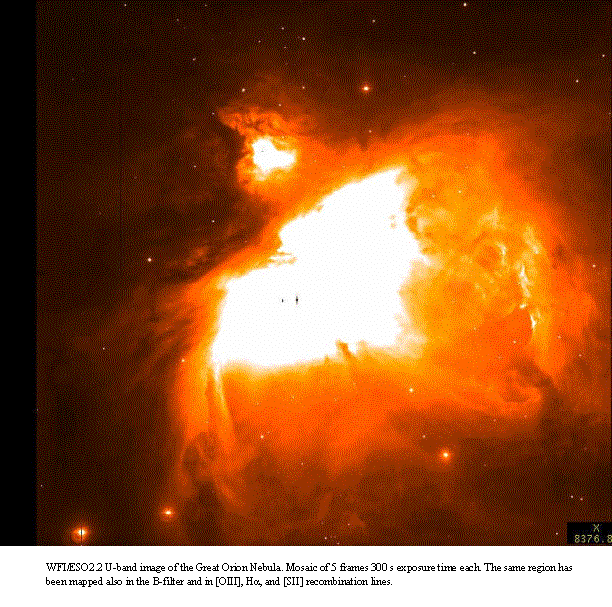
Using the WFI on the ESO 2.2 m telescope, I have imaged in the U-band filter the Great Orion Nebula (~34´×33´) to measure the excess luminosity and obtain the mass accretion rates for hundreds of cluster members. The main goal of this project is to trace possible systematic differences in the mass accretion rates for similar stars located in different nebular environments, e.g. at different distances from the Trapezium stars. This can provide final measure of how the mass accretion rate is affected by the presence of nearby massive stars through the onset of UV flux, and confirm the hypothesis that this phenomenon may produce the departure of the IMF from the classical Salpeter spectrum at low masses observed in the Orion core. The data reduction is in progress at the moment of this writing.
2. Research on Star
Formation in low-mass associations
2.1) Disk
evolution vs. binary formation: the DH/DI Tau system (Ref. 11)
 Using
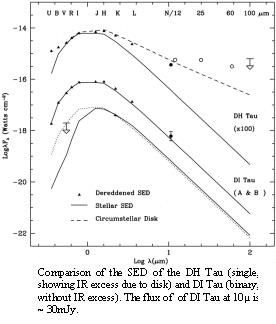
MAX, Meyer, Beckwith, Herbst and I observed in 1997 two young stars in the Taurus
dark cloud, DH Tau and DI Tau, spatially resolving for the first time their
10μm emission. The weak-emission T Tauri star DI Tau, which was
tentatively identified by Skrutskie et al. on the basis of 12 μm IRAS data
as an object in the process of dissipating its circumstellar disk, was found to
have no infrared excess at a wavelength of 10 μm. The nearby classical T
Tauri star DH Tau exhibits excess emission at 10 μm consistent with
predictions based on circumstellar disk models. While both objects appear to
have the same stellar mass, age, and rotation rate, they differ in two
fundamental respects: DH Tau is a single star with an active accretion disk,
and DI Tau is a binary system lacking such a disk. The companion to DI Tau has
a very low luminosity and is located at a projected distance of ~20 AU from the
primary. Assuming the system to be coeval, we derived a mass below the hydrogen
burning limit for the companion. We speculated that the formation of a
substellar mass companion has led to the rapid dissipation of the circumstellar
disk that may have surrounded DI Tau.
Using
MAX, Meyer, Beckwith, Herbst and I observed in 1997 two young stars in the Taurus
dark cloud, DH Tau and DI Tau, spatially resolving for the first time their
10μm emission. The weak-emission T Tauri star DI Tau, which was
tentatively identified by Skrutskie et al. on the basis of 12 μm IRAS data
as an object in the process of dissipating its circumstellar disk, was found to
have no infrared excess at a wavelength of 10 μm. The nearby classical T
Tauri star DH Tau exhibits excess emission at 10 μm consistent with
predictions based on circumstellar disk models. While both objects appear to
have the same stellar mass, age, and rotation rate, they differ in two
fundamental respects: DH Tau is a single star with an active accretion disk,
and DI Tau is a binary system lacking such a disk. The companion to DI Tau has
a very low luminosity and is located at a projected distance of ~20 AU from the
primary. Assuming the system to be coeval, we derived a mass below the hydrogen
burning limit for the companion. We speculated that the formation of a
substellar mass companion has led to the rapid dissipation of the circumstellar
disk that may have surrounded DI Tau.
2.2) The archetype: T Tau (Ref. 8, 10, 66)
My first
observations of T Tauri and its surrounding nebula (Burnham nebula) were made
in 1994 using both the STScI coronograph at Calar Alto (Spain) and the
STScI-Torino alt-az coronograph at ESO-NTT in Hα6563, [SII]6716-6731 and
relative 6670/80 satellite continuum filters. Taking advantage of the subarcsec
seeing conditions, my coworkers and I mapped the circumstellar environment down
to 2" from the star, corresponding to 320A.U. at the T Tauri distance of
160pc. Both the Hα and [SII] images revealed a complex morphology,
characterized by several clumps of shock-excited gas superimposed on large
scale continuum emission. In particular, we detected a jet-like 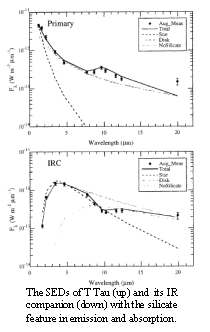 feature
departing from the immediate surroundings of the star in a southly direction
that leads to a region of shock excited clumps. A curved filament departs also
from this region, crossing Burnham nebula up to the previously known Herbig-Haro
object HH A of Schwartz (1990). The south-western part of Burnham nebula is
characterized by a number of small, nearly circular clumps and we found a
faint, isolated HH object in the northern part of the nebula. Taking into
account all the available data, we suggested that an optical jet is ejected by
T Tau S roughly along the plane of the sky. The jet at first moves into the
neutral components originating the shock excited knots and then impacts the
edges of the cavity associated to the outflows. The jet wiggling due to the
orbital motion of the emitting source and/or to precession phenomena could
explain the peculiar excitation status of the Burnham nebula.
feature
departing from the immediate surroundings of the star in a southly direction
that leads to a region of shock excited clumps. A curved filament departs also
from this region, crossing Burnham nebula up to the previously known Herbig-Haro
object HH A of Schwartz (1990). The south-western part of Burnham nebula is
characterized by a number of small, nearly circular clumps and we found a
faint, isolated HH object in the northern part of the nebula. Taking into
account all the available data, we suggested that an optical jet is ejected by
T Tau S roughly along the plane of the sky. The jet at first moves into the
neutral components originating the shock excited knots and then impacts the
edges of the cavity associated to the outflows. The jet wiggling due to the
orbital motion of the emitting source and/or to precession phenomena could
explain the peculiar excitation status of the Burnham nebula.
Herbst, Beckwith, and I returned in 1997 to this source taking near-infrared Fabry-Perot images and low and high resolution long-slit spectroscopy data. The FP images, taken in the v=1-0 S(1) line of molecular hydrogen, reveal a complex system of almost twenty interlocking loops and arcs within 10" of the central stars. These structures are almost certainly shocks, with the H and K band spectra indicating a range of excitation temperatures and velocities. The interaction with the ambient molecular cloud of two, almost perpendicular outflow systems can explain the complex molecular hydrogen morphology of T Tau. Such flows may be collimated by circumstellar disks.
On UKIRT we also obtained spatially resolved near and mid-infrared photometry of the binary, finding evidence for disks in both stars, with a strong silicate absorption line in the infrared companion and an emission feature in the primary. Separating the primary and companion fluxes allowed a reinterpretation of published variability measurements to give an inclination angle of the T Tauri system of 19º.
2.3) Discovery of new jet in the Serpens molecular cloud (Ref. 12,65)
Herbst, Beckwith,
and I have discovered a new molecular hydrogen outflow in the Serpens molecular
cloud. Narrowband filter images taken in the 2.12 μm ν=1-0 S(1)
transition of H2 and
adjacent continuum reveal a series of bright knots of pure line emission
apparently emerging to the north-northwest from the embedded source SMM-3 and
passing close to the visible star CK-8. Low-resolution H- and K-band spectra of
the region show more than a dozen distinct H2 transitions, whose
strength ratios point to shock heating with Texc ~ 2000 K. Echelle
spectra of the S(1) transition with 20 kms-1 resolution reveal
unusual kinematics: the line center velocity increases linearly with distance
to the north-northwest from SMM-3 until the bright knots of emission, at which
point the velocity begins dropping to a fraction of its maximum value. The
molecular hydrogen emission likely arises in limb-brightened bow shocks as a
jet from SMM-3 encounters the ambient molecular cloud. This scenario is
strengthened by recent HCO+ and SiO submillimeter observations of
SMM-3, which show an apparent outflow corresponding to the H2 structures.
2.4) ISO-PHOT observations of circumstellar disks (Ref. 22)
I contributed to an extensive ISO research program lead by S. Beckwith on the study of the structure and evolution of circumstellar disks. Using ISO-PHOT we observed 97 stars in five young clusters at 25 and 60 μm to determine the frequency of infrared emission from circumstellar disks. The clusters have ages between 1 and 300 Myr. Most stars (~80%) that have near-infrared excess emission, thought to be indicative of accretion disks, exhibit far-infrared emission; only one object that has no excess emission in the near-infrared exhibits far-infrared excess emission. No stars older than 10 Myr have evidence for optically-thick disks. These results showed that dust in the disks between about 0.3 and 3 AU disappears on timescales of ~ 10 Myr, identical within the uncertainties to the timescale for cessation of accretion as indicated by near-infrared observations of similar samples. Detection of one object whose dust optical depth is intermediate between opaque and transparent suggests that the duration of the transition phase between optically-thick and thin disk emission is less than 300,000 yr. Broad-band photometry between 2.5 and 100 μm, low resolution spectra between 2 and 12 μm, and 200 μm maps of 18 young stars (1-3 Myr old) in the Taurus and Chamaeleon dark clouds suggests that the irradiation dominates over viscous dissipation of mass accretion in the heating of the disk. The spectral energy distributions are consistent with those predicted by models of disks heated centrally by the stellar/accretion photosphere or by scattering from a diffuse halo surrounding the disk. The observations demonstrate that heating by accretion through the disks contributes little or no power to the energy budget at distances more than a few tenths AU from the central star.
2.5) The formation of a massive protostar: IRAS20126+4104 (Ref. 15)
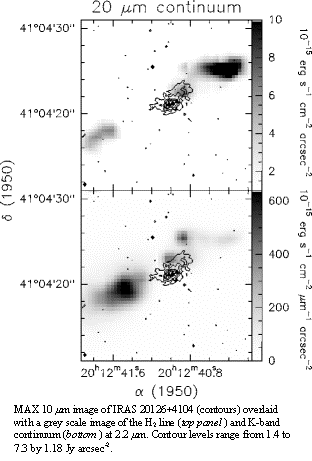 I
participated in an multi-wavelength research program lead by R. Cesaroni on the
source IRAS 20126+4104. We obtained line and continuum observations at 1.3 mm
and 3.5 mm with the Plateau de Bure interferometer, from 350μm to 2 mm
with the James Clerk Maxwell telescope, and at 10 and 20μm with MAX on
UKIRT. The results confirm that IRAS 20126+4104 is a very young stellar object
embedded in a dense, hot core and lying at the centre of a rotating disk. The
bipolar jet first imaged Cesaroni et al. (1997) in the 2.122μm H2
line is seen also in the SiO(2-1) transition, which allows to study the
velocity field in the jet. We developed a simple model to obtain the
inclination angle of the jet (and hence of the disk axis), which turns out to
be almost perpendicular to the line of sight. By studying the diameter of the
disk in different transitions and the corresponding line widths and peak
velocities, we demonstrated that the disk is Keplerian and collapsing, and
computed the mass of the central object and the accretion luminosity. We showed
that if all the mass inducing the Keplerian rotation is concentrated in a
single star, then this cannot be a ZAMS star, but more likely a massive
protostar which still derives most of its luminosity from accretion.
I
participated in an multi-wavelength research program lead by R. Cesaroni on the
source IRAS 20126+4104. We obtained line and continuum observations at 1.3 mm
and 3.5 mm with the Plateau de Bure interferometer, from 350μm to 2 mm
with the James Clerk Maxwell telescope, and at 10 and 20μm with MAX on
UKIRT. The results confirm that IRAS 20126+4104 is a very young stellar object
embedded in a dense, hot core and lying at the centre of a rotating disk. The
bipolar jet first imaged Cesaroni et al. (1997) in the 2.122μm H2
line is seen also in the SiO(2-1) transition, which allows to study the
velocity field in the jet. We developed a simple model to obtain the
inclination angle of the jet (and hence of the disk axis), which turns out to
be almost perpendicular to the line of sight. By studying the diameter of the
disk in different transitions and the corresponding line widths and peak
velocities, we demonstrated that the disk is Keplerian and collapsing, and
computed the mass of the central object and the accretion luminosity. We showed
that if all the mass inducing the Keplerian rotation is concentrated in a
single star, then this cannot be a ZAMS star, but more likely a massive
protostar which still derives most of its luminosity from accretion.
3. Research on Hot Luminous
Stars and LBVs
3.1) AG Carinae (Ref. 4)
I led a theoretical investigation of the past evolutionary history of the Luminous Blue Variable AG Carinae on the basis of the standard dynamical model for the interaction of a hot stellar outflow with a slower wind from an earlier evolutionary phase. We showed that a continuous mass loss is a most viable mechanism by which the star can produce the observed massive shell of ionized gas and dust. In particular we estimated a typical mass loss rate 1-4×10⁻⁴ M¤ yr-1 and a terminal wind velocity V in the range 20-40 km/s for the 'pre-LBV' phase. These values allow us to locate the AG Car precursor in the yellow-supergiant region of the HR diagram.
3.2) HR Carinae (Ref. 9)
In collaboration with a team lead by M. Clampin, I performed multicolor coronographic imaging and optical spectroscopy of the LBV HR Car. Our images revealed the presence, in both Hα and [NII] filters, of a filamentary nebula characterized by a bipolar, nearly point-symmetric structure, similar to some well-known planetary nebulae. The nebular filaments, which extend to 18˝ from the star, appear to originate from a central brighter compact structure which envelopes HR Car, ~8˝ size. From the emission line flux, we estimated the total mass of ionized gas in the nebula to be ~2.1 M¤. We also found evidence for the presence of intrinsic polarization from the change of polarization at the Hα emission line with respect to the continuum. This result implies that the distribution of the scattering material situated close to the star is not spherically symmetric, and indicates that the asymmetries on the small distance scale, as revealed by spectropolarimetric observations, agree with the large scale morphology, as revealed by coronographic imaging.
3.3) HD 168625 (Ref. 13)
T. Herbst and I
obtained the first images of the mid-IR emission 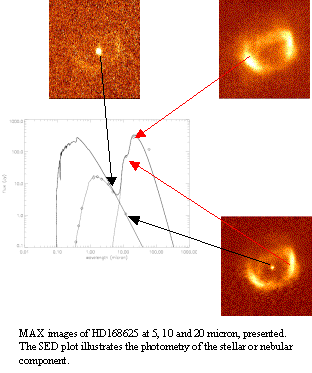 from
the nebula surrounding the Galactic luminous blue variable (LBV) HD 168625.
With MAX on UKIRT we obtained four images, centered at 4.7, 10.1, 11.6, and
19.9μm, plus a Br-γ image with IRCAM3. On the basis of the available
spectrophotometric data and of our photometry of the central star, we revised
the distance currently assumed for this source from 2.2 to 1.2 kpc. The dust
emission, which is optically thin and therefore sensitive to the mass
distribution, clearly indicates the bipolar structure of the nebula. The bulk
of the infrared (IR) flux comes from a geometrically thin layer of dust tracing
the outer edges of the nebular lobes. An inner shell or ring along the equatorial
plane is also detected. From the mid-IR spectral energy distribution we
constrained the composition and temperature of the grains. Through a simple
geometrical model we estimated the dust density and total mass in the shell.
Considering the structure of the nebula from an evolutionary point of view, we
investigated the formation mechanism (novalike ejection vs. interacting stellar
winds) and the recent past of the LBV precursor. We found that the interaction
of the present wind with a slower dusty wind (
from
the nebula surrounding the Galactic luminous blue variable (LBV) HD 168625.
With MAX on UKIRT we obtained four images, centered at 4.7, 10.1, 11.6, and
19.9μm, plus a Br-γ image with IRCAM3. On the basis of the available
spectrophotometric data and of our photometry of the central star, we revised
the distance currently assumed for this source from 2.2 to 1.2 kpc. The dust
emission, which is optically thin and therefore sensitive to the mass
distribution, clearly indicates the bipolar structure of the nebula. The bulk
of the infrared (IR) flux comes from a geometrically thin layer of dust tracing
the outer edges of the nebular lobes. An inner shell or ring along the equatorial
plane is also detected. From the mid-IR spectral energy distribution we
constrained the composition and temperature of the grains. Through a simple
geometrical model we estimated the dust density and total mass in the shell.
Considering the structure of the nebula from an evolutionary point of view, we
investigated the formation mechanism (novalike ejection vs. interacting stellar
winds) and the recent past of the LBV precursor. We found that the interaction
of the present wind with a slower dusty wind ( M¤ yr-1; v
 km s-1) ejected by the stellar precursor in a
previous phase is by far the most viable formation mechanism for the nebula
around HD 168625. Finally, we discussed the general occurrence of an evolution
to the red side of the HR diagram for the LBV precursors.
km s-1) ejected by the stellar precursor in a
previous phase is by far the most viable formation mechanism for the nebula
around HD 168625. Finally, we discussed the general occurrence of an evolution
to the red side of the HR diagram for the LBV precursors.
4. Research on Planetary
Nebulae
4.1) NGC7027 (Ref. 6)
With my collaborators, I performed narrow band, optical line imaging of the young planetary nebula NGC 7027 in sub-arcsecond seeing conditions at the Calar Alto 2.2m telescope. In all our filters, centered on the Hα-6563, Hβ-4861, [NII]-6583, and [OIII]5007 lines and in a 6670/80 Hα continuum band, the nebula shows a complex clumpy structure whereas the central star is well resolved in the continuum band. We obtained a very accurate map of the local extinction up to AV = 5 and estimated for the exciting source mV = 16.60 +/- 0.15, leading to Tstar approximately equal to 220,000 K and Lstar approximately equal to 4,700 solar luminosity. Correcting our images for extinction, the true annular structure of the planetary nebula was for the first time revealed at optical wavelengths. We could definitely confirm that the optical maximum corresponds to a 'hole' in the dust distribution. We tracked the ionization status of the nebula, finding evidence for a complex scenario.
LIST OF
PUBLICATIONS
Referred
journals
1)
A Search for Non
Stellar Contribution to the Optical and Near-IR Flux of RS CVn binaries. I. The
cases of TY Pyx, UV Psc, RU Cnc and VV Mon
M.Busso,
F.Scaltriti, P.Persi, M.Robberto, G.Silvestro, 1987.
Astronomy
Astrophysics, 183, 83.
2)
IRAS Sources
Associated with Nebulosities Resembling Herbig-Haro Objects
P.Persi,
M.Ferrari-Toniolo, M.Busso, M.Robberto, F.Scaltriti,
G.Silvestro,
1988.
The
Astronomical Journal, 95(4), 1167.
3)
A Search for
Young Stellar Objects in Southern Dark Clouds
P.Persi,
M.Ferrari-Toniolo, M.Busso, L.Origlia, M.Robberto,
F.Scaltriti,
G.Silvestro, 1989.
The Astron.
Journ., 99(1), 303.
4)
Evidence for a
yellow-supergiant phase for AG Carinae
M.Robberto, A.Ferrari, A.Nota, F.Paresce
Astronomy
Astrophysics, 269, 330 (1993)
5)
Evidence from infrared
observations of circumstellar matter around chromospherically active binaries
F.Scaltriti,
M.Busso, M.Ferrari-Toniolo, L.Origlia, P.Persi,
M.Robberto, G.Silvestro
Mon.Not.R.Astron.Soc.
264, 5 (1993)
6)
High-resolution
imaging of NGC 7027
M.Robberto, M.Clampin, S.Ligori, F.Paresce, H.J.Staude
Astronomy
Astrophysics 280, 241 (1993)
7)
TIRCAM: a
Mid-Infrared camera for ground-based astronomy
P.Persi,
M.Ferrari-Toniolo, A.R.Marenzi, M.Busso, L.Corcione,
A.Ferrari,
M.Gai, G.Nicolini, F.Racioppi, M.Robberto, G.Bonazzola,
K.Shivanandan,
G.Tofani
Experimental
Astronomy, 5, 363 (1994)
Erratum:
Experimental Astronomy, 6, 293 (1995)
8)
Coronographic
imaging of T Tauri: discovery of an optical jet in Burnham's nebula
M.Robberto, M.Clampin, S.Ligori, F.Paresce, V.Sacca`,
H.J.Staude
Astronomy
Astrophysics 296, 431 (1995)
9)
High resolution
coronographic imaging and spectropolarimetry of the HR Carinae nebula
M.Clampin,
R.E. Schulte-Ladbeck, A. Nota, M.Robberto, F.Paresce,
G.C.Clayton,
The Astronomical Journal, 110,251 (1995)
10)
Wind-Disk-Ambient
Cloud interactions in the Near Environment of T Tauri
T.M.Herbst, M.Robberto,
S.V.W.Beckwith
Astron.J.,
114, 744 (1997)
11)
The
Transitional Pre-Main-Sequence Object DI Tauri: Evidence for a Substellar Companion
and Rapid Disk Evolution
M.R.Meyer,
S.V.W.Beckwith, T.M.Herbst, M.Robberto
Ap.J.489,
L173 (1997)
12)
A New Molecular
Hydrogen Outflow in Serpens
T.M.Herbst,
S.V.W.Beckwith, M.Robberto
Ap.J.Lett.,
486, L59 (1997)
13)
Warm dust
around blue-hypergiants: mid-IR imaging of the LBV HD168625
M.Robberto. T.M.Herbst
Ap.J., 498,
400 (1998)
14)
An inversion
method for the restoration of chopped and nodded images
M.Bertero,
P.Boccacci and M.Robberto
Inverse
Problems, 15, 345 (1999)
15)
Unveiling the
disk-jet system in the massive (proto)star IRAS 20126+4104
R.Cesaroni,
M.Felli, T.Jennes, R.Neri, L.Olmi, M.Robberto, L.Testi
and
C.M.Walmsley
Astron.Astrophys,
345, 949 (1999)
16) Wide-Field Imaging at Mid-Infrared Wavelengths: Reconstruction of Chopped and Nodded Data
Bertero, M.; Boccacci, P.; Robberto, M.
The Publications of the Astronomical Society of the Pacific, 112, 1121 (2000)
17) The Infrared Emission of Circumstellar Envelopes, Dark Silhouettes, and Photoionized Disks in H II Regions
Robberto, M., Beckwith, S. V. W., Panagia, N.
ApJ, 578, 897 (2002)
18)
A Fourier-based method for the restoration of chopped
and nodded images
Bertero, M., Boccacci, P., Custo, A., De Mol, C., Robberto, M .
Astronomy & Astrophysics, 406, 765 (2003)
19) Low Mass Pre-Main Sequence Stars in the Large Magellanic Cloud – II: Accretion rates from HST-WFPC2 Observations
Romaniello, M., Robberto, M . , Panagia, N.
Astronomy & Astrophysics, submitted (2003)
20) High-Resolution Mid-Infrared Observations of the Giant Star Forming Region W51
S.Ligori, Robberto, M., Herbst, T. M.
Astronomy & Astrophysics, submitted (2003)
21) Inversion of second-difference operators with applications to infrared astronomy
Bertero, M., Boccacci, P., Robberto, M .
Inverse Problems, submitted (2003)
Invited reviews
22)
ISO-PHOT
Observations of Circumstellar Disks around Young-Stellar-Objects
M.Robberto, S.V.W.Beckwith, M.R.Meyer and A.Natta
Proc. of ESA Conf.
"The Universe as seen by ISO", P. Cox and M. F. Kessler Editors, ESA
SP-427, p. 195 (1999)
23) Understanding Star Formation with the NGST
Robberto, M.,
Beckwith, S. V. W.
The Institute of Space and Astronautical Science Report SP No. 14, p. 11-18
(2001)
24)
Infrared Astronomy with the Hubble Space Telescope and
the Next Generation Space Telescope
Robberto, M.
Memorie SAIt,
74, 230 (2003)
Books
25)
The design and Construction of Large Optical Telescopes
P. Y. Bely Ed., Springer, (2003)
[Main contributor for IR telescopes and instruments]
SPIE proceedings
26)
First results
with TC-MIRC (Two Channel Medium InfraRed Camera)
M.Robberto, M.Gai, M.D.Guarnieri, S.Ligori, S.Marta,
G.Nicolini,
L.Pellino,
F.Paresce, F.Racioppi
Proc. SPIE
Symposium "Instrumentation in Astronomy VIII",
D.L.Crawford,
E.R.Craine eds., SPIE Proc. Vol.2198, p. 446 (1994)
27)
Stellar
coronograph for the New Technology Telescope
M.Clampin,
F.Paresce, M.Robberto
Proc. SPIE
Symposium "Instrumentation in Astronomy VIII",
D.L.Crawford,
E.R.Craine eds., SPIE Proc. Vol.2198, p. 172 (1994)
28)
A transputer
network for real-time acquisition of IR astronomical data
M.Gai,
M.D.Guarnieri, M.Robberto, L.Pellino, F.Paresce
Proc. SPIE
Symposium "Instrumentation in Astronomy VIII",
D.L.Crawford,
E.R.Craine eds., SPIE Proc. Vol.2198, p. 962 (1994)
29)
MAX: the new
MPIA thermal infrared imager
M.Robberto and T.M.Herbst
Proc. of SPIE
Vol.3354 "Infrared Astronomical Instrumentation",
A.M.Fowler
ed., 711 (1998)
30)
An inversion
method for the restoration of chopped and nodded images
M.Bertero,
P.Boccacci and M.Robberto
Proc. of SPIE
Vol.3354 "Infrared Astronomical Instrumentation",
A.M.Fowler
ed., 877 (1998)
31) Wide Field Camera 3 for the Hubble Space Telescope
Cheng, E. S., Hill, R. J., MacKenty, J. W., Cawley, L., Knezek, P., Kutina, R. E., Lisse, C. M.; Lupie, O. L.; Robberto, M., Stiavelli, M. O'Connell, R. W., Balick, B., Bond, H., Calzetti, D., Carollo, M.; Disney, M., Dopita, M., Frogel, J., Hall, D. N., Hester, J., Holtzman, J., Luppino, G. A., McCarthy, P., Paresce, F., Saha, A., Silk, J., Trauger, J. T., Walker, A., Whitmore, B., Windhorst, R., Young, E. T.
Proc. SPIE Vol. 4013, 367(2000)
32) Performance of HST as an infrared telescope
Robberto, M., Sivaramakrishnan, A., Bacinski, J. J., Calzetti, D., Krist, J. E., MacKenty, J. W., Piquero, J.; Stiavelli, M.,
Proc. SPIE Vol. 4013, 386(2000)
33) Infrared Detectors for WFC3 on the Hubble Space Telescope
Robberto, M., Baggett, S. M., Hanley, C., Hilbert, B., MacKenty, J. W., Cheng, E. S., Hill, R. J., Johnson, S. D., Malumuth, E. M., Polidan, E., Waczynski, A., Wen, Y., Haas, A, Montroy, J. T., Piquette, E., Vural, K., Hall, D. N. B.
Proc. SPIE Vol. 4850, 121 (2002)
available at http://www.stsci.edu/instruments/wfc3/wfc3-docs.html
34) Selection of the Infrared Detectors for Wide Field Camera 3 on the Hubble Space Telescope
Robberto, M., Baggett, S. M., Hilbert, B., MacKenty, J. W., Stiavelli, M., Kimble, R. A., Hill, R. J.,Cottingham, D. A., Delo, G., Johnson, S. D., Landsmanm, E. M., Malumuth, E. M., Polidan, E., Russel, A. M., Waczynski, A., Wen, Y., Haas, A, Montroy, J. T., Piquette, E., Vural, K., Cabelli, C., Hall, D. N. B.
Proc. SPIE Vol. 5167-19 (2003)
Conference contributions: instrumentation
35)
The 10 μm
infrared camera TIRCAM
A.Ferrari,
E.Anderlucci, M.Busso, L.Corcione, G.Nicolini,
M.Robberto, F.Scaltriti, P.Persi, G.Farina,
M.Ferrari-Toniolo,
A.Preite-Martinez,
M.Ranieri, G.Tofani, S.Gennari, F.Lisi,
G.Marcucci,
P.Salinari, M.Sozzi, G.Bonazzola, D.Crosetto, M.Gai,
S.Monticelli,
G.Silvestro, K.Shivanandan, 1989.
Memorie
S.A.It - Vol.60 - N.1-2, p.247.
36)
TC-MIRC: a Two
Channel Medium IR Camera
M.Robberto, M.Gai, G.Bonazzola, L.Corcione, A.Ferrari,
S.Gennari,
G.Nicolini,
F.Paresce, F.Racioppi
Proc. ESO
Conference on "Progress in Telescope and Instrumentation
Technologies",
Garching, 27-30 April 1992. M.-H. Ulrich Ed., ESO
Conference
and Workshop Proceedings No.42, p.709 (1992)
37)
A Coronograph
for the NTT
M.Clampin,
F.Paresce, G.De Marchi, M.Robberto, A.Ferrari, S.Marta
Proc. ESO
Conference on "Progress in Telescope and Instrumentation
Technologies",
Garching, 27-30 April 1992. M.-H. Ulrich Ed., ESO
Conference and
Workshop Proceedings No.42, p.713 (1992)
38)
A stellar
coronograph for the NTT: first result and performance
M.Clampin, M.Robberto,
F.Paresce
in
"Circumstellar dust disk and planet formation", R.Ferlet and
A.Vidal-Madjar
eds., Edition Frontieres, p.351 (1994)
39)
Drift Scanning
Survey Spectrograph:L DS3
M.Gai,
M.G.Lattanzi, M.D.Guarnieri, M.Robberto, U.Munari,
Proceedings
of the 2nd Conference of the Working Group of IAU
Commission 9
on ``Wide-Field Spectroscopy",
Athens, 20-25
May, 1996, Kluwer Academic Publishers, pp. 121-122 (1996)
40)
Thermal IR
imaging with MAX: pushing the limits of single-dish
ground based
observations
M.Robberto, T.M.Herbst, S.V.W.Beckwith, C.Birk,
P.Bizenberger
Proc. ESO
Workshop on “Science with VLT”, F. Paresce ed.,
Springer-Verlag,
p. 391 (1997)
41)
Image
restoration in thermal infrared astronomy
M. Bertero,
P. Boccacci and M. Robberto, 1999,
Proc. Second
Workshop on "Large-Scale Scientific Computations", M.Griebel, S.
Margenov, and P. Yalamov eds., Notes on Numerical Fluid Mechanics, Vol. 73,
p.250 (1999)
Conference
contributions: science
42)
Mechanical
Energy Release by Protostars and Molecular Clouds
G.Silvestro
and M.Robberto, 1985.
Proc.
"Plasma Astrophysics", Varenna, ESA-SP 207, p.235.
43)
On the Line
Profile of Shell Shaped Bipolar Outflows
G.Silvestro
and M.Robberto, 1987.
Proc. IAU
Symposium Nr.122 "Circumstellar Matter", D. Reidel, p. 87.
44)
Near-IR
Observations of the SSV13, SSV9, SSV5 Sources in NGC 1333
M.Busso,
P.Persi, M.Robberto, F.Scaltriti, G.Silvestro, 1987.
Proc. IAU
Symposium Nr.122 "Circumstellar Matter", D. Reidel, p. 113.
45)
An Outflow
Model for Bipolar Planetary Nebulae and the Case of NGC 6302
G.Silvestro
and M.Robberto, 1987.
Proc.
Frascati Workshop "Planetary Nebulae", Reidel, p. 107.
46)
On VLBI
Observations of SN 1987A and a New Calibration of the Extragalactic Distance
Scale
G.Silvestro
and M.Robberto, 1987.
Proc.
"ESO Workshop on SN 1987A", Garching, p. 619.
47)
IRAS and near
IR observsations of active binaries
F.Scaltriti, M.Busso,
P.Persi, L. Origlia, M.Robberto, G.Silvestro, 1987.
Proc. 5th
Cambridge Workshop on Cool Stars, Stellar Systems and the Sun
Colorado
Univ., p.89, 1987
48)
On the
Instability Time-Scale of the Outflow Associated with the
HH 7-11 Chain
G.Silvestro,
M.Busso, P.Persi, M.Robberto, F. Scaltriti, 1987.
Proc.
"10th European Regional Meeting of the IAU", Prague, Vol.4,
p. 25.
49)
IRAS and
Near-Infrared Observations of Peculiar Nebulosities
P.Persi,
M.Busso, M.Ferrari-Toniolo, L.Origlia, M.Robberto,
F.Scaltriti,
G.Silvestro, 1988.
Proc. Second
Torino Workshop "Mass Outflows from Stars an Galactic
Nuclei",
Kluwer, p. 337.
50)
Evidence of
Thin Dust Shells in Some RS CVn stars
F.Scaltriti,
M.Busso, M.Robberto, P.Persi, G.Silvestro, 1988.
Proc. Second
Torino Workshop "Mass Outflows from Stars an Galactic
Nuclei",
Kluwer, p. 325.
51)
A Thin-Shell
Model for Molecular Outflows
M.Robberto and G.Silvestro, 1988.
Proc. Second
Torino Workshop "Mass Outflows from Stars an Galactic
Nuclei",
Kluwer, p. 321.
52)
Dust Envelopes and
IR Excesses in a Sample of RS CVn-Type Binaries
F.Scaltriti,
M.Busso, L.Origlia, M.Robberto, P.Persi, G.Silvestro,
1988.
Proc. IAU
Colloquium N.107 "Algols", Victoria (Canada) 15-19
August 1988,
Ed. A.H.Batten, Kluwer Academic Publishers, P.362
(1989).
53)
A Search for
Young Stellar Objects in Southern Dark Clouds
P.Persi,
M.Ferrari-Toniolo, M.Busso, L.Origlia, M.Robberto,
F.Scaltriti,
G.Silvestro, 1989.
Proc. 3rd
National Conference “Infrared Astronomy”, Gallipoli,
19-22
September 1989.
Memorie S.A.It.
- Vol.61 - N.1, p.67 (1990)
54)
On the Origin
of Circumstellar Shell around RS CVn-type Bynaries
M.Busso,
F.Scaltriti, M.Ferrari-Toniolo, L.Origlia, P.Persi,
M.Robberto, G.Silvestro, 1990.
Proc. 3rd
National Conference "Infrared Astronomy", Gallipoli,
19-22
September 1989.
Memorie
S.A.It. - Vol.61 - N.1, p.77 (1990)
55)
CCD Images of
nebular Sources in star forming regions
L.Origlia,
M.Busso, M.Ferrari-Toniolo, P.Persi, M.Robberto,
F.Scaltriti,
G.Silvestro, 1990.
Proc. 3rd
National Conference "Infrared Astronomy", Gallipoli,
19-22
September 1989.
Memorie
S.A.It. - Vol.61 - N.1, p.95 (1990)
56)
Polarimetry and
CCD Imaging of Herbig Ae/Be stars and Star Forming Regions
F.Scaltriti,
V.Piirola, M.Robberto, M.Busso, 1990.
Proc. NATO
Advanced Research Workshop "Angular Momentum Evolution
of Young
stars", Noto (Italy), 17-21 September 1990. S.Catalano and
J.R.Stauffer
Eds., Kluwer Academic Publishers, p.109 (1991)
57)
Nebular line
imaging of NGC 7027
M.Robberto
Memorie
S.A.It. - Vol.64 - N.3, p.698 (1993)
58)
High Resolution
Coronographic Imaging and Echelle Observations of S119: a new Luminous Blue
Variable?
A.Nota,
L.Drissen, M.Clampin, C.Leitherer, A.Pasquali, C.Robert,
F.Paresce, M.Robberto
Proc. 34th
Herstmonceux Conference "Circumstellar Media in Late
stages of
stellar evolution", Cleigg, Meikle and Stevens Eds.,
Cambridge
University Press, p. 89 (1994)
59)
Multi-color
observations of the beta-Pictoris circumstellar disk
M.Clampin, M.Robberto,
F.Paresce, A.Maccioni
in
"Circumstellar dust disk and planet formation", R.Ferlet and
A.Vidal-Madjar
eds., Edition Frontieres, p.67 (1994)
60)
A search for a
circumstellar disk around 68 Ophiuchi
S.Ligori,
M.Clampin, F.Paresce, M.Robberto, H.J.Staude
in
"Circumstellar dust disk and planet formation", R.Ferlet and
A.Vidal-Madjar
eds., Edition Frontieres, p.377 (1994)
61)
Near infrared
imaging of the southern HII region RCW38
S.Ligori,
A.Moneti, M.Robberto, M.D.Guarnieri, H.Zinneker
Memorie della
Societa` Astronomica Italiana, 65, 815 (1994)
62)
Multi-color coronographic
imaging of the Beta Pictoris disk
M.Clampin,
F.Paresce, M.Robberto, A.Maccioni
Astrophys.Space.Sci.
Vol.224, No.1-2, p.399 (1995)
63)
Optical
coronography at Calar Alto: discovery of a jet from T Tauri
M.Robberto, M.Clampin, S.Ligori, F.Paresce, V.Sacca`,
H.J.Staude
in "Disk
and outflows around young stars", S. Beckwith,
J. Staude, A.
Quetz and A. Natta eds, p.637 (1996)
64)
Line imaging of
NGC 7026
M.Robberto, S.Ligori, M.Stanghellini, D.Thompson
Proc. IAU
Symp. 160 "Planetary Nebulae",
H. J. Habing and
H. J. G. L.
M. Lamers eds., Kluwer Academic Pub., p.275 (1997)
65)
A new molecular
hydrogen outflow in Serpens
T.M.Herbst,
S.V.W.Beckwith, M.Robberto
Proc. IAU
Symp. 182 "Low Mass Star Formation from Infall to Outflow",
p.135 (1997)
66)
Molecular and
Atomic Shocks in the Near Environment of T Tauri
T.M.Herbst, M.Robberto,
S.V.W.Beckwith
Proc. IAU
Symp. 182 "Low Mass Star Formation from Infall to Outflow",
p.135 (1997)
67)
Circumstellar
Disks in Orion: First Results from a Mid-IR survey
M. Robberto, S. V. W. Beckwith, Herbst, T. M.
Star Formation 1999, Proceedings of Star Formation 1999, Editor: T. Nakamoto, Nobeyama Radio Observatory, p. 231(1999)
68)
Mid-IR Images
of W51
S. Ligori, M.
Robberto, T. M. Herbst
Star Formation 1999, Proceedings of Star Formation 1999, Editor: T. Nakamoto, Nobeyama Radio Observatory, p. 377(1999)
69) Mid-IR emission of Circumstellar Disks in the Orion Nebula
Robberto, M., Beckwith, Panagia, N. , Herbst, T. M., Ligori, S., Bertero, M., Boccacci, P., Custo, A.
The Origin of Stars and Planets: the VLT view, ESO Astrophysics Symposia, J.F. Alves and M. J. McCaughrean Eds., Springer, on CD-ROM (2002)
70) Thermal IR imaging of W51-IRS2
Ligori, S., Herbst, T. M., Robberto, M.,
Hot Star Workshop III: The Earliest Stages of Massive Star Birth. ASP Conference Proceedings, Vol. 267. Edited by Paul A. Crowther, p.383 (2002)
71) Mid-IR Imaging of the BN/KL Region
Robberto, M., Beckwith, S. V. W., Ligori, S., Herbst, T. M., Custo, A., Boccacci, P., Bertero, M.
Proc. Ionized Gaseous Nebulae, a Conference to Celebrate
the 60th Birthdays of Silvia Torres-Peimbert and Manuel Peimbert, Mexico City,
November 21-24, 2000 (Eds. W. J. Henney, J. Franco, M. Martos, & M. Peña)
Revista Mexicana de Astronomía y Astrofísica, Vol. 12, pp. 40-40 (2002)
72) The Orion Nebula Cluster at Mid-IR Wavelengths
Robberto, M.,
Proc. Modes of Star Formation and the Origin of Field Populations, ASP Conference Proceedings, Edited by Eva K. Grebel and Walfgang Brandner., Vol. 285., 68 (2002)
Space Telescope Science Institute Internal Reports
73)
WFC3 Near
IR-Channel: PSF and Plate Scale Study
M. Stiavelli,
C. Hanley and M. Robberto,
Instrument
Science Report WFC3 1999-01, Space Telescope Science Institute (1999)
74)
The NICMOS
Exposure Time Calculator: Algorithms and User Interface
A.
Sivaramakrishnan, S. Jolfeltz, M. Sosey, B. Simon, M. Robberto,
Instrument
Science Report NICMOS 2000-01, Space Telescope Science Institute (1999)
75)
First Results from the New HgCdTe MBE Detectors for
WFC3 - IR Channel
M. Robberto, L. Cawley, C. M. Lisse, and B. Hill
Instrument Science Report WFC3 2000-04,
Space Telescope Science Institute (2000)
76)
Encircled Energy Measurements for the M10 WFC3 1R-MUX
Pinhole Images - Set 1
C. Hanley, M. Robberto
Instrument Science Report WFC3
2001-11, Space Telescope Science Institute (2001)
77)
Encircled Energy Measurements for the M10 WFC3 1R-MUX
Pinhole Images - Set 2
C. Hanley, M. Robberto
Instrument Science Report WFC3 2001-14,
Space Telescope Science Institute (2001)
78)
Performance of the HI-101 IR Detector Measured Using
the MPIA System
I.Dashevsky, M. Robberto
Instrument Science Report WFC3 2001-15,
Space Telescope Science Institute (2001)
79)
Optimization of the WFC3 Cold Stop Mask
M. Giavalisco, M. Stiavelli, and M. Robberto
Instrument Science Report WFC3 2001-16,
Space Telescope Science Institute (2001)
80) IR Data Pipeline Using
Fowler Sampling
I. Dashevsky, C. Hanley, M. Robberto
Instrument Science Report WFC3 2001-19,
Space Telescope Science Institute (2001)
81)
The WFC3 Exposure Time Calculators: Functionality and
Operations
C. Hanley, C. Lisse, P. Knezek, Olivia Lupie, Massimo Robberto, and
Jenica Nelan
Instrument Science Report WFC3 2000-02,
Space Telescope Science Institute (2002)
82)
The reference pixels on the WFC3 IR detectors
M. Robberto, C. Hanley, I. Dashevsky
Instrument Science Report WFC3 2002-06,
Space Telescope Science Institute (2002)
83) Masking Technique on
WFC3-IR Images
B. Hilbert, S. Baggett, M. Robberto
Instrument Science Report WFC3 2003-06,
Space Telescope Science Institute (2003)
84) Performance of the
WFC3-IR channel with FPA#64
M. Stiavelli and M. Robberto
Instrument Science Report WFC3 2003-05,
Space Telescope Science Institute (2003)
AAS Meeting Abstracts
85)
New
observations of Beta Pictoris circumstellar disk with the NTT coronograph
M.Clampin,
F.Paresce, M.Robberto
Bull.Am.Ast.Soc.,
Vol.25, No.2, p.903 (1993)
86)
S119: a new
luminous blue variable?
A.Nota, C.Leitherer,
M.Clampin, L.Drissen, A.Pasquali, C.Robert,
F.Paresce, M.Robberto
Bull.Am.Ast.Soc.,
Vol.25, No.2, p.909 (1993)
87) HST/WFPC2 image of the Orion Nebula in the U and B bands
Robberto, M., Beckwith, S. V. W., Makidon, R. B., Panagia, N.
American Astronomical Society Meeting 198, #48.12 (2001)
88)
Testing of
HgCdTe Devices For WFC3
Hill, R.J.,
Waczynski, A., Polidan, E.J., Krebs, D.J., Robberto, M.,
Johnson,
S.D.,
BAAS Vol. 31,
No. 5, 1512 (2000)
89) HST Wide Field Camera 3 Progress Report
MacKenty, J. W., Cheng, E., Hill, R., Cawley, L., Hanley, C., Henry, R. L., Knezek, P., Lisse, C., Lupie, O., Robberto, M., Stiavelli, M.
American Astronomical Society Meeting 196, #32.08 (2000)
90)
Detailed Performance of IR Detectors for WFC3
Hill, R.J., Waczynski,
A., Wen, Y., Johnson, S.D., Polidan, Malumuth, E.,
Robberto,
M.
AAS 202, 401R
(2003)
91)
Performance of the FC3-IR flight detectors
Robberto, M., Baggett, S. M., Hilbert, B. N., MacKenty,
J.W., Stiavelli, M., Hill, R.J., Waczynski, A., Wen, Y., Johnson, S.D.,
Polidan, Malumuth, E., Kimble, R. A.
AAS 202, 403R
(2003)
92)
First results from an HST study of the Mass Accretion
Rates in the Trapezium Cluster
Song, J., Robberto, M., Beckwith, S. V. W., Makidon, R. B., Panagia, N.
AAS 202, 2804S (2003)
Other
93)
Osservazioni
astronomiche nell'infrarosso termico: il progetto TIRCAM
M.Robberto, Tesi di Dottorato,
Universita`
di Torino (1989)