Highlight on recent research:
Derivation of the Stellar Formation History of the Milky Way from White Dwarfs
It is possible to learn about the stellar formation history (SFH) in the disk
of the Milky Way from volume complete samples of stars, hence obtain insights on
how our Galaxy formed and evolved. Various studies have been aimed at
identifying the SFH from stars, but often with conflicting results. Different
approaches were employed [1], such as using the stellar activity in low-mass
stars as an indicator of age, relying on empirical age versus metallicity
relations, and applying statistical methods to HR diagrams (magnitude vs.
color). It is difficult to determine the age of local Sun-like stars with any
method because their outside layers do not change significantly with time. We
have relied instead on white dwarfs as precise cosmic clocks. These former stars
slowly cool with time, and their atmospheric temperature is a direct measure of
their cooling age.
We rely on the 20 pc sample of 117 white dwarfs [2], which is estimated to be
80-90% complete. The significant advantage of this sample is that the remnants
have precise distances, masses, and cooling ages. This allows for a direct
conversion of the remnant parameters to initial stellar parameters (see Figure
1), employing the well studied initial-final mass relation calibrated from
clusters and binaries [3].
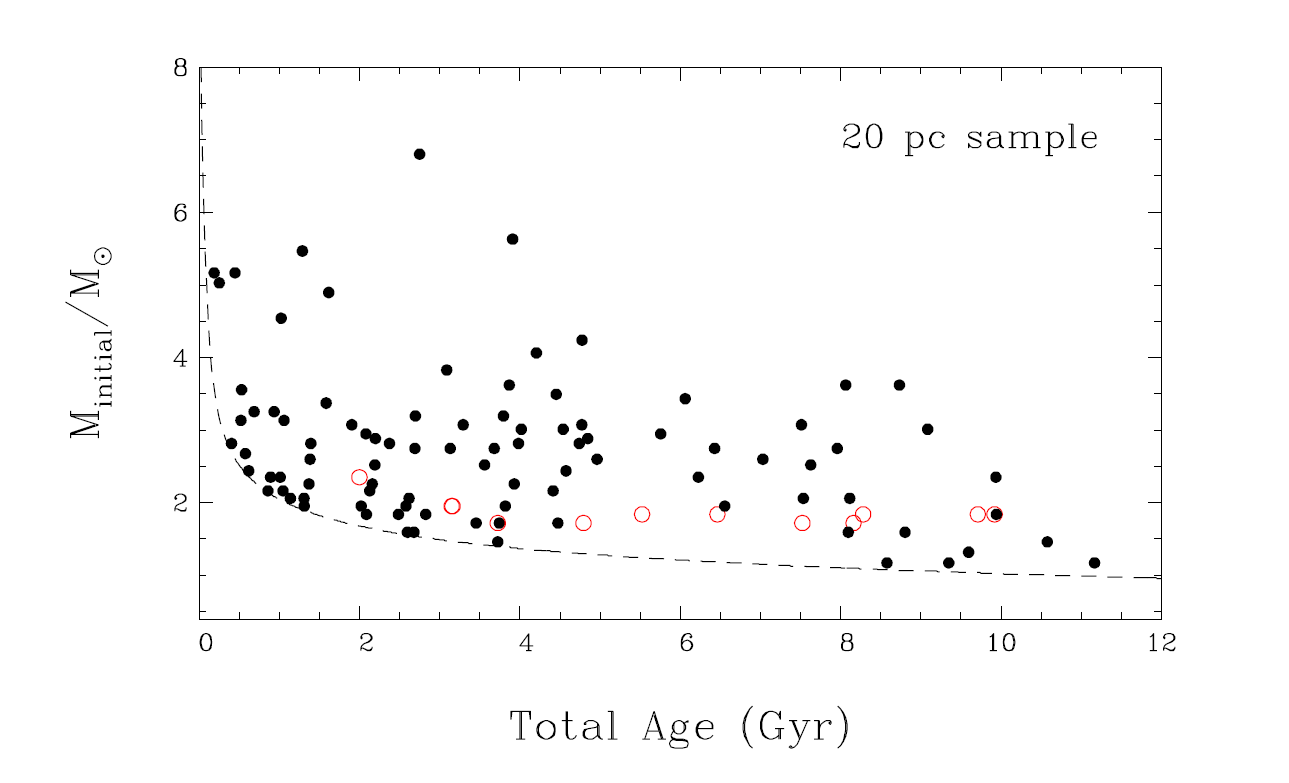
Figure 1. Initial mass of the stars (in solar mass units) that are currently
white dwarfs in the local 20 pc sample of [2] as a function of the time since
formation. The dashed curve identifies the total main-sequence lifetime, hence
below which white dwarfs have not yet formed. The remnants with a fixed log g =
8 value due to incomplete observations are identified with open circles.
Figure 2 presents the number of white dwarfs in 1 Gyr age bins (red). We also
display our best SFH estimate considering the sum of two observational biases
(black histogram). To begin, the total SFH is the sum of objects that are at
present day white dwarfs, stars, and in much smaller number giants. Figure 1
would be populated with H-burning stars below the dashed line, although these
objects are excluded from our sample, and we have corrected for this effect
assuming a Salpeter initial mass function. The second bias comes from the fact
that old stars have larger velocities in the vertical Galactic coordinate, and
have a smaller probability to cross the solar neighborhood at present day. We
correct for this bias with the observed dispersion of the vertical component of
the velocity of stars in Galactic coordinates UVW as a function of age [4].
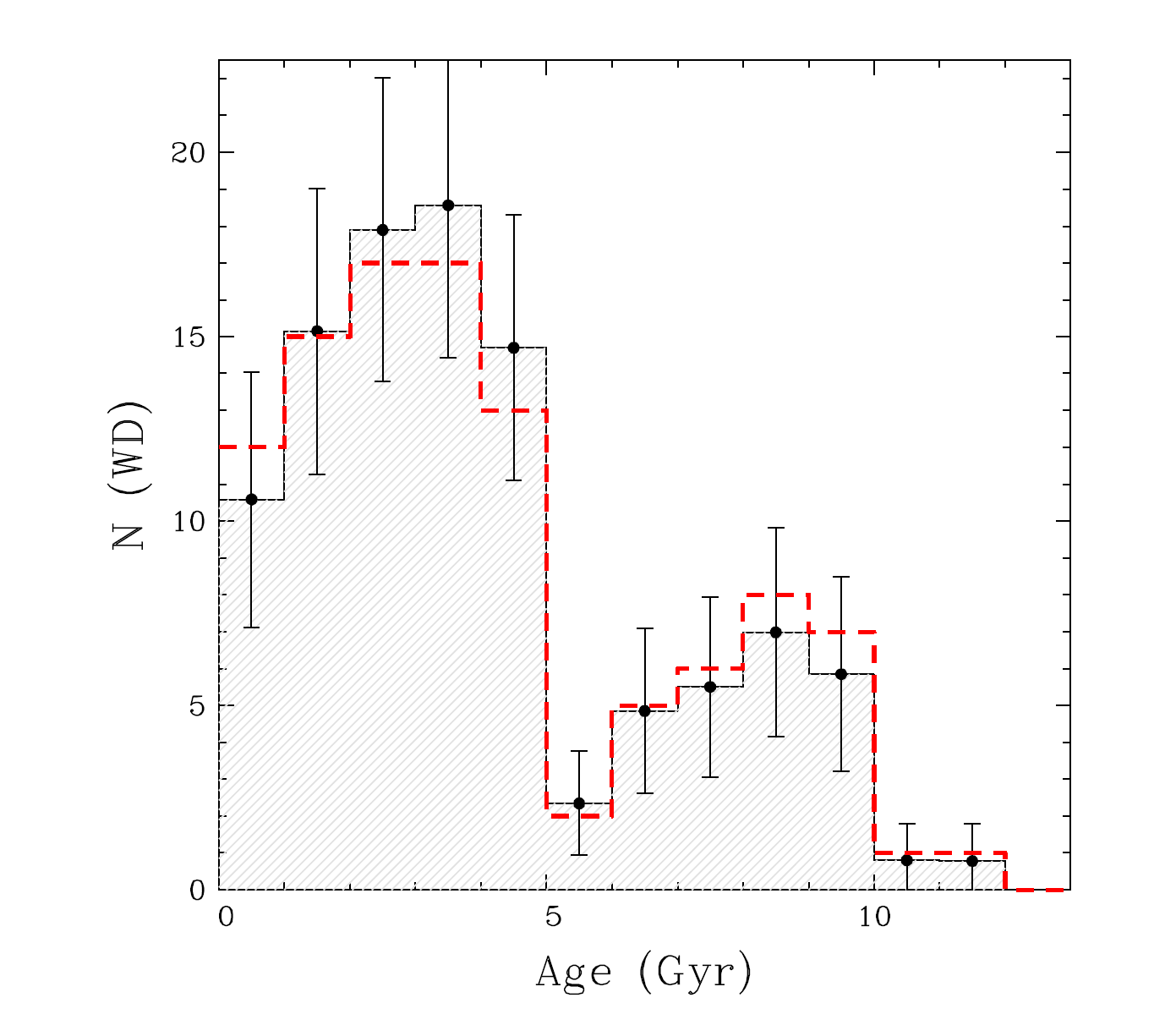
Figure 2. Our derived stellar formation history for the Galactic disk in 1 Gyr
total age bins (black histogram), taking into account the biases due to the
missing main-sequence stars and the velocity dispersion in the Galactic
coordinate W. The error bars take into account number statistics uncertainties.
The red dashed curve shows the raw uncorrected number of white dwarfs with the
data from Figure 1. Both distributions have been normalized for the same total
number of stars.
The two-step feature of the SFH, with an enhanced formation rate in the last
5 Gyr compared to the range 5 < Age (Gyr) < 10, is a significant detection for
the 20 pc sample, which is unlikely to be compromised by biases. We believe that
white dwarfs may be the most powerful cosmic clocks to derive the SFH at
intermediate and large lookback times. For stars formed in the last ~2 Gyr, very
few of them became white dwarfs hence it is difficult to recover a precise
history. The largest limitation of the current analysis is the small size of the
20 pc white dwarf sample and Gaia will soon improve this situation.
[1] Soderblom, D. R. 2010, ARA&A, 48, 581
[2] Giammichele, N., Bergeron, P., & Dufour, P. 2012, ApJS, 199, 29
[3] Kalirai, J. S., Hansen, B. M. S., Kelson, D. D., et al. 2008, ApJ, 676, 594
[4] Seabroke, G. M., & Gilmore, G. 2007, MNRAS, 380, 1348