


Mauro Giavalisco
Observatories of the Carnegie Institution of Washington, 813 Santa
Barbara Street, Pasadena, CA 91101
Charles C. Steidel
Palomar Observatory, California Institute of Technology, Mail
Stop 105-24, Pasadena, CA 91125
Max Pettini
Royal Greenwich Observatory, Madingley Road, Cambridge, CB3 0EZ, UK
Mark Dickinson
Space Telescope Science Institute, 3700 San Martin Dr. Baltimore, MD
21218
Kurt Adelberger
Palomar Observatory, California Institute of Technology, Mail
Stop 105-24, Pasadena, CA 91125
F. Duccio Macchetto
Space Telescope Science Institute, 3700 San Martin Dr. Baltimore, MD
21218
Based on observations obtained at the W. M. Keck Observatory,
which is operated jointly by the California Institute of Technology and the
University of California. Based also on observations with the NASA/ESA Hubble Space
Telescope obtained at the Space Telescope Science Institute which is operated
by AURA under NASA contract NAS 5-26555.
Hubble Fellow.
Alfred P. Sloan Foundation Fellow.
NSF Young Investigator.
Affiliated with the Space Science Department, ESA.
 , designed to be sensitive
to the presence of a Lyman discontinuity in an otherwise very blue far-UV
continuum in galaxies at
, designed to be sensitive
to the presence of a Lyman discontinuity in an otherwise very blue far-UV
continuum in galaxies at  . The candidate
galaxies with
. The candidate
galaxies with  have been spectroscopically followed-up using
the Keck 10-m telescope and their redshifts have been confirmed at z>3. The
optical (rest-frame UV) photometry shows star-formation rates in the range
4--
have been spectroscopically followed-up using
the Keck 10-m telescope and their redshifts have been confirmed at z>3. The
optical (rest-frame UV) photometry shows star-formation rates in the range
4-- (12--
(12-- ) M
) M yr
yr if
if  (0.05), while the
K-band one (rest-frame V) shows that these galaxies are very young,
probably observed
(0.05), while the
K-band one (rest-frame V) shows that these galaxies are very young,
probably observed  yr after the onset of star-formation. Deep
HST imaging shows that the morphologies of the z>3 galaxies are very
compact with typical half-light radii
yr after the onset of star-formation. Deep
HST imaging shows that the morphologies of the z>3 galaxies are very
compact with typical half-light radii  --
-- arcsec, or
 --
-- (
( --
-- ) kpc at
  if
if  (0.05),
indicating that the largest fraction of the star-formation takes place in regions
comparable in size to the present-day bulges of spirals or cores of
ellipticals. The space density, star-formation rates, mass, morphologies and
physical sizes all suggest that we have finally identified the parent
population of the present-day normal bright galaxies during a phase of intense
star formation.
(0.05),
indicating that the largest fraction of the star-formation takes place in regions
comparable in size to the present-day bulges of spirals or cores of
ellipticals. The space density, star-formation rates, mass, morphologies and
physical sizes all suggest that we have finally identified the parent
population of the present-day normal bright galaxies during a phase of intense
star formation.
Despite large observational efforts, the early evolutionary phases of the
normal galaxies, i.e., the present-day bright elliptical and spirals that
define the Hubble sequence, remain largely unconstrained from an empirical
perspective. In the last few years, a number of deep redshift surveys (Lilly et
al. 1995a,1995b, Steidel et al. 1995, Glazebrook et al. 1995a, Cowie et
al. 1994, Cowie, Hu & Songaila 1995a) and deep post-refurbishment HST
imaging (Driver et al. 1995a,1995b, Glazebrook et al. 1995b, Schade et
al. 1995, Cowie Hu & Songaila 1995b) have extensively probed the
evolutionary state of galaxies at  or
or  (60)% of the
life of the Universe if
(60)% of the
life of the Universe if  km s
km s Mpc
Mpc and
and  (
( ). These works
find that the later and less bright types of the luminosity function underwent
a significant amount of evolution in number density and/or luminosity
(star-formation rate) over the probed cosmic epochs, while during the same
time span the bright and more massive galaxies have remained substantially
unchanged.
). These works
find that the later and less bright types of the luminosity function underwent
a significant amount of evolution in number density and/or luminosity
(star-formation rate) over the probed cosmic epochs, while during the same
time span the bright and more massive galaxies have remained substantially
unchanged.

Figure: The idea behind the  photometric system. The
transmittance curves of the filters are superimposed on the synthetic
spectrum of an unreddened star-forming galaxy (Bruzual & Charlot 1993)
redshifted at
photometric system. The
transmittance curves of the filters are superimposed on the synthetic
spectrum of an unreddened star-forming galaxy (Bruzual & Charlot 1993)
redshifted at  . The spectrum of Q2233+1310 is also plotted.
Several years ago we started a program to probe the evolutionary status of
normal galaxies at redshifts z>3. To detect galaxies at similar distances, we
adopted a custom photometric system, named  , designed to reach
very faint flux levels and provide accurate color photometry.
As Figure 1 shows, the technique
relies on the presence of the 912Å Lyman discontinuity, both the one
intrinsic to the atmospheres of massive hot stars and that contributed by the
intervening galaxian and extragalactic neutral hydrogen, in the otherwise
very blue and flat (in
, designed to reach
very faint flux levels and provide accurate color photometry.
As Figure 1 shows, the technique
relies on the presence of the 912Å Lyman discontinuity, both the one
intrinsic to the atmospheres of massive hot stars and that contributed by the
intervening galaxian and extragalactic neutral hydrogen, in the otherwise
very blue and flat (in  units) rest-frame UV spectral energy
distribution of relatively unreddened star formation (Steidel & Hamilton
1992,1993, Steidel, Pettini & Hamilton 1995). In practice, z>3 galaxy
candidates are selected from a color-color plane by having very red
units) rest-frame UV spectral energy
distribution of relatively unreddened star formation (Steidel & Hamilton
1992,1993, Steidel, Pettini & Hamilton 1995). In practice, z>3 galaxy
candidates are selected from a color-color plane by having very red  colors (they must actually be undetected in
  , as this passband is always
entirely blueward of the Lyman discontinuity) and blue
, as this passband is always
entirely blueward of the Lyman discontinuity) and blue  colors.
The spectroscopic confirmation of a (radio quiet) Lyman  emitter at
  (Macchetto et al. 1993, Giavalisco, Macchetto & Sparks 1994) which was also
a
(Macchetto et al. 1993, Giavalisco, Macchetto & Sparks 1994) which was also
a  z>3 candidate (Steidel & Hamilton 1993), provided
empirical support of the validity of the adopted color criterion in isolating
z>3 star-forming galaxies. Since then, with the
z>3 candidate (Steidel & Hamilton 1993), provided
empirical support of the validity of the adopted color criterion in isolating
z>3 star-forming galaxies. Since then, with the  system we observed a number of fields both around QSOs with known
optically-thick absorption systems (known to be caused by normal, massive
galaxies, see Steidel, Dickinson & Persson 1995), so that their
identification could guide the search for further examples of bright
galaxies at high redshifts, and general sky fields, building a sample of
system we observed a number of fields both around QSOs with known
optically-thick absorption systems (known to be caused by normal, massive
galaxies, see Steidel, Dickinson & Persson 1995), so that their
identification could guide the search for further examples of bright
galaxies at high redshifts, and general sky fields, building a sample of
 z>3 galaxy candidates. We also embarked on a systematic program
of HST imaging of the z>3 candidates to study their morphological
properties, finding that they are consistent with what expected from bright
galaxies observed during an epoch of relatively intense star-formation
activity (Giavalisco et al. 1995, Giavalisco, Steidel & Macchetto 1996).
We have studied the spatial distribution of these
candidates (Giavalisco, Steidel & Szalay 1994), finding that, similar to
bright galaxies at the present cosmological epochs, they are characterized by
relatively strong clustering. Finally, we embarked on a systematic program of
HST imaging of the z>3 candidates to study their morphological
properties, and showed that they are consistent with what expected from bright
galaxies observed during an epoch of relatively intense star-formation
activity (Giavalisco et al. 1995, Giavalisco, Steidel & Macchetto 1996).
z>3 galaxy candidates. We also embarked on a systematic program
of HST imaging of the z>3 candidates to study their morphological
properties, finding that they are consistent with what expected from bright
galaxies observed during an epoch of relatively intense star-formation
activity (Giavalisco et al. 1995, Giavalisco, Steidel & Macchetto 1996).
We have studied the spatial distribution of these
candidates (Giavalisco, Steidel & Szalay 1994), finding that, similar to
bright galaxies at the present cosmological epochs, they are characterized by
relatively strong clustering. Finally, we embarked on a systematic program of
HST imaging of the z>3 candidates to study their morphological
properties, and showed that they are consistent with what expected from bright
galaxies observed during an epoch of relatively intense star-formation
activity (Giavalisco et al. 1995, Giavalisco, Steidel & Macchetto 1996).
In October 1995 we followed-up suitable z>3 galaxy candidates from our list
with the W. M. Keck 10-meter telescope and the LRIS spectrograph and confirmed
that they are indeed high-redshift star-forming, but otherwise normal galaxies
(Steidel et al. 1996). Using multi-slit masks we obtained
spectra for 30 candidates in three fields, 25 of which were
``robust'' in the definition of Steidel et al. (1995), and the remaining five
were ``marginal'' candidates, added to explore the parameter space and test
the limits of the color selection criterion. Of the 25 robust candidates, 17
were proved to be in the redshift range  , corresponding to
an efficiency of 70% in finding high-redshift galaxies. Among the
remaining candidates, three turned out to be QSOs in the redshift range
, corresponding to
an efficiency of 70% in finding high-redshift galaxies. Among the
remaining candidates, three turned out to be QSOs in the redshift range 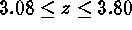 (photometrically similar to star-forming galaxies), which
brings the efficiency of the method of finding high-redshift objects to
80%, and five were inconclusive because of insufficient S/N. Of the five
``marginal'' candidates, one turned out to be a galaxy at
(photometrically similar to star-forming galaxies), which
brings the efficiency of the method of finding high-redshift objects to
80%, and five were inconclusive because of insufficient S/N. Of the five
``marginal'' candidates, one turned out to be a galaxy at  , three
were subdwarf stars, and one was inconclusive. It is important to note that
all the inconclusive spectra are still consistent with being galaxies
at
, three
were subdwarf stars, and one was inconclusive. It is important to note that
all the inconclusive spectra are still consistent with being galaxies
at  , and no one of them shows any feature, such as a
possible [OII]
, and no one of them shows any feature, such as a
possible [OII] line emission, indicative of an interloper with
redshift significantly lower than the targeted regime. Very likely, the
efficiency of the color criterion in finding galaxies at z>3 is as high as
90%.
line emission, indicative of an interloper with
redshift significantly lower than the targeted regime. Very likely, the
efficiency of the color criterion in finding galaxies at z>3 is as high as
90%.
Figure 1 shows examples of the Keck spectra of z>3 galaxies, chosen to
illustrate the variety of features encountered. In each case we have included
for comparison a recent HST spectrum of the central starburst region in the
Wolf-Rayet galaxy NGC 4214 (Leitherer et al. 1996).
The similarity between the high-redshift galaxies and local
examples of starbursts is striking. In each case the dominant characteristics
of the far-UV spectrum are:
(i) a flat continuum;
(ii) weak or absent Lyman  emission;
(iii) prominent high-ionization stellar lines of He II, C IV, Si IV and
N V;
and (iv) strong interstellar absorption lines due to low-ionization
stages of C, O, Si and Al.
The continuum specific luminosity at 1500Å of a typical
z >3 galaxy in our sample is
emission;
(iii) prominent high-ionization stellar lines of He II, C IV, Si IV and
N V;
and (iv) strong interstellar absorption lines due to low-ionization
stages of C, O, Si and Al.
The continuum specific luminosity at 1500Å of a typical
z >3 galaxy in our sample is
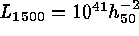 erg s
erg s Å
Å (for
(for  ; 3 times greater for
  );
this is
);
this is  --1500 times higher (depending on the value of
  )
than the knot of star formation in NGC 4214 observed by
Leitherer et al. (1996) and
)
than the knot of star formation in NGC 4214 observed by
Leitherer et al. (1996) and  --100 times higher than the
brightest such knots seen in nearby starburst galaxies.
Thus, for a `normal' IMF, the
far--UV continuum we see in the z > 3 objects is produced by the
equivalent of
--100 times higher than the
brightest such knots seen in nearby starburst galaxies.
Thus, for a `normal' IMF, the
far--UV continuum we see in the z > 3 objects is produced by the
equivalent of  --
-- O5 stars.
Modulo the uncertainties in models of young galaxies (see, e.g., Charlot
1996), we estimate that the maximum reddening allowed by the
observed  colors, in the range
  --
-- , after
accounting for the blanketing of the G band by the Lyman
, after
accounting for the blanketing of the G band by the Lyman  forest
(see Madau 1995 and Steidel et al. 1995),
is
forest
(see Madau 1995 and Steidel et al. 1995),
is  magnitudes. Taking this as an upper limit,
and using the ``extragalactic'' reddening curve of Calzetti et al. (1994), the
extinction at observed
magnitudes. Taking this as an upper limit,
and using the ``extragalactic'' reddening curve of Calzetti et al. (1994), the
extinction at observed  (rest
(rest  Å) would be
  magnitudes, or a factor of < 5. The corresponding optical reddening in the
rest-frame of the galaxies would be
magnitudes, or a factor of < 5. The corresponding optical reddening in the
rest-frame of the galaxies would be 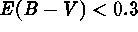 magnitudes.
Interestingly, despite the apparent lack of a large amount of dust, the Lyman  emission is always much weaker (usually by factors of more than 10)
than the ionization--bound, dust--free expectations, given the production of
ionizing photons by massive stars which we measure directly from the UV continuum.
Reasons for the preferential extinction of Lyman
emission is always much weaker (usually by factors of more than 10)
than the ionization--bound, dust--free expectations, given the production of
ionizing photons by massive stars which we measure directly from the UV continuum.
Reasons for the preferential extinction of Lyman  emission have been
discussed by, e.g., Charlot & Fall (1993) and Chen & Neufeld (1994). Our
observations are entirely consistent with the same low (but non--zero) dust
content inferred to be present in the high redshift damped Lyman
emission have been
discussed by, e.g., Charlot & Fall (1993) and Chen & Neufeld (1994). Our
observations are entirely consistent with the same low (but non--zero) dust
content inferred to be present in the high redshift damped Lyman  absorption systems (e.g., Pei et al. 1991, Pettini et al. 1994). In galaxies where the
Lyman
absorption systems (e.g., Pei et al. 1991, Pettini et al. 1994). In galaxies where the
Lyman  line is observed in emission, the typical rest--frame equivalent width is
 --20Å, but apparently most z>3 galaxies have Lyman
  \
emission lines weaker than these values, in striking similarity to nearby
star--forming galaxies (e.g., Giavalisco, Koratkar, & Calzetti 1996). For
example, C23 0000-263 in Figure 2 has among the largest implied star formation
rates in our sample, and yet has no measurable Lyman
\
emission lines weaker than these values, in striking similarity to nearby
star--forming galaxies (e.g., Giavalisco, Koratkar, & Calzetti 1996). For
example, C23 0000-263 in Figure 2 has among the largest implied star formation
rates in our sample, and yet has no measurable Lyman  emission.
While there is a great deal of variety in the strengths of the lines which
are predominantly of stellar origin
(C IV  , Si IV
  ,1402 and
He II
,1402 and
He II  ), we find these features to be generally weaker
than in the spectra of present-day starbursts. This is probably an
abundance effect; these lines are formed predominantly in the winds of
massive stars, where both mass-loss rates and wind terminal velocities are
known to depend sensitively on metallicity (e.g., Walborn et al. 1995).
), we find these features to be generally weaker
than in the spectra of present-day starbursts. This is probably an
abundance effect; these lines are formed predominantly in the winds of
massive stars, where both mass-loss rates and wind terminal velocities are
known to depend sensitively on metallicity (e.g., Walborn et al. 1995).
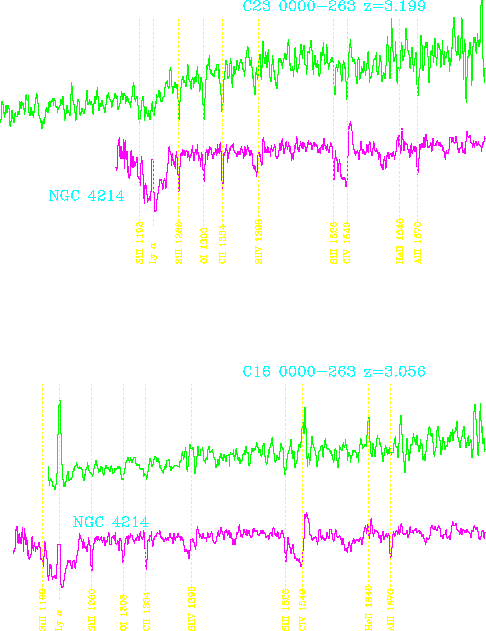
Figure: Examples of Keck spectra of z>3 galaxies. Below each observed
spectrum, we have plotted the spectrum of a star forming ``knot'' in NGC 4214,
a nearby starburst galaxy (Leitherer et al. 1996), after shifting the spectrum
to the measured redshift of the high-z galaxy. Some of the spectral features
seen in local star--forming regions (both stellar and interstellar) have been
labeled, for comparison with the high redshift objects (see text for
discussion).
The strongest interstellar lines indicated in Figures 2 and 3 have typical
rest-frame equivalent widths  --3.5Å. While the interstellar
medium of these galaxies has obviously undergone some chemical enrichment,
it is not possible to deduce metallicities from our spectra, since the
absorption lines in question are undoubtedly heavily saturated. Under these
circumstances, values of metallicity anywhere
between 1/1000 of solar and solar are compatible with the line strengths and
higher-resolution observations of intrinsically weaker lines are
required to measure element abundances (Pettini & Lipman 1995).
The equivalent widths of saturated absorption lines are much more
sensitive to the velocity dispersion of the gas than to its column density.
The observed
--3.5Å. While the interstellar
medium of these galaxies has obviously undergone some chemical enrichment,
it is not possible to deduce metallicities from our spectra, since the
absorption lines in question are undoubtedly heavily saturated. Under these
circumstances, values of metallicity anywhere
between 1/1000 of solar and solar are compatible with the line strengths and
higher-resolution observations of intrinsically weaker lines are
required to measure element abundances (Pettini & Lipman 1995).
The equivalent widths of saturated absorption lines are much more
sensitive to the velocity dispersion of the gas than to its column density.
The observed  --
-- Å correspond to FWHM
 --700
--700  which in turn imply approximate velocity dispersions
 --320
--320  (slightly higher values apply if rotation is
the dominant effect). In any case, if these velocity spreads reflect primarily
gravitationally induced motions in the large-scale interstellar medium of
the galaxies, the masses implied are comparable to those of present-day
luminous galaxies. Smaller masses would result if interstellar shocks,
local to the star-forming regions, contribute to the line widths.
Spectra of higher S/N and resolution are required to resolve
this question.
(slightly higher values apply if rotation is
the dominant effect). In any case, if these velocity spreads reflect primarily
gravitationally induced motions in the large-scale interstellar medium of
the galaxies, the masses implied are comparable to those of present-day
luminous galaxies. Smaller masses would result if interstellar shocks,
local to the star-forming regions, contribute to the line widths.
Spectra of higher S/N and resolution are required to resolve
this question.
More recent  observations of blank-sky fields with the COSMIC camera
at the prime focus of the Palomar 5 m telescope, covering a field of view
of 9
observations of blank-sky fields with the COSMIC camera
at the prime focus of the Palomar 5 m telescope, covering a field of view
of 9  9, have allowed an accurate measurement
of the surface density of the z>3 galaxies. These new images allow us to
be complete in our identification of z>3 galaxies down to
9, have allowed an accurate measurement
of the surface density of the z>3 galaxies. These new images allow us to
be complete in our identification of z>3 galaxies down to  ,
and we find a total of 31 robust candidates satisfying the ``robust'' selection
criterion out of a total of 2340 objects detected to the same apparent magnitude
level. We, therefore, deduce a surface density of Lyman break candidates of
,
and we find a total of 31 robust candidates satisfying the ``robust'' selection
criterion out of a total of 2340 objects detected to the same apparent magnitude
level. We, therefore, deduce a surface density of Lyman break candidates of
 arcmin
 (or
(or  per square degree).
Thus, Lyman break objects in the redshift range
per square degree).
Thus, Lyman break objects in the redshift range 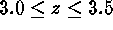 represent about 1.3% of all objects to
  , and
2.0% of all objects in the magnitude range
, and
2.0% of all objects in the magnitude range 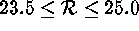 .
.
In 1995 October we also obtained deep  band images of a small subset of
the z>3 candidates using the Near Infrared Camera on the W. M. Keck telescope.
A total of five candidates was observed, with typical integration times of 6000s,
four of which with confirmed redshift. The measured K magnitudes (typically
measuring rest--frame B or V of the galaxies) range from
band images of a small subset of
the z>3 candidates using the Near Infrared Camera on the W. M. Keck telescope.
A total of five candidates was observed, with typical integration times of 6000s,
four of which with confirmed redshift. The measured K magnitudes (typically
measuring rest--frame B or V of the galaxies) range from  --22.1, with

 . These colors are consistent with models of continuous
star formation which could have begun as early as
. These colors are consistent with models of continuous
star formation which could have begun as early as  Gyr prior to the epoch
at which we observe them and are redder than would be expected if we were
seeing instantaneous ``bursts'' of star formation (Bruzual & Charlot 1993).
A consequence of adopting the maximum amount of reddening allowed by the
UV colors of the galaxies is a reddening in
Gyr prior to the epoch
at which we observe them and are redder than would be expected if we were
seeing instantaneous ``bursts'' of star formation (Bruzual & Charlot 1993).
A consequence of adopting the maximum amount of reddening allowed by the
UV colors of the galaxies is a reddening in  of
of
 magnitudes; this would lower the ages significantly and
formally allow single burst models younger than a few times
magnitudes; this would lower the ages significantly and
formally allow single burst models younger than a few times  years.
We regard such short lifetimes as unlikely as they would imply that we are
seeing large numbers of galaxies all bursting simultaneously.
years.
We regard such short lifetimes as unlikely as they would imply that we are
seeing large numbers of galaxies all bursting simultaneously.
One of the advantages of searching for
high-z galaxies in the optical is that one observes directly the far--UV
continuum produced by early-type stars (our  bandpass samples the
rest-frame continuum at
bandpass samples the
rest-frame continuum at  Å). Consequently, in the
absence of dust (see above), relatively minor assumptions are necessary to
deduce the formation rate of massive stars and the accompanying production
of ionizing photons; this is not the case for measurements of [OII]
line luminosities which are subject to uncertainties as large as a factor of
Å). Consequently, in the
absence of dust (see above), relatively minor assumptions are necessary to
deduce the formation rate of massive stars and the accompanying production
of ionizing photons; this is not the case for measurements of [OII]
line luminosities which are subject to uncertainties as large as a factor of
 (see Gallagher, Bushouse, & Hunter 1989). To estimate star formation
rates from the observed UV luminosities, we have made use of the calculations
by Leitherer, Robert, & Heckman (1995) which are based on ultraviolet
libraries of massive star spectra coupled with an evolutionary synthesis
code. We have used the ``continuous star formation'', rather than ``single
burst'', models, as we consider the former case more likely, for reasons
given above. For a Salpeter initial mass function with an upper mass
cut-off of 80 M
(see Gallagher, Bushouse, & Hunter 1989). To estimate star formation
rates from the observed UV luminosities, we have made use of the calculations
by Leitherer, Robert, & Heckman (1995) which are based on ultraviolet
libraries of massive star spectra coupled with an evolutionary synthesis
code. We have used the ``continuous star formation'', rather than ``single
burst'', models, as we consider the former case more likely, for reasons
given above. For a Salpeter initial mass function with an upper mass
cut-off of 80 M ,
a SFR =
,
a SFR =  yr
yr produces a
luminosity at 1500Å (in the rest-frame)
produces a
luminosity at 1500Å (in the rest-frame)
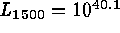 erg s
erg s Å
Å .
At
.
At  (in the middle of the redshift
range to which we are sensitive to
the detection of Lyman break galaxies),
an apparent
(in the middle of the redshift
range to which we are sensitive to
the detection of Lyman break galaxies),
an apparent  (on the AB system)
corresponds to
(on the AB system)
corresponds to 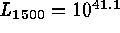 erg s
erg s Å
Å (
( km s
km s Mpc
Mpc ) for
) for  , and
, and
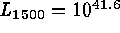 erg s
erg s Å
Å for
for  .
The population of Lyman break galaxies we detect is in the range
.
The population of Lyman break galaxies we detect is in the range
 ;
therefore, the implied star formation
rates range from
;
therefore, the implied star formation
rates range from  --
-- M
M yr
yr (
( ) to
) to
 --
-- M
M yr
yr (
( ), with the weighted
average being
), with the weighted
average being  (
( ) M
) M yr
yr for
for  (0.05).
Assuming that we have uniformly probed the redshift
range  in our surveys (an assumption that is supported by
the results of the spectroscopy), the co-moving density of the star--forming
galaxies is at least
in our surveys (an assumption that is supported by
the results of the spectroscopy), the co-moving density of the star--forming
galaxies is at least
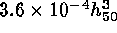 (
( )
Mpc
)
Mpc for
for  (0.05), or about 1/2 (1/10) of
the space density of present--day
galaxies with
(0.05), or about 1/2 (1/10) of
the space density of present--day
galaxies with  for
for  (Ellis et al. 1996).
The total star formation rate
per co--moving volume produced by the observed population
at z>3 is then
(Ellis et al. 1996).
The total star formation rate
per co--moving volume produced by the observed population
at z>3 is then
 (
( )
M
)
M yr
yr Mpc
Mpc for
for  (0.05).
These numbers must be viewed as strict lower limits on the total star formation
rate at z > 3---the fraction arising in only the most actively star--forming objects;
taken at face value, the star formation density that we observe is only
(0.05).
These numbers must be viewed as strict lower limits on the total star formation
rate at z > 3---the fraction arising in only the most actively star--forming objects;
taken at face value, the star formation density that we observe is only
 of the total star formation rate seen at the present epoch
(Gallego et al. 1995). For comparison, the star formation rates (per object) and
star formation densities recently reported by Cowie, Hu, & Songaila (1995b)
at
of the total star formation rate seen at the present epoch
(Gallego et al. 1995). For comparison, the star formation rates (per object) and
star formation densities recently reported by Cowie, Hu, & Songaila (1995b)
at  are approximately the same as we have observed at
  .
.
In parallel with the ground-based imaging and spectroscopy observations, we
have been investigating the morphological properties of the z>3 galaxies
with HST and WFPC2 (Giavalisco, Steidel & Macchetto 1996). To improve
the overall observing efficiency, we have also followed the strategy of
performing our ground-based photometric searches for z>3 galaxies in
existing deep HST fields, and we now have images of  galaxies from several fields, both our own and archival.
The images typically probe the rest-frame UV spectrum in the range 1400--1900Å and have high enough resolution that we can attempt a quantitative discussion of their sizes and light distribution.
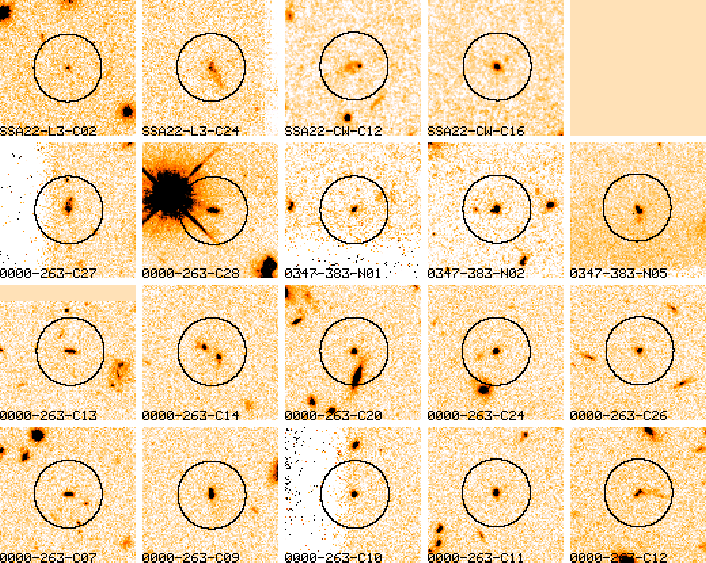
Figure: A mosaic of HST images of the  selected z>3
galaxies and galaxy candidates. The compact morphology of these galaxies is
clearly evident from the images, which show the relatively more regular cores
surrounded by diffuse nebulosities.
selected z>3
galaxies and galaxy candidates. The compact morphology of these galaxies is
clearly evident from the images, which show the relatively more regular cores
surrounded by diffuse nebulosities.
Figure 4 shows a mosaic of z>3 galaxies from the 0000-263, 0347-383 and
SSA22 (2217-003) fields. Even from a visual inspection of the images
it is clear that the majority of the z>3 galaxies have compact
morphologies, typically
characterized by a bright ``core'', often surrounded by more diffuse
nebulosities with significantly lower surface brightness. The core is
typically  arcsec in radius, with a characteristic central surface
brightness
arcsec in radius, with a characteristic central surface
brightness  mag arcsec
 . The nebulosities extend on
larger areas and are more irregularly distributed.
However, there are four cases of more diffuse galaxies in the sample,
C13, C27, and C28 in the 0000-263 field (we note that C28 is a candidate
damped Lyman
. The nebulosities extend on
larger areas and are more irregularly distributed.
However, there are four cases of more diffuse galaxies in the sample,
C13, C27, and C28 in the 0000-263 field (we note that C28 is a candidate
damped Lyman  absorber in the spectrum of Q0000-263, see Steidel &
Hamilton 1992), and C24 in the SSA22-L3 field. The diffuse galaxies have
larger sizes than the compact galaxies, do not possess an obvious ``core'' and
have lower central surface brightness. There are also two cases of
``double-core'' galaxies, SSA22-CW-C12 and 0000-263-C12.
Finally, the galaxy 0000-263-C14, seems to be an interacting system.
absorber in the spectrum of Q0000-263, see Steidel &
Hamilton 1992), and C24 in the SSA22-L3 field. The diffuse galaxies have
larger sizes than the compact galaxies, do not possess an obvious ``core'' and
have lower central surface brightness. There are also two cases of
``double-core'' galaxies, SSA22-CW-C12 and 0000-263-C12.
Finally, the galaxy 0000-263-C14, seems to be an interacting system.
We have determined quantitatively the morphology of the galaxies in two
different ways. We
have analyzed their radial light profile and found that many of them can be
reasonably well described in terms of the traditional  or exponential
profiles. However, we caution that these fits are intended to broadly
classify the light profiles and are
not meant to imply that a particular galaxy rigorously follows a given model.
In addition, we are fitting functions designed to model the
light distribution of present-day galaxies at 4500Å rest-frame, and
characterized by a very modest amount of star formation, to galaxies at z>3
observed at 1600Å rest-frame and with a star-formation rate one order of
magnitude (or more) higher. Clearly, we do not yet know whether the same
physical interpretation relating morphology to the dynamical state of the
galaxies would hold.
or exponential
profiles. However, we caution that these fits are intended to broadly
classify the light profiles and are
not meant to imply that a particular galaxy rigorously follows a given model.
In addition, we are fitting functions designed to model the
light distribution of present-day galaxies at 4500Å rest-frame, and
characterized by a very modest amount of star formation, to galaxies at z>3
observed at 1600Å rest-frame and with a star-formation rate one order of
magnitude (or more) higher. Clearly, we do not yet know whether the same
physical interpretation relating morphology to the dynamical state of the
galaxies would hold.
We have also derived measures of the light concentration, but because of the approximate nature of the analysis above, we have not computed them from the parameters of the fit, as deviations from the adopted model and inaccurate modelling of the wings of the light distribution would have resulted in large errors. Rather, we have measured the isophotal magnitudes (using FOCAS) and a set of concentric aperture magnitudes, centered at the peak of the light distribution (the centering box had a size of 5 pixels), to produce a growth curve and derive the half-light radius.
Several interesting results have emerged from the analysis of the HST images:
1) Most of the the z>3 galaxies are characterized
by a compact morphology, generally having a ``core''  arcsec in
diameter, which at redshift
arcsec in
diameter, which at redshift  (the mean value for our survey)
corresponds to
(the mean value for our survey)
corresponds to  (
( ) kpc. The core typically contains about
90--95% of the total luminosity of the galaxy, and has a half-light
radius in the range 0.2--0.3 arcsec, corresponding to
) kpc. The core typically contains about
90--95% of the total luminosity of the galaxy, and has a half-light
radius in the range 0.2--0.3 arcsec, corresponding to  --
-- (
( --
-- ) kpc. Since at the observed rest-frame far--UV wavelengths,
the emission is directly proportional to the formation rate of massive stars,
one can conclude that
) kpc. Since at the observed rest-frame far--UV wavelengths,
the emission is directly proportional to the formation rate of massive stars,
one can conclude that  --95% of the stars that are being formed
in these galaxies are concentrated in a region whose size is that of a
present-day luminous galaxy. Moreover, the characteristic central
concentration of the star formation has a scale size similar to a
present--day spheroid. If the morphology of the massive stars is
a good tracer of the overall stellar distribution, then the light distribution
of the core is consistent with a dynamically relaxed structure.
--95% of the stars that are being formed
in these galaxies are concentrated in a region whose size is that of a
present-day luminous galaxy. Moreover, the characteristic central
concentration of the star formation has a scale size similar to a
present--day spheroid. If the morphology of the massive stars is
a good tracer of the overall stellar distribution, then the light distribution
of the core is consistent with a dynamically relaxed structure.
2) The core is very often surrounded by low surface brightness nebulosities, generally distributed asymmetrically, and which may extend for a few arcsecs (see, e.g., 0000-263-C09 and 0347-383-N05). These nebulosities are clearly seen in Figures 2 and 3 as deviations from the more regular profile of the core. We note that the presence of such halos is consistent with the intense star-formation activity observed in the z>3 galaxies, even if the morphology of the underlying stellar distribution is relatively regular. For instance, the presence of extended gaseous components is expected from the intense supernovae rate that must be taking place in these systems (Ikeuchi & Norman 1991). Also, halos with irregular morphology and lower SFR are consistent with dissipative collapse (Baron & White 1987) of the cores. In such a scenario a core-halo segregation is actually expected due to the increased cloud collision rate and SFR in the denser, more collapsed regions (Silk & Norman 1981).
3) The central SB of the compact z>3 galaxies is
consistently close to 23 mag arcsec . At the observed rest-frame
wavelengths, the surface brightness is proportional to the star-formation
efficiency. Given that these galaxies have all comparable UV extinction,
we can conclude that they have also comparable star-formation efficiency,
indicative of a similarity of physical processes in the core regions.
. At the observed rest-frame
wavelengths, the surface brightness is proportional to the star-formation
efficiency. Given that these galaxies have all comparable UV extinction,
we can conclude that they have also comparable star-formation efficiency,
indicative of a similarity of physical processes in the core regions.
4) There are four cases of diffuse galaxies, namely 0000-263-C13,
0000-263-C27, 0000-263-C28 and SSA22-L3-C24, whose light profiles are very
well fitted by exponential laws. The central surface brightness of these
galaxies is significantly lower than that of their more compact counterparts,
showing an overall reduced star-formation efficiency. Interestingly, galaxy
0000-263-C28 is a candidate to be one of the two damped Lyman  systems
in the spectrum of Q0000-263, either at
systems
in the spectrum of Q0000-263, either at  or
or  .
.
5) In three cases out of 19, SSA22-CW-C12, 0000-263-C12, and
0000-263-C14, we observe galaxies with multiple morphology, where two
major light concentrations with similar apparent luminosity, two ``cores''
in our terminology, are separated by about 1 arcsec or less, corresponding to
 (
( ) kpc. The two individual sub-components are spatially
resolved in the first case, where one is much more concentrated
than the other, barely resolved in the second case, and too small to conclude
anything in the third case. In all cases, the galaxies clearly show extended
diffuse nebulosity around or extending from them, which is suggestive of
systems in interaction. This could be interpreted as evidence of hierarchical
merging of sub-units into more massive systems taking place with time scales
about an order of magnitude shorter than the time stretch of the probed cosmic
epoch, or
) kpc. The two individual sub-components are spatially
resolved in the first case, where one is much more concentrated
than the other, barely resolved in the second case, and too small to conclude
anything in the third case. In all cases, the galaxies clearly show extended
diffuse nebulosity around or extending from them, which is suggestive of
systems in interaction. This could be interpreted as evidence of hierarchical
merging of sub-units into more massive systems taking place with time scales
about an order of magnitude shorter than the time stretch of the probed cosmic
epoch, or 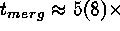
 yr. We note that in all cases the
``merging'' units have smaller luminosity than the other systems, but
comparable central surface brightness. This is fully
consistent with the interpretation of these galaxies as young spheroidal
systems. Interestingly, both parents and daughters of this possible merging
scenario have comparable morphologies.
yr. We note that in all cases the
``merging'' units have smaller luminosity than the other systems, but
comparable central surface brightness. This is fully
consistent with the interpretation of these galaxies as young spheroidal
systems. Interestingly, both parents and daughters of this possible merging
scenario have comparable morphologies.
6) Very interestingly, in the sample available to us, the
geometry of the cores has a high degree of spherical symmetry, and there are
no cases of highly elongated structures, such as the ``chain galaxies''
discussed by Cowie et al. (1995b). These chain galaxies are apparently formed
by strings of star-forming regions of similar surface brightness. Given their
knotty structure and the fact that they seem to have comparable
star-formation rates to those of the z>3 galaxies, if placed at z>3, we
would expect that the ``morphological k-correction'' (namely the change in
the apparent morphology of a galaxy due to shifting the observed rest-frame
light towards blue wavelengths coupled with surface brightness selection
effects) would make them appear even more elongated because of  surface-brightness dimming of the more diffuse regions that surround the
knots. None among the 19 galaxies observed so far has, even approximately,
such a morphology. We have quantified this by studying the axial ratios of
the isophotes, which provide an upper limit to the axial ratios of the galaxy
core regions. These values have a mean of
surface-brightness dimming of the more diffuse regions that surround the
knots. None among the 19 galaxies observed so far has, even approximately,
such a morphology. We have quantified this by studying the axial ratios of
the isophotes, which provide an upper limit to the axial ratios of the galaxy
core regions. These values have a mean of  , are larger than
  --2 only for the markedly exponential galaxies and are never larger
than
--2 only for the markedly exponential galaxies and are never larger
than  . In comparison, Cowie et al. report unconvolved axial ratios
as high as 9.5, with a mean value of 4.7 for the chain galaxies.
. In comparison, Cowie et al. report unconvolved axial ratios
as high as 9.5, with a mean value of 4.7 for the chain galaxies.
7) The z>3 galaxies are often intrinsically relatively
``round'' and centrally concentrated, and seem to show a small dispersion of
morphologies, in contrast with the larger variety observed in the galaxies
harboring most of the star formation at later epochs (cf. Cowie et al.
1995a,1995b, Driver et al. 1995a,1995b, Glazebrook et al. 1995b). In
interpreting the far--UV morphologies of galaxies at substantial redshifts,
one must bear in mind the strong surface brightness selection effects
(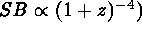 . On the other hand, the SED of unreddened
star-forming galaxies is essentially flat from
. On the other hand, the SED of unreddened
star-forming galaxies is essentially flat from  Å to
Å to  Å rest-frame, and even further if the galaxy is young. At the
wavelength of a typical WFPC2 filter (e.g., the F702W with
Å rest-frame, and even further if the galaxy is young. At the
wavelength of a typical WFPC2 filter (e.g., the F702W with  Å), this corresponds to observing galaxies in the redshift interval
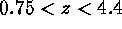 with minimal ``morphological k-corrections'' (see Giavalisco et
al. 1996). This means that it is not unfair to compare UV morphologies of the
z >3 galaxies with that of the
with minimal ``morphological k-corrections'' (see Giavalisco et
al. 1996). This means that it is not unfair to compare UV morphologies of the
z >3 galaxies with that of the  systems.
In summary, we have discovered a population of star--forming galaxies
with redshifts 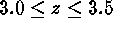 using a color--selection technique whose
efficiency is very high, allowing a first systematic study
of the nature of galaxies at such large redshifts. The fact that we detect
such a substantial population using a flat--UV spectrum selection criterion
suggests that dust obscuration may not be an important limiting factor
in searches for high-redshift galaxies.
using a color--selection technique whose
efficiency is very high, allowing a first systematic study
of the nature of galaxies at such large redshifts. The fact that we detect
such a substantial population using a flat--UV spectrum selection criterion
suggests that dust obscuration may not be an important limiting factor
in searches for high-redshift galaxies.
The space density, star formation rates, morphologies and physical
sizes, masses, and early epoch of the galaxy population that we have
isolated all support the idea that the progenitors of the present-day bright
galaxies have finally been observed during a phase characterized by intense
star formation. The observed volume density of the z>3 galaxies is within
a factor of a few that of present--day galaxies with  , and their integrated
star-formation rate is at least 25% of what is observed in the local universe.
Rough dynamical estimates suggest that these galaxies are massive systems. In
view of the fact that galactic spheroids must have formed relatively
early to attain a state of quiescent evolution by
, and their integrated
star-formation rate is at least 25% of what is observed in the local universe.
Rough dynamical estimates suggest that these galaxies are massive systems. In
view of the fact that galactic spheroids must have formed relatively
early to attain a state of quiescent evolution by  , we find
the centrally concentrated star formation that characterizes the z>3
population, together with all the other established properties, compelling
evidence that we are observing directly, and for the first time, the ongoing
formation of the spheroid components of
what would become the luminous galaxies of the present epoch. At
, we find
the centrally concentrated star formation that characterizes the z>3
population, together with all the other established properties, compelling
evidence that we are observing directly, and for the first time, the ongoing
formation of the spheroid components of
what would become the luminous galaxies of the present epoch. At 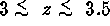 we are probably seeing an epoch where the star formation was
concentrated primarily in the central regions of massive galaxies (the
``spheroid epoch''). This star formation appears to have ``migrated''
over time to more morphologically peculiar objects, and finally to
the present where the bulk of the star formation is distributed in spiral
disks.
we are probably seeing an epoch where the star formation was
concentrated primarily in the central regions of massive galaxies (the
``spheroid epoch''). This star formation appears to have ``migrated''
over time to more morphologically peculiar objects, and finally to
the present where the bulk of the star formation is distributed in spiral
disks.
Our results demonstrate beyond doubt that by z>3 massive galaxy formation was well under way, and the galaxies that we have identified are the sites of the most active star formation at that epoch, therefore, representing an important phase in the early history of galaxy formation. The properties of these objects must be reproduced by any theory attempting to explain the formation of normal galaxies.
Baron, E. & White, S. D. M. 1987, ApJ, 322, 585
Bruzual, G. & Charlot, S. 1993, ApJ, 405, 538
Calzetti, D., Kinney, A.L., & Storchi-Bergmann, T. 1994, ApJ, 429, 582
Charlot, S. 1996, in From Stars to Galaxies, eds. C. Leitherer & U. Fritze--von Alvensleben (ASP Conference Series), in press
Charlot, S. & Fall, S.M. 1993, ApJ, 415, 580
Chen, W. L. & Neufeld, D. A. 1994, ApJ 432, 567
Cowie, L.L., Gardner, J.P., Hu, E.M., Songaila, A., Hodapp, K.-W., & Wainscoat, R.J. 1994, ApJ, 434, 114
Cowie, L.L., Hu, E.M., & Songaila, A. 1995a, AJ, 110, 1576
Cowie, L.L., Hu, E.M., & Songaila, A. 1995b, Nature, 377, 603
Ellis, R. S., Colless, M., Broadhurst, T., Heyl, J., & Glazebrook, K. 1995, MNRAS, in press
Driver, S., Windhorst, R., & Griffith, R. 1995a, ApJ, 453, 48
Driver, S., Windhorst, R., Ostrander, E., Keel, W., Griffith, R., & Ratnatunga, K. 1995b, ApJ, 449, L23
Gallagher, J.S., Bushouse, H., & Hunter, D.A. 1989, AJ, 97, 700
Gallego, J., Zamorano, J., Aragon-Salamanca, A., & Rego, M. 1995, ApJL, in press
Giavalisco, M., Steidel, C. C., & Macchetto, F. 1996, submitted
Giavalisco, M., Koratkar, A., & Calzetti, D. 1996, ApJ, in press
Giavalisco, M., Livio, M., Bohlin, R., Macchetto D. F., & Stecher, T. P. 1996, AJ, accepted for publication
Giavalisco, M., Macchetto, F., & Sparks, W. 1994, A&A, 288, 103
Giavalisco, M., Steidel, C. & Szalay, A. 1994, ApJ, 425, L5
Giavalisco, M., Macchetto, F., Madau, P., & Sparks, W. 1995, ApJ, 441, L13
Glazebrook, K., Ellis, R., Colless, M. M., Broadhurst, T. J., Allington-Smith, J. R., & Tanvir, N. R. 1995a, MNRAS, 273, 157
Glazebrook, K., Elliss, R., Santiago, B., & Griffith, R. 1995b, MNRAS, in press
Ikeuchi, S. & Norman, C. A. 1991, ApJ, 375, 479
Leitherer, C., Robert, C., & Heckman, T.M. 1995, ApJS, 99, 173
Leitherer, C., Vacca, W.D., Conti, P.S., Filippenko, A.V., Robert, C., & Sargent, W.L.W. 1996, ApJ, submitted
Lilly, S., Le Fevre, O., Crampton, D., Hammer, F., & Tresse, L. 1995a, ApJ, 455, 50
Lilly, S., Tresse, L., Hammer, F., Crampton, D., & Le Fevre, O. 1995, ApJ, 455, 108
Macchetto, F., Lipari, S., Giavalisco, M., Turnshek, D. A. & Sparks, W. B. 1993, ApJ, 404, 511
Madau, P. 1995, ApJ, 441, 18
Pei, Y., Fall, S. M., & Bechtold, J. 1991, ApJ 378, 6
Pettini, M., Smith, L. J., Hunstead, R. W., & King, D. L. 1994, ApJ 426, 79
Pettini, M., Hunstead, R.W., King, D.L, & Smith, L.J. 1995, in QSO Absorption Lines, ed. G. Meylan (Berlin: Springer-Verlag), p.55
Pettini, M. & Lipman, K. 1995, AA, 297, L63
Schade, D., Lilly, S. J., Crampton, D., Hammer, F., Le Fevre, O., & Tresse, L. 1995, ApJ, 451, L1
Steidel, C.C., Giavalisco, M., Pettini, M., Dickinson, M., & Adelberger, K. 1996, ApJ, in press
Steidel, C.C., Dickinson, M., & Persson, S.E. 1994, ApJ, 437, L75.
Steidel, C.C. & Hamilton, D. 1992, AJ, 104, 941 (Paper I)
Steidel, C.C. & Hamilton, D. 1993, AJ, 105, 2017 (Paper II)
Steidel, C.C., Pettini, M., & Hamilton, D. 1995 (Paper III), AJ, 110, 2519
Walborn, N.R., Lennon, D.J., Haser, S.M., Kudritzki, R-P, & Voels, S.A. 1995, PASP, 107, 104
