


David Schade, S. J. Lilly
Department of Astronomy, University of Toronto, Toronto, Canada M5S 3H8
F. Hammer, O. Le Fèvre & L. Tresse
DAEC, Observatoire de Meudon, 92195 Meudon, France
David Crampton
Dominion Astrophys. Obs., National Research Council of Canada, Victoria,
V8W 4M6
F. Barrientos, O. López-Cruz
Department of Astronomy, University of Toronto, Toronto, Canada M5S 1A7
[1]Based on observations with the NASA/ESA Hubble Space Telescope obtained at the Space Telescope Science Institute, which is operated by AURA, Inc., under NASA contract NAS5-26555.
 and
and  .
Hubble Space Telescope images with
resolution of
.
Hubble Space Telescope images with
resolution of  kpc show that
galaxies at
kpc show that
galaxies at  display the same range of morphological
types as the local population: ellipticals, spirals, and irregulars
are all present.
Detailed surface photometry shows that the majority of galaxies
bluer than present-day Sbc are either
apparently normal disk galaxies with
a mean surface brightness
display the same range of morphological
types as the local population: ellipticals, spirals, and irregulars
are all present.
Detailed surface photometry shows that the majority of galaxies
bluer than present-day Sbc are either
apparently normal disk galaxies with
a mean surface brightness  higher by
  mag than their
local counterparts, or are objects dominated by compact
blue components, often showing asymmetric structure.
In the cluster environment,
HST images have been used to make accurate measurements
of the size and luminosity of early-type galaxies.
Ellipticals of a given size at
mag than their
local counterparts, or are objects dominated by compact
blue components, often showing asymmetric structure.
In the cluster environment,
HST images have been used to make accurate measurements
of the size and luminosity of early-type galaxies.
Ellipticals of a given size at  are found to be
brighter by
are found to be
brighter by  mag than those in present-day rich clusters.
Thus, Hubble Space
Telescope has provided a number of new insights into
the nature of high-redshift galaxies in both the field
and in clusters: many of the changes we see in the galaxy
population may be due to luminosity evolution of
nearly-normal galaxies.
mag than those in present-day rich clusters.
Thus, Hubble Space
Telescope has provided a number of new insights into
the nature of high-redshift galaxies in both the field
and in clusters: many of the changes we see in the galaxy
population may be due to luminosity evolution of
nearly-normal galaxies.
Keywords: galaxies:evolution---galaxies:fundamental parameters
Until recently, little was known about the properties of the galaxy population at significantly earlier epochs. The steep slope of the faint galaxy counts (Ellis 1990, Lilly, Cowie & Gardner 1991) has been interpreted as evidence for evolution of the galaxy population but the cause and nature of that evolution was a mystery. Over the years, various more-or-less exotic physical explanations, such as bursting dwarf galaxies, vanishing populations, and wholesale merging (see Lilly 1993 for a review) have been proposed. A number of studies with HST imaging of large numbers of galaxies without measured redshifts (e.g., Glazebrook et al. 1995, Driver, Windhorst, & Griffiths 1995) emphasize the peculiar nature of much of the faint galaxy population. It has proven difficult to distinguish between evolutionary scenarios, or even to establish the basic physical properties of the faint galaxy population, without redshift information which is needed to compute luminosity, physical size, restframe color, and intrinsic surface brightness.
The Canada-France Redshift Survey (Lilly et al. 1995a and references
therein) is a
statistically complete sample
of 943 objects with  and is large enough to estimate the multi-variate
galaxy luminosity function
and is large enough to estimate the multi-variate
galaxy luminosity function 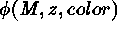 (Lilly et al. 1995b).
The purely statistical information provided by the luminosity
function has been augmented by morphological information
from HST (Schade et al. 1995, hereafter referred to as CFRS IX).
By imaging the galaxies that make up the evolving
population, it is possible to see directly
what types of objects are present at high redshift
and active in the evolutionary process.
This ability to measure the structure of individual galaxies is critically
important in the pursuit of
an understanding of the physics at work behind
the evolutionary process. The
physical structure of a galaxy is expected to change less
abruptly than its luminosity (which can vary enormously
with changes in the star-formation rate) so that the structure is
invaluable as a means of associating a
galaxy at high redshift with its local counterpart, i.e., with its
evolutionary endpoint
in the local population.
(Lilly et al. 1995b).
The purely statistical information provided by the luminosity
function has been augmented by morphological information
from HST (Schade et al. 1995, hereafter referred to as CFRS IX).
By imaging the galaxies that make up the evolving
population, it is possible to see directly
what types of objects are present at high redshift
and active in the evolutionary process.
This ability to measure the structure of individual galaxies is critically
important in the pursuit of
an understanding of the physics at work behind
the evolutionary process. The
physical structure of a galaxy is expected to change less
abruptly than its luminosity (which can vary enormously
with changes in the star-formation rate) so that the structure is
invaluable as a means of associating a
galaxy at high redshift with its local counterpart, i.e., with its
evolutionary endpoint
in the local population.
We assume  km sec
 Mpc
Mpc and
and  throughout this paper.
The multi-variate luminosity function (LF)
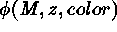 computed from the Canada-France
Redshift Survey (Lilly et al. 1995b) shows that LF of those
galaxies with restframe colors bluer than a present-day Sbc galaxy
evolves strongly between redshift slices at
computed from the Canada-France
Redshift Survey (Lilly et al. 1995b) shows that LF of those
galaxies with restframe colors bluer than a present-day Sbc galaxy
evolves strongly between redshift slices at 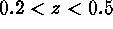 and
and
 . This evolution
could be due to an increase in overall galaxy density by a factor of
. This evolution
could be due to an increase in overall galaxy density by a factor of  at high redshift or, alternatively, by a uniform brightening of the galaxy
population by
at high redshift or, alternatively, by a uniform brightening of the galaxy
population by  mag
relative to the population at lower redshift.
More complicated evolutionary scenarios are, of course, also possible.
In contrast to the behavior of the blue population,
the luminosity function of red galaxies is consistent
with no evolution over the entire redshift range 0 < z < 1.
mag
relative to the population at lower redshift.
More complicated evolutionary scenarios are, of course, also possible.
In contrast to the behavior of the blue population,
the luminosity function of red galaxies is consistent
with no evolution over the entire redshift range 0 < z < 1.
Because the luminosity function is merely a statistical description of the galaxy population, its behavior does not reveal the physical behavior of individual galaxies. Constraints of a physical nature require the analysis of the properties of individual objects.
HST imaging provides detailed morphological information
about high-redshift galaxies due to its impressive resolution
( kpc at
  ).
It is possible to detect large-scale
peculiarities, to locate strong star-forming regions (e.g., whether they are
nuclear or scattered over the face of the galaxy), and
most importantly to make quantitative measures of galactic
structure (size, surface brightness, bulge/total luminosity,
spatially resolved colors).
Such images show that
the galaxy population at high-redshift has at least 3
distinct morphological components, illustrated
in Figure 1 (and in color in Figure 3 of CFRS IX). The first
component is the set of red galaxies (
).
It is possible to detect large-scale
peculiarities, to locate strong star-forming regions (e.g., whether they are
nuclear or scattered over the face of the galaxy), and
most importantly to make quantitative measures of galactic
structure (size, surface brightness, bulge/total luminosity,
spatially resolved colors).
Such images show that
the galaxy population at high-redshift has at least 3
distinct morphological components, illustrated
in Figure 1 (and in color in Figure 3 of CFRS IX). The first
component is the set of red galaxies ( )
which in terms of Hubble types would be mostly E/S0 based on
their fractional bulge luminosity (
)
which in terms of Hubble types would be mostly E/S0 based on
their fractional bulge luminosity ( ). In the
CFRS IX sample 4/32, (10%) of the galaxies fall in
this range. The second component of the
population is the late-type or disk-dominated galaxies
(19/32 objects or 60%).
The disks of these objects have a mean surface brightness higher
at
). In the
CFRS IX sample 4/32, (10%) of the galaxies fall in
this range. The second component of the
population is the late-type or disk-dominated galaxies
(19/32 objects or 60%).
The disks of these objects have a mean surface brightness higher
at  by more than 1 magnitude relative to the local Freeman (1970)
constant surface-brightness law (Figure 2). The third component (9/32 or
30%) consists
of the ``blue-nucleated galaxies'' (BNGs) which are dominated by
compact blue components and are undergoing star-formation. The
CFRS IX sample shows a strong association of the BNG phenomenon
with asymmetric structure and interactions/mergers.
The BNGs are evident in figure 3 of CFRS IX as objects with strong blue
compact (but resolved) components. It is not clear if
a counterpart of these galaxies exists among the local
population. They may be compact starbursts
in disk galaxies, bursting spheroid galaxies, or they
may represent a phase in the formation of bulges.
by more than 1 magnitude relative to the local Freeman (1970)
constant surface-brightness law (Figure 2). The third component (9/32 or
30%) consists
of the ``blue-nucleated galaxies'' (BNGs) which are dominated by
compact blue components and are undergoing star-formation. The
CFRS IX sample shows a strong association of the BNG phenomenon
with asymmetric structure and interactions/mergers.
The BNGs are evident in figure 3 of CFRS IX as objects with strong blue
compact (but resolved) components. It is not clear if
a counterpart of these galaxies exists among the local
population. They may be compact starbursts
in disk galaxies, bursting spheroid galaxies, or they
may represent a phase in the formation of bulges.

Figure: Images from WFPC2 of 32 galaxies at 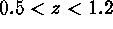 in the F814W
filter with galaxies arranged in order of luminosity (most luminous at the
top) and color (increasingly bluer toward the right). A wide range of
galaxy morphology is present in this sample. (See Schade et al. 1995 for an
accompanying color illustration.)
in the F814W
filter with galaxies arranged in order of luminosity (most luminous at the
top) and color (increasingly bluer toward the right). A wide range of
galaxy morphology is present in this sample. (See Schade et al. 1995 for an
accompanying color illustration.)

Figure: The relation between size and luminosity for disk galaxies at
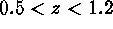 with asymmetric objects excluded. The Freeman (1970)
relation is indicated. (See Schade et al. (1995)
with asymmetric objects excluded. The Freeman (1970)
relation is indicated. (See Schade et al. (1995)
The high-redshift population shown in CFRS IX is similar in some respects to the local population. All galaxy types from ellipticals through spirals to irregular galaxies are present at high redshift. The colors correlate with morphology in the sense that early-type galaxies are dominated by compact red central bulge components and disks are predominantly blue. Spiral structure and bars are evident in some galaxies. The overall qualitative impression is that this population is not strikingly different from the local galaxy population although we are seeing them during a much younger phase in their development (at 1/3 to 1/2 their present age).
The initial CFRS sample of field galaxies with HST imaging has thus revealed a great deal about the late-type galaxy population at high-redshift. What can HST tell us about the evolution of elliptical galaxies? Although the small number of early-type objects in the CFRS IX HST sample precludes a detailed study at the moment, such galaxies are common in the cores of rich clusters of galaxies. High-redshift clusters have been frequent targets of HST and high-quality data has been analyzed using the same two-dimensional surface photometry procedures as in CFRS IX.
Barrientos, Schade, & López-Cruz (1996) measured the
properties of early-type galaxies in the cluster
CL0939+4713 at z=0.41
with Hubble Space Telescope and compared the results to
an identical analysis of a ground-based image of the Coma cluster.
These two images of clusters have
nearly identical physical resolution ( kpc),
spatial coverage (
kpc),
spatial coverage ( Mpc on a side), and signal-to-noise
ratio (
Mpc on a side), and signal-to-noise
ratio ( at
at  ), so that the
results are directly comparable. Two-dimensional surface photometry
measurements show that these
two clusters have tight sequences of luminous early-type
galaxies in the plane of
), so that the
results are directly comparable. Two-dimensional surface photometry
measurements show that these
two clusters have tight sequences of luminous early-type
galaxies in the plane of  versus
  (half-light
radius) with indistinguishable slopes. However, the two
sequences are offset from one another in luminosity
such that a galaxy of a given size at
(half-light
radius) with indistinguishable slopes. However, the two
sequences are offset from one another in luminosity
such that a galaxy of a given size at  is
is  more luminous than a corresponding
galaxy in the Coma sequence (see Figure 3).
The most direct interpretation of this result is that
we are seeing luminosity evolution of individual galaxies
and this interpretation is consistent with passively evolving models
of elliptical galaxies whose stellar populations were formed
in a single massive burst at z > 1 (Bruzual 1993).
more luminous than a corresponding
galaxy in the Coma sequence (see Figure 3).
The most direct interpretation of this result is that
we are seeing luminosity evolution of individual galaxies
and this interpretation is consistent with passively evolving models
of elliptical galaxies whose stellar populations were formed
in a single massive burst at z > 1 (Bruzual 1993).

Figure: The relation between size and luminosity for elliptical galaxies in
the Coma cluster compared with those in CL0939+47 at  . (See
Barrientos et al. 1996)
The best-fit line for Coma is plotted on both panels.
. (See
Barrientos et al. 1996)
The best-fit line for Coma is plotted on both panels.
The results of Schade et al. (1995) and Barrientos et al. (1996) show that
detailed structural measurements are possible for high-redshift galaxies
using Hubble Space Telescope and that such quantitative
measurements of well-selected samples can reveal important
information about the evolutionary state of distant galaxies.
The strongest possible constraints on
models of the evolution of galaxies can be constructed by combining
detailed quantitative information for individual galaxies with the
statistical information that is available because these galaxies
originate in well-selected statistical samples. The luminosity
function (with units of mag Mpc
Mpc ) represents one of a family
of generalized distribution functions, (e.g., the ``size-function'' of
disks, Figure 4
(Schade et al. 1996) each of which is a
projection of the multi-variate
distribution function of galaxy properties into lower
dimensionality. Any model of galactic evolution can be expressed as a
prediction about the evolution in the distribution function
) represents one of a family
of generalized distribution functions, (e.g., the ``size-function'' of
disks, Figure 4
(Schade et al. 1996) each of which is a
projection of the multi-variate
distribution function of galaxy properties into lower
dimensionality. Any model of galactic evolution can be expressed as a
prediction about the evolution in the distribution function
 ).
The distribution at high-redshift can be measured accurately
given a large enough sample combined with HST
imaging and can then be compared with
the distribution at lower redshift or in the local population.
Increasingly rigorous tests will become possible as sample
sizes become larger.
).
The distribution at high-redshift can be measured accurately
given a large enough sample combined with HST
imaging and can then be compared with
the distribution at lower redshift or in the local population.
Increasingly rigorous tests will become possible as sample
sizes become larger.

Figure: The space density of disks as a function of size (see Schade et
al. 1996).
This figure shows that the space density of small (1< h < 4 kpc)
disks is roughly constant with redshift. There is
a surplus of luminous ( ) small disks at high redshift (with a median
luminosity of
) small disks at high redshift (with a median
luminosity of  ) relative to the same size range at low redshift.
This surplus is accounted for by the number density of lower
luminosity disks (
) relative to the same size range at low redshift.
This surplus is accounted for by the number density of lower
luminosity disks ( ; median luminosity
  ) at lower
redshift (
) at lower
redshift (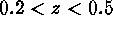 ). In other words, reaching
  magnitudes
deeper into
the luminosity function at low redshift produces the same density of disks
in this size range as is seen at high redshift.
magnitudes
deeper into
the luminosity function at low redshift produces the same density of disks
in this size range as is seen at high redshift.
The completion of large, complete redshift surveys, the estimation
of the evolving galaxy luminosity function, and the availability
of detailed quantitative morphological information derived from
HST imaging have provided a rapid increase in our knowledge of
the galaxy population from 0 < z < 1. All morphological
types known among luminous galaxies locally are also seen at  .
The majority of blue galaxies at
.
The majority of blue galaxies at  are either apparently
normal disk
galaxies (
are either apparently
normal disk
galaxies ( of the blue objects) or
``blue-nucleated galaxies'' (
of the blue objects) or
``blue-nucleated galaxies'' ( ) which are associated with
asymmetric structure and mergers.
The mean surface
brightness of the disk galaxies is higher than the local value by
more than 1 magnitude. These two effects--disk brightening and the
BNG phenomenon (also associated with ongoing star formation)--must
be responsible for much of the observed evolution in the luminosity
function of faint field galaxies.
In rich clusters, evolution in the size-luminosity relation of
luminous ellipticals suggests that passive evolution of
an old stellar population (with little
ongoing star-formation) may dominate the changes in these galaxies.
A straightforward view of these findings is that luminosity
evolution (due to decreasing star-formation in the field population
and to an aging stellar population in cluster ellipticals) may
constitute a large part of the overall evolution of the
galaxy population since redshift one.
) which are associated with
asymmetric structure and mergers.
The mean surface
brightness of the disk galaxies is higher than the local value by
more than 1 magnitude. These two effects--disk brightening and the
BNG phenomenon (also associated with ongoing star formation)--must
be responsible for much of the observed evolution in the luminosity
function of faint field galaxies.
In rich clusters, evolution in the size-luminosity relation of
luminous ellipticals suggests that passive evolution of
an old stellar population (with little
ongoing star-formation) may dominate the changes in these galaxies.
A straightforward view of these findings is that luminosity
evolution (due to decreasing star-formation in the field population
and to an aging stellar population in cluster ellipticals) may
constitute a large part of the overall evolution of the
galaxy population since redshift one.
Barrientos, F., Schade, D., & López-Cruz, O. 1996, ApJ, in press
Broadhurst, T., Ellis, R., Glazebrook, K. 1992 Nature, 355, 55
Bruzual, G. 1993, ApJ, 405, 538
Driver, S., Windhorst, R., Griffiths, R. 1995, ApJ, 453, 48
Ellis, R. S. 1990 in Evolution of the Universe of Galaxies, ed. R.G. Kron, A.S.P. Conf. Series, Vol. 10, p. 248
Freeman, K. 1970, ApJ, 160, 811
Glazebrook, K., Ellis, R., Santiago, B., & Griffiths, R. 1995, MNRAS, 275, L19
Lilly, S. J. 1993, ApJ, 411, 501
Lilly, S. J., Le Févre O., Crampton, D., Hammer, F., & Tresse, L. 1995a, ApJ, 455, 50
Lilly, S. J., Tresse, L., Hammer, F., Crampton, D., & Le Févre O. 1995b, ApJ, 455, 108
Lilly, S.J., Cowie, L.L., & Gardner, J. P. 1991, ApJ, 369, 79
Schade, D., Lilly, S. J., Crampton, D., Hammer, F., Le Fèvre, O., & Tresse, L. 1995, ApJ, 451, L1 (CFRS IX)
Schade, D., Lilly, S. J., Le Fèvre, O., Hammer, F., & Crampton, D. 1996, ApJ, in press