


David C. Koo
UCO/Lick Observatory and Board of Astronomy and Astrophysics,
University of California, Santa Cruz, CA 95064 USA
 , such faint galaxies have luminosities similar to that of
typical galaxies today. Though small, our sample already suggests that
the median redshift for I > 22 galaxies is higher than the
, such faint galaxies have luminosities similar to that of
typical galaxies today. Though small, our sample already suggests that
the median redshift for I > 22 galaxies is higher than the  expected for the ``maximal merger model'' of Carlberg (1995). The HST
images show that galaxies with redshifts
expected for the ``maximal merger model'' of Carlberg (1995). The HST
images show that galaxies with redshifts  have frequent
signatures of mergers, interactions, and infall of minor galaxies into
larger hosts; possess a wide diversity of morphological types; and
consist of stellar populations in several objects that are already so
red that their major formation epoch occurred at redshifts z > 2.
have frequent
signatures of mergers, interactions, and infall of minor galaxies into
larger hosts; possess a wide diversity of morphological types; and
consist of stellar populations in several objects that are already so
red that their major formation epoch occurred at redshifts z > 2.
Keywords: faint galaxies, high redshifts, blue galaxies
A key astronomical observation is that galaxy counts and colors reveal a large surface density of very faint, blue, field galaxies. Despite intensive observational and theoretical work for nearly two decades, such high counts remain a major cosmological mystery. The classical explanation is that such galaxies are those seen at higher redshifts during earlier epochs of more extensive star formation. Yet, ever deeper redshift surveys by several groups and comparisons to their models did not reveal the expected, high-redshift population. This paradox paved the way for a number of more exotic explanations, including the need for a cosmological constant, rapid merging, disappearing populations, bursting dwarfs, or rapid changes with redshift in the shape of the galaxy luminosity function. Others proposed that such exotic models were premature, given our incomplete knowledge of the local luminosity function, selection effects, and uncertainties in the models (references and a recent review of these issues can be found in Koo 1996). Although some convergence has been achieved over the last few years by the different groups, no consensus has been reached. Thus, the nature of faint blue galaxies is a puzzle that persists, but has recently been amenable to powerful new studies by HST and Keck.
HST provides several new approaches to studying faint galaxies. Taking
advantage of the higher spatial resolution and the relative constancy
at high redshifts of apparent sizes for a given linear scale, several
groups have classified the morphologies of very faint galaxies. They
find that the blue galaxies are dominated by late-type or peculiar
morphologies and that such galaxies indeed exceed their model
predictions by large factors (see overview by Longair in these
proceedings). Moreover, the peculiar morphologies are suggestive of
increased interactions and mergers among higher redshift
galaxies. Besides providing morphology as an independent check of the
input models used to interpret faint counts and colors, HST data also
provide size measurements. Such measurements can reveal whether new
populations (e.g., very blue, compact galaxies undergoing starbursts)
are appearing. Sizes can also yield the surface brightnesses of
distant galaxies (assuming redshifts are available) and hence a direct
measure of luminosity evolution, assuming intrinsic galaxy sizes have
not evolved. Similarly, bulge to disk ratios, color gradients, the
shapes of light profiles, and the colors of nuclei are all potential
tools to detect the presence of new components (e.g., larger fraction
of AGN activity) or the evolution of known galaxy components, but
these more sophisticated methods have yet to be exploited fully (see
Schade in these proceedings). Even the
shapes and orientations are useful, e.g., in gravitational lensing
tests that can indirectly probe the redshifts of objects too faint
for spectroscopy or in testing for the intrinsic shapes of very
faint galaxies. The higher spatial resolution also offers improved
measures of the clustering of galaxies on small scales (see Griffiths
in these proceedings). Finally, HST accesses
the deep ultraviolet, a regime where
the relationship of low redshift Lyman  lines to field galaxies or the UV colors of local galaxies can be
studied.
Such data can then be compared to similar, but more distant, samples.
lines to field galaxies or the UV colors of local galaxies can be
studied.
Such data can then be compared to similar, but more distant, samples.
Large, ground-based telescopes, such as the Keck 10-m, provide complementary data to unravel the nature of faint galaxies. Of perhaps greatest importance, Keck provides redshifts to very faint limits. Such redshifts are crucial to determine whether particular galaxies are near or far, intrinsically blue or red, bright or faint, large or small, low or high surface brightness, etc. Even the interpretation of a galaxy's morphology is dependent on its observed rest-frame wavelength and thus its redshift. But Keck spectra provide more than redshifts. With sufficient spectral and spatial resolution and quality, the spectra of faint galaxies can also yield rotation curves and the velocity dispersions of gas and stars (e.g., Forbes et al. 1996, Vogt et al. 1996). Combined with the size and inclination from HST images, these internal kinematics translate to direct measures of the total masses, whether luminous or dark, of distant galaxies. Such masses provide entirely new methods to tackle galaxy evolution and to address such fundamental questions as whether the faint blue galaxies are massive or not, whether they are in their early phases or later stages of star formation, whether they follow local relationships such as the Tully-Fisher, Faber-Jackson, elliptical fundamental plane, etc. The masses of distant galaxies are more closely tied to theoretical simulations than luminosities and colors (which depend on understanding star formation) and thus serve as more direct probes of the merger rate. Finally, Keck spectra of high quality can also yield direct clues to the ages and metal abundances of the stellar populations of distant galaxies. Such information provide independent checks of both cosmology (via time) and galaxy evolution, via the dependence of metal production with star formation.
Distant galaxy programs which exploit these new parameters from HST
and Keck are very much in their infancy. One such program
now underway is called the Deep Extragalactic Evolutionary Probe, or
DEEP (Mould 1993, Koo 1995).
Here we provide early results of a new DEEP
pilot survey
that combines redshifts from the Keck Telescope with photometry,
colors, and morphologies from refurbished HST images taken by
Groth et al. (1996).
Though this Keck redshift sample has only 33 galaxies (due to the loss of
80% of the run to weather), the
magnitudes are so faint (11 with I < 22, 13 with 22 < I < 23, and
9 with I > 23) and the redshifts so high
(median  ), that this survey provides a unique glimpse of the nature of
faint, distant field galaxies of typical luminosities (L
), that this survey provides a unique glimpse of the nature of
faint, distant field galaxies of typical luminosities (L )
at an epoch beyond half the Hubble age.
We highlight several intriguing hints
that have already emerged.
)
at an epoch beyond half the Hubble age.
We highlight several intriguing hints
that have already emerged.
Photometry and morphology are extracted from HST images taken by Groth et al. (1996). The survey region consists of 28 overlapping WFPC2 fields, each observed in the F606W (V) filter for 2800s and F814W (I) for 4400s. One field, however, was exposed for seven hours in the same filters. Our spectroscopic survey was centered on this very deep field, but also covered four other flanking fields of shallower depth.
All but two bright galaxies
were observed through masks cut with multiple
slitlets, which allowed simultaneous exposure of
 25 or more
targets with the Low Resolution Imaging Spectrograph (LRIS, see Oke
et al. 1995).
We adopted a slitwidth of 1.1 arcsecs and achieved
a dispersion of 1.28Å per px (3--4px resolution)
over a spectral range of 6500Å to 9100Å.
25 or more
targets with the Low Resolution Imaging Spectrograph (LRIS, see Oke
et al. 1995).
We adopted a slitwidth of 1.1 arcsecs and achieved
a dispersion of 1.28Å per px (3--4px resolution)
over a spectral range of 6500Å to 9100Å.
The galaxies chosen for spectroscopy do not
constitute a totally random, magnitude-limited sample, but were instead
chosen to be representative of a variety of morphologies,
magnitudes, and colors to a limit of  .
Three of the faintest emission-line redshifts were found
serendipitously in the slit of the primary target; eight galaxies, all
with I > 22, had no or uncertain redshifts.
Also note that [OII] 3727Å\
is redshifted beyond our spectral limit
of
.
Three of the faintest emission-line redshifts were found
serendipitously in the slit of the primary target; eight galaxies, all
with I > 22, had no or uncertain redshifts.
Also note that [OII] 3727Å\
is redshifted beyond our spectral limit
of  Å for redshifts
  .
Thus we were gratified to
achieve an overall completeness of 80% (33/41)
to a limit of I > 24.
This is presumably due to the high incidence of strong emission lines
among very faint galaxies.
.
Thus we were gratified to
achieve an overall completeness of 80% (33/41)
to a limit of I > 24.
This is presumably due to the high incidence of strong emission lines
among very faint galaxies.
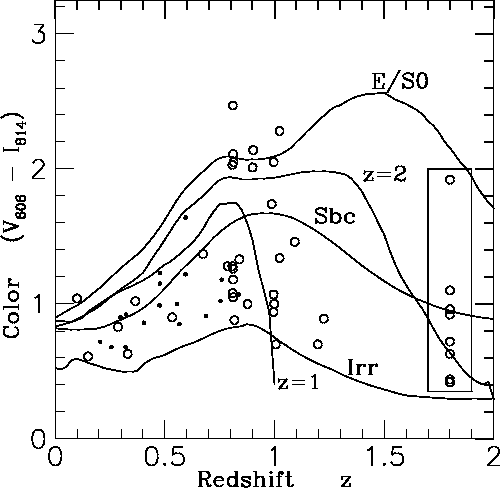
Figure: V-I color vs redshift plot of Keck targets from
this work (open circles) and Forbes et al. 1996 (points).
Objects without redshifts are placed in the
separate box to the right.
Several labeled lines show the expected colors for various spectral energy
distributions, including one resulting from an instantaneous burst of
star formation at
redshift z = 2 (using the models of Bruzual & Charlot 1993)
that becomes almost as red as a non-evolving
local elliptical or S0 (E/S0) by z < 1;
another resulting from a model burst at z = 1 that
might be compared to the bursting dwarfs in the model of Babul &
Ferguson (1996);
another to the colors of a local Sbc galaxy; and the
bluest one for N4449,
a very actively star-forming Irr galaxy.
Figure 1 summarizes our results in a V-I color versus redshift diagram for our
entire Keck sample, including 18 galaxies from Forbes et al. (1996). The
curves provide guides to the intrinsic colors of the galaxies. One striking
aspect of our data is the high concentration at redshifts  and
and
 ,
which yields a median
,
which yields a median  to 1.0, regardless of the redshifts of the eight failures.
This median redshift is not consistent with
to 1.0, regardless of the redshifts of the eight failures.
This median redshift is not consistent with
 , a value predicted by the
``maximal merger models'', which otherwise fit existing brighter
observations (Carlberg 1995). The higher median, however, matches an
extrapolation of the landmark I = 22 Canada-France Redshift Survey
(Lilly et al. 1995) or even some
simple luminosity evolution models (e.g., Gronwall & Koo 1995).
, a value predicted by the
``maximal merger models'', which otherwise fit existing brighter
observations (Carlberg 1995). The higher median, however, matches an
extrapolation of the landmark I = 22 Canada-France Redshift Survey
(Lilly et al. 1995) or even some
simple luminosity evolution models (e.g., Gronwall & Koo 1995).
Figure 1 shows how well the galaxies fall within the bounds seen
in the colors of normal, local galaxies.
We find neither unusually blue nor unusually red
galaxies.
Other implications from the figure are
(i) that at high redshifts  , some field galaxies do
exist with intrinsic colors comparable to that found for
local ellipticals; (ii) that the most recent major star-formation event
in these red galaxies (assuming no dust)
occurred at redshifts
, some field galaxies do
exist with intrinsic colors comparable to that found for
local ellipticals; (ii) that the most recent major star-formation event
in these red galaxies (assuming no dust)
occurred at redshifts  ;
(iii) that the current model
of Babul & Ferguson (1996) does not quite match the observed
color distribution nor the presence of very
blue galaxies beyond redshifts
;
(iii) that the current model
of Babul & Ferguson (1996) does not quite match the observed
color distribution nor the presence of very
blue galaxies beyond redshifts  ; and (iv) that intrinsically
blue galaxies
partake
in the strong clustering seen at redshifts
; and (iv) that intrinsically
blue galaxies
partake
in the strong clustering seen at redshifts  and
and
 . Furthermore, although HST images show
strong and frequent hints of mergers,
interactions, other peculiar patterns, and
infall of minor galaxies into larger hosts, normal galaxies are also visible.
The morphologies of
. Furthermore, although HST images show
strong and frequent hints of mergers,
interactions, other peculiar patterns, and
infall of minor galaxies into larger hosts, normal galaxies are also visible.
The morphologies of  galaxies are thus not confined to
late-type, peculiar systems and, conversely,
the late-type galaxies seen in deep HST images are
not predominantly at low redshifts (i.e., of low-luminosity).
galaxies are thus not confined to
late-type, peculiar systems and, conversely,
the late-type galaxies seen in deep HST images are
not predominantly at low redshifts (i.e., of low-luminosity).
This glimpse of very faint  field galaxies strongly suggests
that we need to invoke an unknown, possible complex, mixture of
physical processes to account for the faint blue galaxies, rather than
to rely on a single dominant mechanism, such as mergers or bursting
dwarfs.
field galaxies strongly suggests
that we need to invoke an unknown, possible complex, mixture of
physical processes to account for the faint blue galaxies, rather than
to rely on a single dominant mechanism, such as mergers or bursting
dwarfs.
I would like to acknowledge that these results are contributions from a team effort of DEEP and E. Groth and especially the younger members: R. Brunner, A. Connolly, D. Forbes, C. Gronwall, R. Guzman, A. Phillips, N. Vogt, and K. Wu. Funding for this work was provided by NSF grants AST91-20005 and AST-8858203 and NASA grants AR-5801.01-94A and GO-2684.04-87A.
Babul, A. & Ferguson, H. C. 1996, preprint.
Bruzual, G. A. & Charlot, S. 1993, ApJ, 405, 538
Carlberg, R. G. 1995, in proceedings of Ringberg Workshop, preprint
Forbes, D. A., Phillips, A. C., Koo, D. C., & Illingworth, G. D. 1996, ApJ, in press
Gronwall, C. & Koo, D. C. 1995, ApJ, 440, L1
Groth, E. J. et al. 1996, in preparation
Koo, D. C. 1995, in proceedings of Wide Field Spectroscopy and the Distant Universe, eds. S. Maddox & A. Aragón-Salamanca (World Scientific: Singapore), 55
Koo, D. C. 1996, in proceedings of IAU No. 168, Examining the Big Bang and Diffuse Background Radiations, ed. M. Kafatos (Kluwer: Dordrecht), in press
Lilly, S. J., Tresse, L., Hammer, F., Le Fèvre, O., & Crampton, D. 1995, ApJ, 455, 108
Mould, J. 1993, in Sky Surveys: Protostars to Protogalaxies, ed. B. T. Soifer, (ASP Conf. Ser., 43), 281
Oke, J. B., Cohen, J. G., Carr, M., Cromer, J., Dingizian, A., et al. 1995, PASP, 107, 375
Vogt, N. P., Phillips, A. C., et al. 1996, ApJ, in preparation