


Kenneth R. Sembach
Massachusetts Institute of Technology, Cambridge, MA 02138 USA
Blair D. Savage
University of Wisconsin-Madison, Madison, WI 53706 USA
Keywords: abundances, atoms, dust grains, interstellar, halo gas
Measurements of the elemental abundances within interstellar clouds provide information about the physical conditions and chemical composition of gas in the Milky Way. Only recently has it become possible to determine accurate elemental abundances for clouds in the halo of the Galaxy. These abundances supply information about the chemical evolution of the interstellar gas, the presence and composition of interstellar dust at large distances from the plane, and the physical processes responsible for transferring gas and dust between the disk and halo. In time, it will be possible to compare these abundances directly with those found for halo clouds in other galaxies or quasar absorption line hosts.
We have recently used the Goddard High-Resolution Spectrograph
(GHRS) aboard the Hubble Space Telescope to measure the amount of
interstellar Mg II, Si II, P II, S II, Mn II, Cr II, Fe II, Ni II, Zn II,
and Ge II toward HD 116852, a low latitude halo star at z = -1.5 kpc
(see Sembach & Savage 1996).
The high-resolution (echelle) observations of Mn II and Fe II
reveal a rich interstellar velocity structure extending from -70 to
+35 km s . The velocity separation of the absorption components
caused by differential Galactic rotation allows us to study the
abundances of halo clouds below the Sagittarius and Norma spiral
arms. We find that the gas-phase abundances of Mg, Si, S, Mn, Cr,
Fe, and Ni relative to Zn in the HD 116852 halo clouds below the arms are
similar to those of clouds in the low halo (
. The velocity separation of the absorption components
caused by differential Galactic rotation allows us to study the
abundances of halo clouds below the Sagittarius and Norma spiral
arms. We find that the gas-phase abundances of Mg, Si, S, Mn, Cr,
Fe, and Ni relative to Zn in the HD 116852 halo clouds below the arms are
similar to those of clouds in the low halo (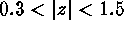 kpc)
of the solar neighborhood (Spitzer & Fitzpatrick 1993,1995, Fitzpatrick,
this volume, p.
kpc)
of the solar neighborhood (Spitzer & Fitzpatrick 1993,1995, Fitzpatrick,
this volume, p.  ). Comparisons
of the halo cloud abundances with those of clouds in the disk
indicate that compositional differences exist between the mantled
grains in disk clouds and the grain cores in halo clouds.
). Comparisons
of the halo cloud abundances with those of clouds in the disk
indicate that compositional differences exist between the mantled
grains in disk clouds and the grain cores in halo clouds.
For a sample of halo clouds, the average logarithmic gas-phase
abundance ratios relative to solar abundance ratios (see Section 2)
are [Mg/Zn] = -0.52, [Si/Zn] = -0.26, [S/Zn] = -0.05, [Mn/Zn] = -0.61,
[Cr/Zn] = -0.51, [Fe/Zn] = -0.64, and [Ni/Zn] = -0.84. These abundance
values should be
similar to [X/H] since Zn is nearly
undepleted in the warm neutral gas. There are no systematic differences in these
abundances for halo clouds with galactocentric distances (R ) of 7--10
kpc. The gas- and dust-phase abundance patterns in the
halo clouds are consistent with more severe grain destruction in the
clouds at greater distances from the plane. We calculate
(Mg+Fe)/Si = 3.3 in the dust grains if solar abundances are
used as references and (Mg+Fe)/Si = 8.6 if B-star reference
abundances are used. These ratios imply that there must be grains
composed of Fe and/or Mg oxides, or perhaps even pure Fe, in the halo
clouds. Since pure Fe grains are destroyed much more rapidly than
silicates behind fast shocks, we favor silicates and oxides as the
likely constituents of grain material in the halo clouds. For more complete
discussions of these topics and those below see Savage & Sembach (1996a,b).
) of 7--10
kpc. The gas- and dust-phase abundance patterns in the
halo clouds are consistent with more severe grain destruction in the
clouds at greater distances from the plane. We calculate
(Mg+Fe)/Si = 3.3 in the dust grains if solar abundances are
used as references and (Mg+Fe)/Si = 8.6 if B-star reference
abundances are used. These ratios imply that there must be grains
composed of Fe and/or Mg oxides, or perhaps even pure Fe, in the halo
clouds. Since pure Fe grains are destroyed much more rapidly than
silicates behind fast shocks, we favor silicates and oxides as the
likely constituents of grain material in the halo clouds. For more complete
discussions of these topics and those below see Savage & Sembach (1996a,b).
We define the gas-phase abundance of element X relative to hydrogen by
(X/H) = N(X)/N(H), where the subscript g refers to gas. In
practice, we measure N(X II) and N(H I).
For many clouds, no ionization correction is necessary. For the
HD 116852 sight line, the abundances should be accurate to better than 0.15
dex, even if most of the absorption arises in a diffuse ionized gas
of the type seen by Reynolds (1993), and they are probably
accurate to better than 0.06 dex for a realistic distribution of neutral and
ionized gases along the sight line.
= N(X)/N(H), where the subscript g refers to gas. In
practice, we measure N(X II) and N(H I).
For many clouds, no ionization correction is necessary. For the
HD 116852 sight line, the abundances should be accurate to better than 0.15
dex, even if most of the absorption arises in a diffuse ionized gas
of the type seen by Reynolds (1993), and they are probably
accurate to better than 0.06 dex for a realistic distribution of neutral and
ionized gases along the sight line.
The normalized gas-phase abundance (=interstellar depletion) of an element
is given by  (X) = (X/H)
 /(X/H)
 (linear form) or
[X/H] = log(X/H)
(linear form) or
[X/H] = log(X/H) -- log(X/H)
 (logarithmic form),
where the subscript c refers to a cosmic reference. We take the
Anders & Grevesse (1989) abundances in
meteorites as the cosmic reference (but also explore other
alternatives).
Assuming that the dust contains the elemental content missing from the gas
leads to a dust abundance given by (X/H)
(logarithmic form),
where the subscript c refers to a cosmic reference. We take the
Anders & Grevesse (1989) abundances in
meteorites as the cosmic reference (but also explore other
alternatives).
Assuming that the dust contains the elemental content missing from the gas
leads to a dust abundance given by (X/H) = (X/H)
 -- (X/H)
 .
We list the
cosmic (reference) abundances, gas-phase (measured) halo cloud abundances, and
dust-phase (derived) halo cloud abundances in Table 1.
.
We list the
cosmic (reference) abundances, gas-phase (measured) halo cloud abundances, and
dust-phase (derived) halo cloud abundances in Table 1.

Table 1: Gas and Dust Abundances for Halo Clouds
Using the above results, we derive a grain composition
(Mg+Fe)/Si = (27+25)/16 = 3.3 0.6 using the meteoritic reference
abundances and (Mg+Fe)/Si = (12+13)/2.9 = 8.6
0.6 using the meteoritic reference
abundances and (Mg+Fe)/Si = (12+13)/2.9 = 8.6 0.6 using the meteoritic
reference abundances less 0.2 dex (i.e., B-star abundances).
0.6 using the meteoritic
reference abundances less 0.2 dex (i.e., B-star abundances).
Common silicate grain compositions yield (Mg+Fe)/Si = 1.0 for (Mg,Fe)SiO (Enstatite, Orthopyroxene) and (Mg+Fe)/Si = 2.0 for (Mg,Fe)
 SiO
SiO (Forsterite, Fayalite). The differences between the observed ratios of
Mg, Fe, and Si in the halo clouds and these silicates indicate that the Mg and
Fe must also exist in some other type of dust grain cores. Possible
carriers of the Mg and Fe include pure Fe grains and oxides such as
MgO (Periclase), Fe
(Forsterite, Fayalite). The differences between the observed ratios of
Mg, Fe, and Si in the halo clouds and these silicates indicate that the Mg and
Fe must also exist in some other type of dust grain cores. Possible
carriers of the Mg and Fe include pure Fe grains and oxides such as
MgO (Periclase), Fe O
O (Hematite) or Fe
 O
O (Magnetite).
If we think of the halo cloud values in Table 1 as abundances in the grain
cores, then subtracting the halo cloud abundances from cool diffuse
cloud abundances (such as those for
 Oph or
  Per), which track both grain and mantle compositions,
yields mantle abundances
(Mg+Fe)/Si
Per), which track both grain and mantle compositions,
yields mantle abundances
(Mg+Fe)/Si  1.0 consistent with a silicate (pyroxene) composition.
The halo cloud abundance pattern is consistent with a more severe processing of dust in the halo clouds than in disk clouds (see Sembach & Savage 1996). This processing may result from more frequent and/or more severe shocking of halo clouds compared to disk clouds. The halo cloud composition indicates that localized enrichment of the gas behind a shock is probably most pronounced when the grain cores are destroyed.
About 70% of the Mg, 45% of the Si, and 77% of the Fe atoms in the clouds are locked into dust grains (Table 1). The very small variations in the halo cloud abundances (Sembach & Savage 1996) strongly support the idea that the cores of the dust grains are resilient and have a basic composition common to widely separated Galactic regions.
The transfer of dust into the low halo may occur through supernova injection or photo-levitation of diffuse clouds in the disk. These processes are probably sufficient to strip the mantles off the grain cores but not to destroy the cores themselves. Since pure Fe grains are destroyed much more rapidly than silicates behind fast shocks (see Jones et al. 1994), we favor oxides as the additional Fe-bearing material in the halo cloud dust grains.
Searches for enrichment of Fe-Peak elements (Fe, Ni) relative
to  -process elements (Mg, Si) in halo gas by Type Ia supernovae have
not been successful (Jenkins & Wallerstein 1996).
The small variation in the halo
cloud Fe abundance (
-process elements (Mg, Si) in halo gas by Type Ia supernovae have
not been successful (Jenkins & Wallerstein 1996).
The small variation in the halo
cloud Fe abundance ( 10%) is probably more reflective of efficient
mixing than it is of in situ processes.
10%) is probably more reflective of efficient
mixing than it is of in situ processes.
It is possible that some of the sub-solar gas-phase abundances
observed in halo clouds could be due to a lower average metallicity
in the halo compared to the disk rather than due to incorporation of
material into dust grains. The infall of unprocessed gas, or gas with
low metal abundances, could dilute the halo material and reduce
the gaseous abundances below expected values. Such a scenario
has been proposed to explain the apparent deficiency (a factor of
2) of interstellar gas-phase oxygen toward stars near the Sun
(Meyer et al. 1994). Observations of metal
abundances in HVCs at large distances from the Galactic plane
suggest that some of these clouds have metal abundances of  0.1--0.3
solar (Lu, Savage, & Sembach 1994a,b). While it is possible that the
HVCs could contribute to
lowering the halo metallicity, it remains to be determined if there is
a large enough population of such clouds (or their lower velocity
counterparts) to sufficiently counteract the opposing tendency to
drive the metallicity toward solar when the disk and halo gases
mix.
0.1--0.3
solar (Lu, Savage, & Sembach 1994a,b). While it is possible that the
HVCs could contribute to
lowering the halo metallicity, it remains to be determined if there is
a large enough population of such clouds (or their lower velocity
counterparts) to sufficiently counteract the opposing tendency to
drive the metallicity toward solar when the disk and halo gases
mix.
Anders, E. & Grevesse, N. 1989, Geochim. Cosmochim. Acta, 53, 197
Jenkins, E.B. & Wallerstein, G. 1996, ApJ, in press
Jones A.P., Tielens, A.G.G.M., McKee, C.F., & Hollenbach, D.J. 1994, ApJ, 433, 797
Lu, L., Savage, B.D., & Sembach, K.R. 1994a, ApJ, 426, 563
Lu, L., Savage, B.D., & Sembach, K.R. 1994b, ApJ, 437, L59
Meyer, D.M., Jura, M.J., Hawkins, I., & Cardelli, J.A. 1994. ApJ, 437, L59
Reynolds, R. 1993, in Back to the Galaxy, eds. S. Holt & F. Verter, (New York: AIP), 156
Savage, B.D. & Sembach, K.R. 1996a, ARA&A, in press
Savage, B.D. & Sembach, K.R. 1996b, in Cosmic Abundances, the
6 Annual Astrophysics Conference in Maryland, eds. S. Holt & G. Sonneborn
Sembach, K.R. & Savage, B.D. 1996, ApJ, in press (Jan)
Spitzer, L. & Fitzpatrick, E.L. 1993, ApJ, 409, 299
Spitzer, L. & Fitzpatrick, E.L. 1995, ApJ, 445, 196