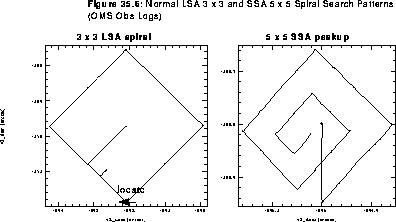
The target search phase slewed the telescope in a spiral search pattern. At each dwell point, the flux in the aperture was measured. All targets were first acquired using the LSA because the SSA is so small. (Note, however, that the SSA ACQ/PEAKUP algorithm is the same as that used for the LSA Return-to-Brightest (RTB) target search.) The target is assumed to be somewhere within the LSA 3 x 3 (or 5 x 5) spiral search pattern. The separation between dwell points during the LSA search was 1.52 arcsec on the sky (for an SSA ACQ/PEAKUP 5 x 5 spiral search, the separation was 0.052 arcsec). Figure 35.6 displays normal LSA 3 x 3 and SSA 5 x 5 spiral search patterns (from OMS jitter files). The spiral searches are plotted in V2,V3 space.
Most LSA acquisitions from mid-1993 on specified the BRIGHT=RETURN (RTB) option. This feature automatically returned the spacecraft pointing to the dwell position with the highest total counts. Since a 32-bit onboard register was used to store and compare the measured counts, overflow was not a problem. Alternatively, BRIGHT and FAINT limits may have been specified for the spiral search. For this case, a 16-bit register was used to store the measured counts and wrapping of the counter could result if a diode exceeded about 65,000 counts. The spacecraft pointing stopped at the first dwell position that had a flux between the selected limits. If no dwell position was found to meet the requirements, the spacecraft pointing remained at the last position.
cl> hsel z2il0102t.ulh $I,zfluxm yes

z2il0102t.ulh     16092
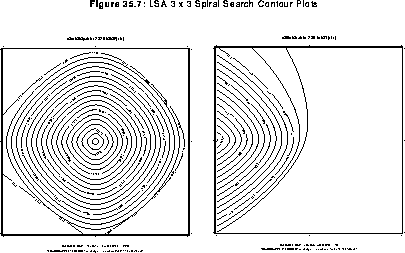
Figure 35.7 shows examples of contour plots for two LSA ACQ .d1h/.d1d pseudo-images. The target was found at the first dwell position for the first example, while for the second example, the target was found at dwell position 6. For both examples, the spacecraft pointing was returned to the dwell position with the maximum flux.
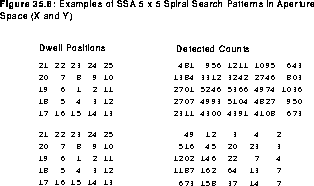
During the spiral search, the telescope slews were parallel to the GHRS x and y detector coordinates. The first slew in the sequence is in the positive x direction. The next slew is in the negative y direction, followed by a slew in the negative x direction. All subsequent slews are performed to complete the spiral pattern. Figure 35.6 displays the spiral search geometry and the corresponding detected counts at each dwell position for the two LSA ACQs presented in Figure 35.7. Figure 35.8 displays two examples of the SSA 5 x 5 spiral search. The upper search pattern found the target (a Cepheid binary star) at dwell position 1. The lower search pattern found the target (a B0-B2III-I star) on the edge of the spiral pattern at position 19. The spectra for this program were fine, indicating the target was found and subsequently moved to the center of the aperture.
35.5.3 OMS Products and Guiding
The guide stars used for pointing control during an observation can be found in the Observatory Management System (OMS) observation log header and in the SHP (.shd/.shh) header file. The OMS data header file (.cmh or .jih) contains information about the observation. The header is divided into groups of keywords that deal with a particular topic (e.g., spacecraft data, background light, pointing control data, line of sight jitter summary). A more complete description of OMS products can be found in Appendix C of Volume I.
cl> hsel z2il0102j.cmh $I guideact yesYou can check the OMS header keywords to verify that the guiding mode was the one requested. Archive users should check the guiding mode to verify that no changes occurred during the observation. If you suspect that a target rolled out of the aperture during an exposure, you can check the counts in each group of the raw science data.
z2il0102j.cmh "FINE LOCK"
A "type 51" slew was used to track moving targets (planets, satellites, asteroids, comets). Observations were scheduled with FINE LOCK acquisition, i.e., with two or one guide star. Usually, a guide star pair stayed within the pickle during the entire set of observations (obset), but if two guide stars were not available, a single guide star may have been used. This assumes the drift was small or perhaps that the observer stated the roll was not important for the program. An option during scheduling was to drop from FGS control to GYRO control when the guide stars moved out of the pickle. Guide star handoffs (which are not a simple dropping of the guide stars to GYRO control) could affect the guiding and may be noticeable when the jitter ball (V3 vs. V2) is plotted.
On January 19, 1996, there was a failure in tape recorder #2. This recorder had been used for recording engineering data for subsequent playback to the ground. The failure was permanent, causing engineering data to be obtained only during real-time TDRSS availability (typically 80% or so during each orbit). Consequently, there are gaps in the engineering data and gaps in the OMS products.
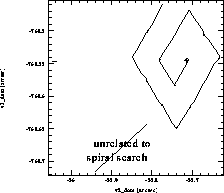
For example, plotting "v2_dom" versus "v3_dom" will generate a plot that looks like a ball of string, which is why it is sometimes called the jitter ball. The same plot for a target acquisition will display the spiral search and locate phase that occurred. See fifth page of paper product example.
st> sgraph "z2o40402j.cmi v2_dom v3_dom"After entering the plotting command, the command will plot the data in the graphics window and auto scale using the minimum and maximum data values. The plot may be misleading due to the auto scaling of the axis units, so be careful.
The GHRS Carrousel
All acquisition mirrors and gratings were mounted on a rotating carrousel. There were times when the carrousel failed to lock into position if a target acquisition took longer than expected to complete, due to carrousel movement. The subsequent observations may have been affected and exposure times shortened (FINCODE=106).
Figure 35.9: SSA ACQ/PEAKUP Started Late Due to Long Guide Star -Re-acquisition
False Fine Lock
A false lock, an anomaly that is not specific to GHRS, was simply a failure of an FGS (Fine Guidance Sensor) to lock onto the null point of the S-curve for the acquired guide star. Instead, it locked onto noise, onto a fake fine error signal at the edge of the FGS interference field of view, or onto a very weak S-curve. These sources of noise may be influenced by:
The potential impacts of a false lock may include:
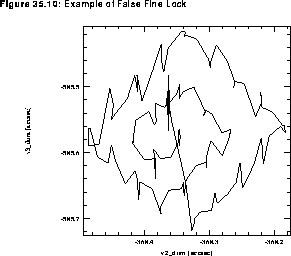
A loss of lock did not necessarily result in the loss of science if the guide stars could be re-acquired and the observation completed before the next scheduled activity. However, this was unlikely for most GHRS observations and a delay usually forced an observation to time-out.
A spoiler star could result in acquiring the wrong star with the FGS and the target would not be in the aperture due to this mispointing of HST. This could also result in a shift in the pointing following a guide star re-acquisition when the scheduled star was acquired. The target could roll in and out of the aperture resulting in changes in the counts between observations obtained during different orbits.
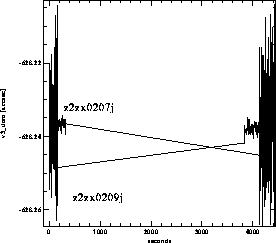
The differences between the predicted (PREDGSEP) and the actual (ACTGSSEP) measured separation between Guide Stars can be used to test for a spoiler star. For the following example, the science observation z2zx0207 started with the target in the aperture, was halted for earth occultation, and the observation completed on the following orbit. However, the guide star re-acquisition (REACQ) locked up on a spoiler star. The target was not centered in the aperture during the remaining exposure time. Observation z2zx0208 was noise. Observation z2zx0209 was halted for earth occultation and upon the REACQ, the target was moved into the aperture. For this observation, the first part of the exposure resulted in noise, while for the second orbit, the target was in the -aperture.
cl> hedit z2zx020*.jih PREDGSEP,ACTGSSEP .

z2zx0204j.jih,PREDGSEP = 1328.046 <-- SSA ACQ/PEAKUP

z2zx0204j.jih,ACTGSSEP = 1326.466

z2zx0205j.jih,PREDGSEP = /               <-- SPYBAL

z2zx0205j.jih,ACTGSSEP = /

z2zx0206j.jih,PREDGSEP = /               <-- WAVECAL

z2zx0206j.jih,ACTGSSEP = /
z2zx0207j.jih,PREDGSEP = 1328.046 <-- first science obs.

z2zx0207j.jih,ACTGSSEP = 1328.019         guide star REACQ

z2zx0208j.jih,PREDGSEP = 1328.046         wrong pointing

z2zx0208j.jih,ACTGSSEP = 1328.019

                                                                    <-- guide star REACQ

z2zx0209j.jih,PREDGSEP = 1328.046 <-- correct pointing

z2zx0209j.jih,ACTGSSEP = 1326.475
z2zx020aj.jih,PREDGSEP = 1328.046 <-- no further problemsFigure 35.11 presents the overplotting of the pointing for each observation (v2_dom versus seconds). This shows the change in HST pointing for this program. An HST Observation Problem Report (HOPR) was filed by the PI and the observations were repeated using different guide stars.
Figure 35.11: Jump in HST Pointing due to a Spoiler Guide Star
Single FGS Mode
On February 12, 1993, FGS 2 was temporarily turned off. Some observations shortly thereafter were executed with guiding from a single FGS. Later, a guide star acquisition could fail, resulting in use of a single guide star. For GHRS this could become a problem if the observation was being done in the SSA because the star could roll out of the aperture, as seen by a decrease in counts in the data. At some point, it was decided that single FGS mode was perfectly all right for LSA observations because the amount of expected roll wouldn't take the star out of the LSA, but it was not to be done for SSA observations. If you see a large drop-off in counts with SSA data, one explanation could be use of a single FGS. Recentering Events
During a recentering event, pointing control of the telescope by the Fine Guidance Sensors was paused until the spacecraft motion excursions became small enough that FGS guiding could be resumed. Recenterings typically lasted a few seconds, the total spacecraft motion was less than 0.1 to 0.2 arcsec, and after the recentering was finished the pointing position should be the same as before the recentering (to within ~7 milliarcsec).35.5.5 Images and Maps
Location of Targets Within the SSA
The location of a single star within the Small Science Aperture cannot be determined with an SSA image.1
Orientation
To determine the orientation of the GHRS apertures on the sky, you need the value of the PA_APER keyword in the SHP header (.shh). This number is the position angle of the +y axis of GHRS measured from north through east. The +y axis is the direction from the LSA to the SSA. The +x axis is the direction of increasing wavelength.
cl> display test.hhh[*,-*].Once you have this orientation then you apply the offset angle (PA_APER) to get northeast lined up.
You should also know that RA_APER1 and DECAPER1 are the predicted RA and Dec of the center of the aperture used, for the beginning of the observation. GHRS PEAKUPs effectively re-zero the coordinate system so one would need to use the OBS logs (jitter files) to get the actual pointing.
stevens@stsci.edu Copyright © 1997, Association of Universities for Research in Astronomy. All rights reserved. Last updated: 01/14/98 15:45:39