
FOC Instrument Handbook

CHAPTER 12:
Acknowledgments


The FOC has been brought to its present status by the devoted efforts of many groups including the ESA/ST Project Office Staff, the FOC Investigation Definition Team (IDT) and various industrial contractors (especially British Aerospace, Matra-Espace and Dornier System GmbH). The authors are particularly grateful to a number of people in these and other organizations that gave generous amounts of their time to assist us in producing this handbook, in particular, the entire IDT: R. Albrecht, C. Barbieri, J. C. Blades, A. Boksenberg, P. Crane, J. M. Deharveng, M. Disney, P. Jakobsen, T. Kamperman, I. R. King, F. Macchetto (Principal Investigator), C. D. Mackay, F. Paresce, and G. Weigelt.

Figure 12.1: Extended format (512z 1024) de-zoomed image taken with the pre-COSTAR F/48 relay under uniform external illumination. This image does not show the effects of vignetting that will be present after the installation of COSTAR. The slit finger is just visible at the right center edge inside the default 512 512 imaging format which is outlined with the solid line.
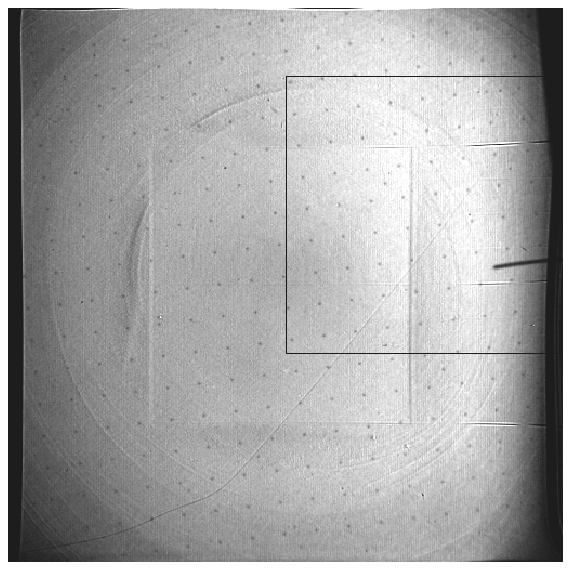
Figure 12.2: Extended format (512z 1024) de-zoomed image taken with the pre-COSTAR F/96 relay under uniform external illumination. The occulting fingers and clipping of the frame due to the baffle are clearly visible.
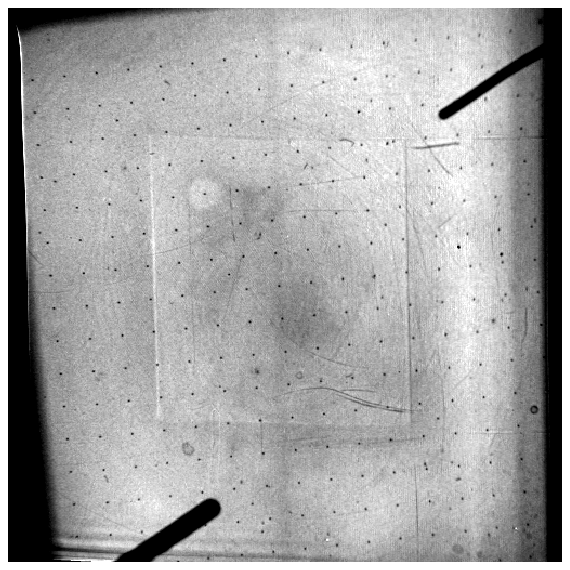
Figure 12.3: Extended format (512z 1024) de-zoomed negative image taken with the pre-COSTAR F/48 relay in spectrograph mode of an extended external object. The area in the upper left corner suffers serious vignetting, limiting the wavelength coverage for slitless spectroscopy.
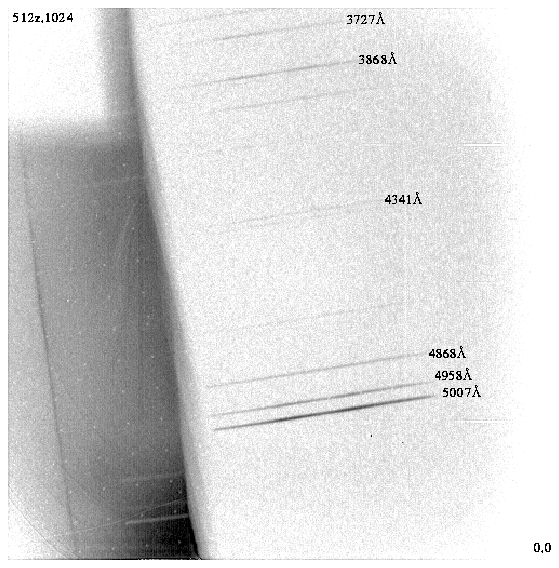
Figure 12.4: Central 256 512 pixels of the full 256 1024 pixel negative image taken with the COSTAR-corrected F/96 relay showing a star at the undispersed position overlayed with the image showing its Far-UV prism spectrum.
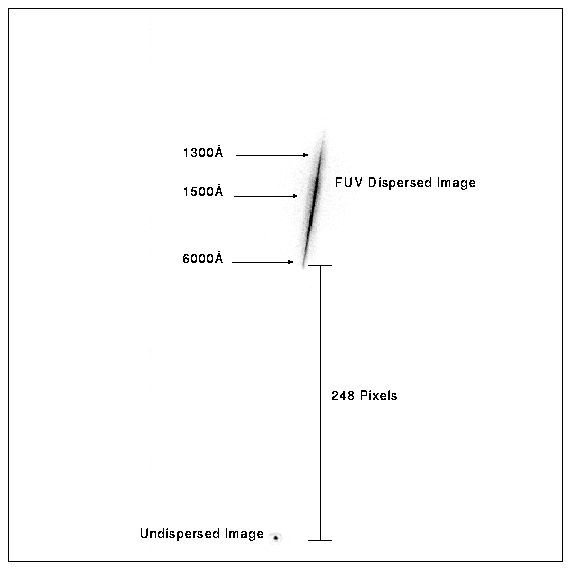
Figure 12.1: - Extended format (512z 1024) de-zoomed image taken with the pre-COSTAR F/48 relay under uniform external illumination. This image does not show the effects of vignetting that will be present after the installation of COSTAR. The slit finger is just visible at the right center edge inside the default 512 512 imaging format which is outlined with the solid line.
Figure 12.2: - Extended format (512z 1024) de-zoomed image taken with the pre-COSTAR F/96 relay under uniform external illumination. The occulting fingers and clipping of the frame due to the baffle are clearly visible.
Figure 12.3: - Extended format (512z 1024) de-zoomed negative image taken with the pre-COSTAR F/48 relay in spectrograph mode of an extended external object. The area in the upper left corner suffers serious vignetting, limiting the wavelength coverage for slitless spectroscopy.
Figure 12.4: - Central 256 512 pixels of the full 256 1024 pixel negative image taken with the COSTAR-corrected F/96 relay showing a star at the undispersed position overlayed with the image showing its Far-UV prism spectrum.

Generated with CERN WebMaker