[Top] [Prev] [Next] [Bottom]
Layout
NICMOS has a variety of imaging modes. The instrument provides direct imaging in broad, medium, and narrow-band filters at a range of spatial resolutions in the near infrared from 0.8 to 2.5 microns, together with broad-band imaging polarimetry, coronographic imaging and maskless grism spectroscopy. To guide you through NICMOS's capabilities and help optimize your scientific use of the instrument we have divided this Handbook into four parts: Part I - Introduction; Part II - Users's Guide; Part III - Supporting Material; and Part IV - Calibration. Figure 1.1 provides a roadmap to navigating the document; following the roadmap is a list of chapters and their contents.
Figure 1.1: Roadmap for Using the NICMOS Instrument Handbook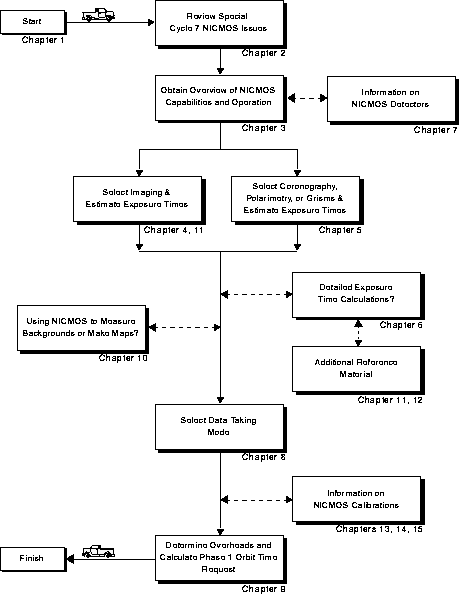
The chapters of this Handbook are as follows:
Part I - Introduction
- Chapter 1, Introduction on page 3.
- Chapter 2, Special Considerations for Cycle 7-NICMOS on page 11, describes special considerations for the use of NICMOS during Cycle 7-NICMOS.
Part II - Users Guide
- Chapter 3, Overview of NICMOS on page 19, provides an introduction to the full capabilities of NICMOS. A discussion is provided to help guide you through the technical details you will need to consider in choosing the optimum NICMOS configuration and in determining the number of orbits to request.
- Chapter 4, Imaging on page 39, provides a description of NICMOS's imaging capabilities including camera resolutions and throughputs.
- Chapter 5, Coronography, Polarimetry and Grism Spectroscopy on page 67, provides detailed information on coronographic imaging, grism spectroscopy, and polarimetry.
- Chapter 6, Exposure Time Calculations on page 89, describes how to perform signal to noise calculations, either by using pencil and paper, or using software tools that are provided on the World Wide Web (WWW).
- Chapter 7, NICMOS Detectors on page 105, describes the basic properties of the detectors used in the three cameras including their physical characteristics, capabilities and limitations.
- Chapter 8, Detector Readout Modes on page 119 explains the data taking modes which take advantage of the non-destructive readout capabilities of the NICMOS arrays. While nearly all observers will choose to use MULTIACCUM mode, we give advice the observer should consider in choosing the most appropriate mode.
- Chapter 9, Overheads and Orbit Time Determination on page 133, provides information to convert from a series of planned science exposures to an estimate of the number of orbits, including spacecraft and NICMOS overheads. This chapter applies principally to the planning of Phase I proposals.
Part III - Supporting Material
- Chapter 10, Techniques for Dithering, Background Measurement and Mosaicing on page 145, gives a guide to measuring the sky background when observing with -NICMOS. This chapter describes the implementation of a pre-defined set of patterns which accomplish dithering and chopping from the field of interest, and allow easy generation of large mosaic images.
- Chapter 11, Imaging Reference Material on page 161, provides summary information and filter transmission curves for each imaging filter, ordered by camera and increasing wavelength.
- Chapter 12, Flux Units and Line Lists on page 209, provides formulae and tables for the conversion of flux units, and a list of common infrared spectral lines.
Part IV - Calibration
- Chapter 13, Calibration Pipeline on page 231, briefly describes the processing of NICMOS data by the STScI pipeline and the data that will be sent to observers.
- Chapter 14, Expected Calibration Accuracies on page 243 summarizes the accuracies expected for NICMOS data calibrated by the STScI pipeline during Cycle 7-NICMOS.
- Chapter 15, Calibration Plans on page 245, provides a summary of the status and results from the Servicing Mission Observatory Verification (SMOV) and an overview of the Cycle 7 calibration plan.
[Top] [Prev] [Next] [Bottom]
stevens@stsci.edu
Copyright © 1997, Association of Universities for Research in Astronomy. All rights
reserved.
Last updated: 07/24/97 15:31:16