[Top] [Prev] [Next] [Bottom]
Instrument Design
Physical Layout
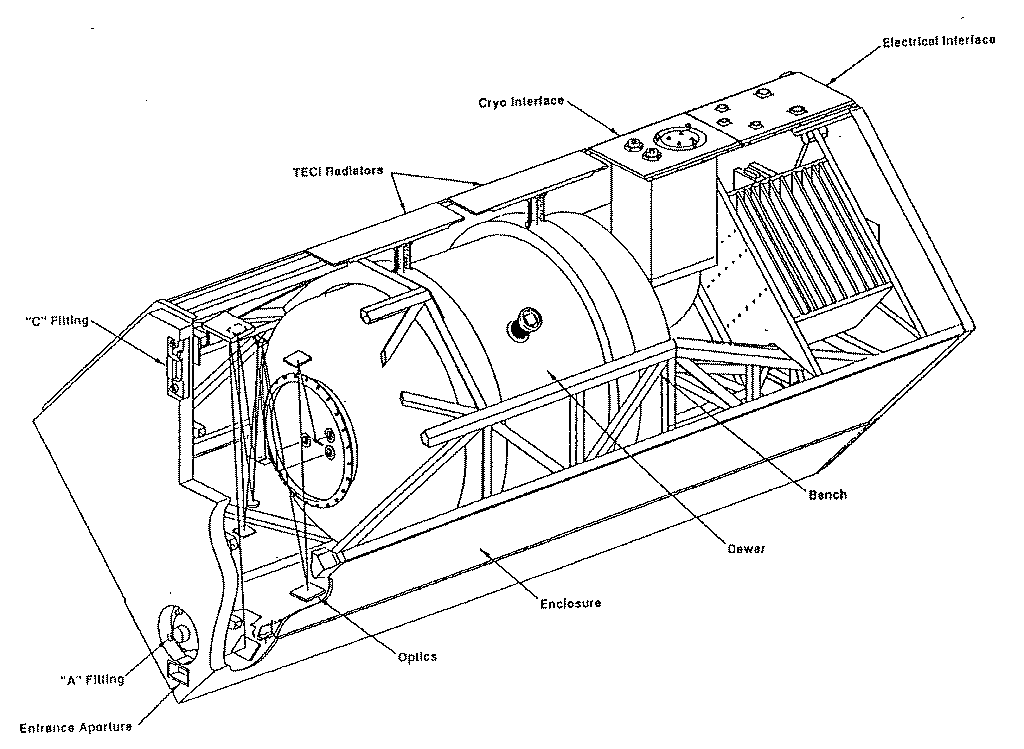
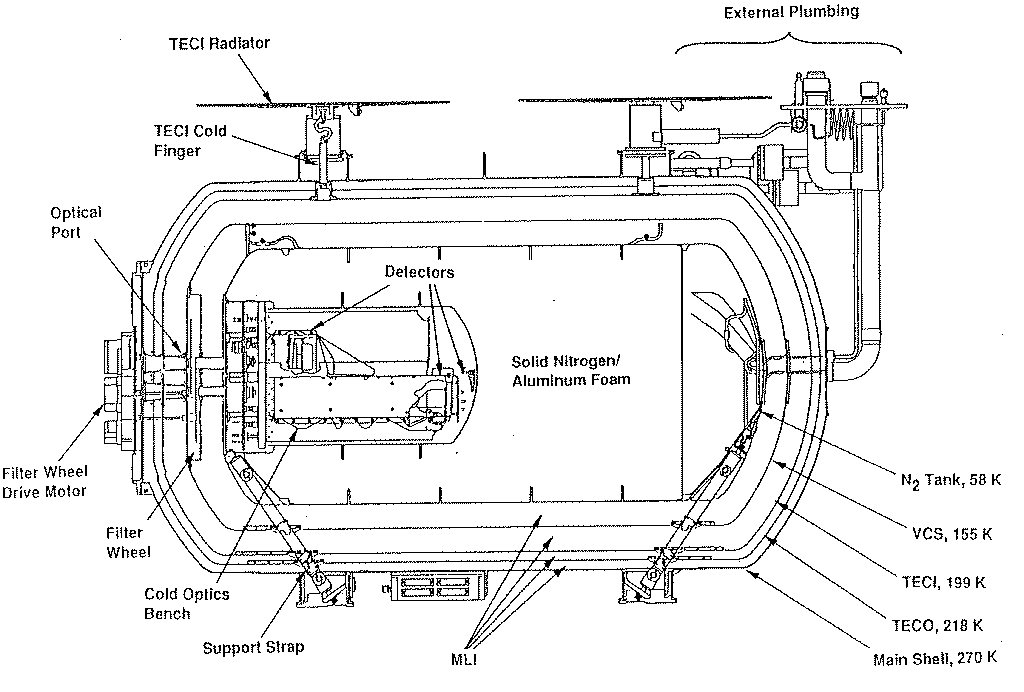
NICMOS is an axial bay instrument which replaced the FOS in the HST aft shroud during the Second HST Servicing Mission in February 1997. Its enclosure contains four major elements: a graphite epoxy bench, the dewar, the fore-optics bench, and the electronics boxes. The large bench serves to establish the alignment and dimensional stability between the HST optics (via the latches or fittings), the room temperature fore optics bench, and the cryogenic optics and detectors mounted inside the dewar. The NICMOS dewar uses solid nitrogen as a cryogen for a design lifetime of approximately 4.5 +/- 0.5 years. Cold gas vented from the dewar is used to cool the vapor cooled shield (VCS) which provides a cold environment for both the dewar and the transmissive optical elements (i.e., the filters, polarizers, and grisms). The VCS is itself enclosed within two layers of thermal electrically cooled shells (TECs).
Figure 3.1 is an overview of the NICMOS instrument; Figure 3.2 shows details of the dewar.
Figure 3.1: Instrument Overview
Enlarged Figure 3.1
Figure 3.2: Solid Nitrogen Dewar
Enlarged Figure 3.2
Dewar Anomaly
The NICMOS dewar was filled with about 240 pounds of liquid nitrogen which was then solidified (in stages) by passing cold helium gas through a coil located at the aft end (the fore end has the "A" latch and the entrance aperture). This reduced the temperature of the nitrogen to about 40K. During testing and storage, the block of solid nitrogen increased in temperature as expected (from passive heat inputs). To avoid reaching the triple point (at ~63K) the block was recooled approximately every 6-8 weeks using the helium cooling coil. After several iterations of this procedure, it was observed that the focal position of the detectors was moving both with the change in temperature and over the thermal cycles. It became clear that solid nitrogen with aluminum foam (a 1% by volume material included to assure good thermal conductivity as the nitrogen sublimated on orbit), was both structurally quite strong and that the recooling cycle was resulting in cryopumping at the aft (colder) end of the dewar. That is, nitrogen vapor, evaporating from the "warm" fore end of the nitrogen block, froze onto the cooling coil at the aft end. This reduced the vapor pressure at the aft end, pumping more vapor to this end, and prompting more evaporation at the fore end. This process pumped nitrogen from the fore end to the aft end. As the dewar was allowed to warm up, the ice at the aft end pushed in the interior surfaces of the dewar, expanding it. By mid-1996 the three cameras in NICMOS were no-longer confocal although there were good reasons to expect that they would return to a nearly confocal state after a fraction of the nitrogen had evaporated on orbit. At that time a total deformation of ~4 mm had been observed and steps were taken to both assure that the dewar remained flightworthy and that subsequent recooling cycles did not stretch the dewar further. Also, the internal optical alignment and focus mechanism (the Pupil Alignment Mechanism-PAM) was replaced with a version permitting twice the focus range and a demonstrated capability for frequent movement. The PAM, originally intended to align the input beam onto the corrective optic and to bring NICMOS into confocality with the WFPC2 (the only HST instrument without an internal focus mechanism), would be used to support unique focus setting for each NICMOS camera and to switch between them routinely.
After NICMOS was installed in HST, the dewar expanded considerably further than it had on the ground for reasons still not understood. A maximum motion of ~11 mm was observed in March 1997 and a slow contraction since then has occurred. The motion history of NICMOS and the resulting image quality are discussed in Chapter 4.
This unexpectedly large deformation has several undesirable effects:
Imaging Layout
The NICMOS fore-optics assembly is designed to correct the spherically aberrated HST input beam. As shown in the left hand panel of Figure 3.3 it comprises a number of distinct elements. The Pupil Alignment Mechanism/mirror (PAM) directs light from the telescope onto a re-imaging mirror, which focuses an image of the OTA pupil onto an internal Field-Offset Mechanism (FOM) comprising a pupil mirror that provides a small offset capability (26 arcsec). An internal flat field source is also provided. The FOM provides correction for conic error in the OTA pupil.
Figure 3.3: Ray Diagrams of the NICMOS Optical Train.
The left panel shows the fore-optics. The right panel shows the field
divider and re-imaging optics for the three cameras.
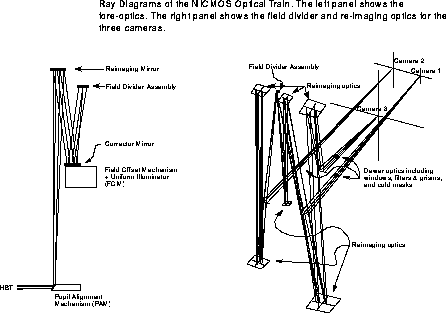
After the FOM, the Field Divider Assembly provides three separate but closely-spaced imaging fields, one for each camera (right hand panel of Figure 3.3). The dewar itself contains a series of cold masks to eliminate stray IR emission from peripheral warm surfaces.
A series of relay mirrors generate different focal lengths and magnifications for the three cameras, each of which contains a dedicated 256 x 256 pixel HgCdTe detector array that is developed from the NICMOS 3 design. NICMOS achieves diffraction limited performance in the high resolution Camera 1, NIC1, longward of 1.0 microns, and in Camera 2, NIC2, longward of 1.75 microns.
The operation of each camera is separate from the others which means that filters, integration times, readout times and readout modes can be different in each, even when two or three are used simultaneously. The basic imaging properties of each of the cameras is summarized in Table 3.3.
Camera 1
Camera 1 (NIC1) provides the highest available spatial resolution with an 11 x 11 arcsec field of view and 43 milliarcsec sized pixels (equivalent to the WFPC2 PC pixel scale). The filter complement includes broad and medium band filters covering the spectral range from 0.8 to 1.8 microns and narrow band filters for Paschen  , He I, [Fe II]
  1.64µm, and [S III] 0.953 µm, both on and off band. It is equipped with the short wavelength polarizers (0.8 to 1.3 microns).
Camera 2
Camera 2 (NIC2) provides an intermediate spatial resolution with a 19.2 x 19.2 arcsec field of view and 75 mas pixels. The filters include broad and medium band filters covering the spectral range from 0.8 to 2.45 microns. The filter set also includes filters for CO, Brackett  , H2 S2 (1-0) 2.122 µm, Paschen , HCO2 + C2, and the long wavelength polarizers (1.9-2.1 microns). Camera 2 also provides a coronographic mask with a 300 milliarcsec radius.
Camera 3
Camera 3 (NIC3) provides the lowest spatial resolution with a large 51.2 x 51.2 arcsec field of view and 200 milliarcsec pixels. It includes broad filters covering the spectral range 0.8 to 2.3 microns, medium band filters for the CO band (and an adjacent shorter wavelength continuum region), and narrow band filters for H2 S2 (1-0), [Si VI] 1.962 µm, Paschen-, [Fe II] 1.64 µm, and He I 1.083 µm. Camera 3 also contains the multi-object spectroscopic capability of NICMOS with grisms covering the wavelength ranges 0.8-1.2 microns, 1.1-1.9 microns, and 1.4-2.5 microns.
Placement and Orientation of Cameras
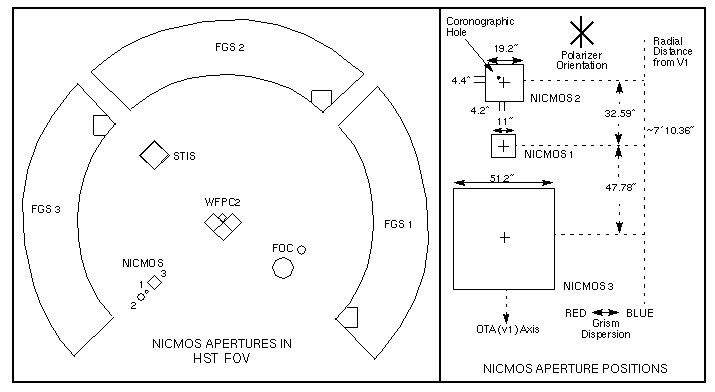
The placement and orientation of the NICMOS cameras in the HST focal plane is shown in Figure 3.4. Notice that the cameras are in a straight line pointing radially outward from the center of the telescope focal plane. From the observer's point of view the most important aspect of the layout of NICMOS comes when trying to plan an observation of an extended source with all three cameras simultaneously, when the user must bear in mind the relative positions and orientations of the three cameras. Note that the gaps between the cameras are large, and therefore that getting good positioning for all cameras may be rather difficult.
Note that the position of the NICMOS cameras relative to the HST focal plane (i.e., the FGS frame) depends strongly on the focus position of the PAM. Since independent foci and their associated astrometric solutions are supported for each camera, this is transparent to the observer.
Figure 3.4: NICMOS Field Arrangement
Comparison to WFPC2 and STIS
In addition to NICMOS, between 0.8 and 1.0 microns HST offers the WFPC2 camera for wide field imaging. These two cameras complement each other. The Wide Field CCDs of WFPC2 have an imaging plate scale of ~0.1 arcsec per pixel over each of the three chips, while the PC offers a plate scale of ~0.045 arcsec per pixel on one CCD. The WFPC2 CCDs cover a much larger area of the sky (nearly 160 x 160 arcsec) compared with NICMOS. On the other hand, NICMOS has increasingly higher sensitivity as we move towards 1.0 microns.
A unique feature of the WFPC2 is the presence of ramp filters which permit observations in any narrow bandpass up to 9800Å. These filters are limited to a ~10 x 10 arcsec field of view. The WFPC2 has a narrow band methane filter at 8920Å. Both WFPC2 and NICMOS have [S III] filters. NICMOS offers an adjacent off-band (or slightly redshifted) complementary continuum filter.
In Table 3.4, we summarize the sensitivities of WFPC2 and NICMOS in their region of overlap. In this wavelength region WFPC2's sensitivity is dropping rapidly with increasing wavelength, while NICMOS's is rising. The signal to noise achievable in one hour on a V=20 A0 star is seen to be comparable in the overlap region, and so the choice of which instrument to use is likely to be driven by the field of view desired (WFPC2's is much larger) and whether any further observations are required at either shorter (WFPC2) or longer (NICMOS) wavelengths. NIC3 observations assume that it is in focus.
The Space Telescope Imaging Spectrograph (STIS) also offers CCD based imaging to 1.1 µm with 0.05" pixels and higher quantum efficiency than WFPC2 (although without a useful filter set). Additionally, STIS offers a large complement of slit and slitless spectroscopic capabilities that could complement near-infrared NICMOS science.
[Top] [Prev] [Next] [Bottom]
stevens@stsci.edu
Copyright © 1997, Association of Universities for Research in Astronomy. All rights
reserved.
Last updated: 07/24/97 15:17:04