[Top] [Prev] [Next] [Bottom]
Designing NICMOS Observations
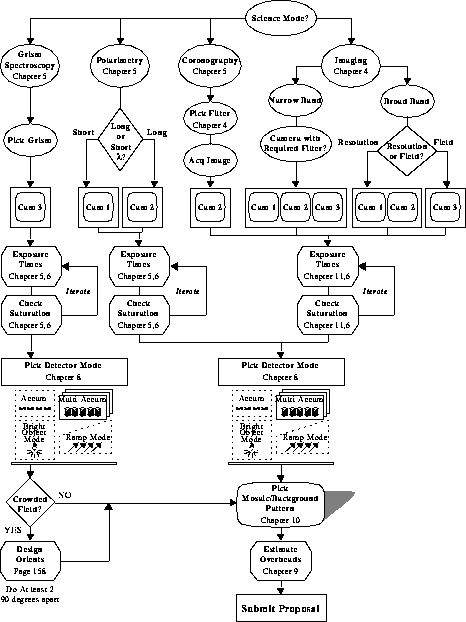
In the preceding sections, we provided you with an overview of the scientific capabilities of NICMOS and the basic layout and operation of the instrument. Subsequent chapters will provide detailed information about the performance and operation of the instrument. In this section, we describe the conceptual steps you will need to take when designing a NICMOS observing proposal. The basic sequence of steps in defining a NICMOS observation are shown in flow diagram form in Figure 3.7, and are:
- Identify your science requirements and select the basic NICMOS configuration to support those requirements (e.g., imaging, polarimetry, coronography). Refer to the detailed accounts given in Chapter 4 and Chapter 5.
- Select the wavelength region of interest and hence determine if your observations will be Background or Read-Noise limited using the Exposure Time Calculator available on the STScI NICMOS WWW page (see Chapters 4 and 6).
- Establish which MULTIACCUM sequence you need to use. Detailed descriptions of these are provided in Chapter 8. This does not need to be specified in a Phase I proposal. However, if you require a readout mode other than MULTIACCUM this should be justified in the Phase I proposal.
- Estimate the exposure time to achieve the required signal to noise ratio and check feasibility (i.e., saturation and bright object limits). To determine your exposure time requirements and assess whether you are close to the brightness and dynamic range limitations of the detectors, use the Exposure Time Calculator.
- If necessary choose a chop and dithering pattern either to measure the background or to enable mapping of areas bigger than the field of view of the NICMOS cameras you plan to use. See Chapter 10.
- If you are doing coronographic observations, additional target acquisition exposures will be required to center your target in the aperture to the accuracy required for your scientific aims (e.g., you may wish to center the nucleus of a galaxy in a crowded field behind the coronographic spot).
- Calculate the total number of orbits required, taking into account the overheads. In this, the final step, you combine all your exposures (science and non-science, alike) into orbits, using tabulated overheads, and determine the total number of orbits you require. Refer to Chapter 9 when performing this step.
Figure 3.7: Specifying a NICMOS Observation
Zoom to larger view
[Top] [Prev] [Next] [Bottom]
stevens@stsci.edu
Copyright © 1997, Association of Universities for Research in Astronomy. All rights
reserved.
Last updated: 07/24/97 15:17:04