[Top] [Prev] [Next] [Bottom]
Grism Spectroscopy
A grism is a combination of a prism and grating arranged to keep light at a chosen central wavelength undeviated as it passes through the grism. Grisms are normally used to create spectra in a camera by inserting the grism into the normal camera beam. The grism then creates a dispersed spectrum centered on the location of the object in the camera field of view. The resolution of a grism is proportional to the tangent of the wedge angle of the prism in much the same way as the resolution of gratings are proportional to the angle between the input and the normal to the grating.
NICMOS uses this mode of operation without any slit or aperture at the input focus so that all objects in the field of view display their spectra for true multi-object spectroscopy. The NICMOS grisms operate in the spectral range between 0.8 and 2.5 µm. The grisms reside in the filter wheel for Camera 3, therefore the spatial resolution of the spectroscopy is similar to the spatial resolution of Camera 3. The filter wheel contains three grisms, of infrared grade fused silica, which cover the entire NICMOS wavelength range with a spectral resolving power of ~200 per pixel.
 Since the Grisms are located exclusively in Camera 3, they are subject to the same
limitations and policies as all other NIC3 observations.
Since the Grisms are located exclusively in Camera 3, they are subject to the same
limitations and policies as all other NIC3 observations.
Also, so far all SMOV grism tests have been obtained with NIC3 significantly out
of focus. These data suggest that the grisms will perform as expected.
The two shorter wavelength grisms exploit the low natural background of HST while the longest wavelength grism is subject to the thermal background emission from HST.
The NICMOS grisms have an interference filter coated on their entrance faces to limit the bandpass of the spectrum. This is necessary to prevent overlap of orders and reduce thermal background from the telescope. Since the NICMOS grisms do not have an input slit or aperture, there is not a reduction of the background flux found in slit dispersing systems. This is not a significant problem in the shorter wavelengths, but the long wavelength grism has a high background flux.
The basic parameters of the NICMOS grisms are given in Table 5.1.
Relationship Between Wavelength and Pixel
Table 5.2 gives the dispersion relationship in the form:
wavelength = m*pixel + b,
where wavelength is in microns and the 0 pixel is at the central wavelength. The relationship is plotted in Figure 5.8. The actual location of the plus and minus pixels will be dependent on the grism orientation and the location of the source in the image. The grisms are aligned as accurately as possible along a row or column of the array. We do not expect any distortion or curvature in the spectrum.
The orientation and position of the spectra relative to the direct object has been measured in orbit and has been confirmed to be identical to the Thermal Vacuum measurements. The current best estimates of the dispersion relations are those measured before launch.
Figure 5.8: Wavelength Versus Pixel Number for each Grism. Note that the actual location of the central wavelength on the detector depends on the position of the source.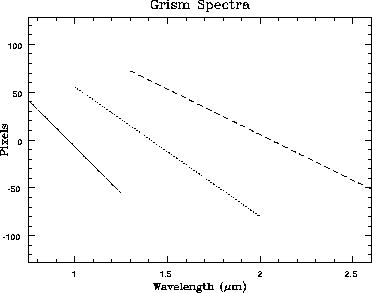
Multi-Object Spectroscopy
Grism observations are carried out in the same manner as any of the imaging operations discussed earlier. In multi-object spectroscopy one of the grisms in the filter wheel for NIC3 will be selected. The observations then proceed via one of the readout and operation modes discussed later.
Although multi-object spectroscopic observations can stand alone with no supporting observations, we recommend pairing them with an image in Camera 3, through an appropriate filter, at the same pointing. This provides the location of each object in the field and aids in the identification of their individual spectra. Because of this natural pairing it is anticipated that most spectroscopy observations will be in at least a two image sequenced observation.
The direction of dispersion is perpendicular to the radial direction in Camera 3 where the radial direction is defined by a vector originating at the center of the field of view for Camera 3 and pointing toward the center of the OTA axis. In complex fields, such as extended objects and crowded fields, individual spectra of targets may overlap and cause confused images. In such cases, it may be possible to alleviate the superposition of spectra by requesting a specific orientation of the telescope during the Phase II Proposal submission. For complex fields, several different orientations may be necessary so that the individual spectra can be deconvolved from those of other sources in the field. It should be recognized that specifying an orientation for a grism observation creates constraints on the number of visibility windows available for scheduling. If different orientations are needed to unscramble the source spectra, then this will make telescope scheduling difficult.
Since Camera 3 may only be available for use during one or two campaigns (at presently unknown dates), some orientation constraints could easily prove impossible to satisfy.
Grism Decision Chart
The decision chart given in Figure 5.9 leads you through the construction of a grism observation.
Figure 5.9: Grism Decision Chart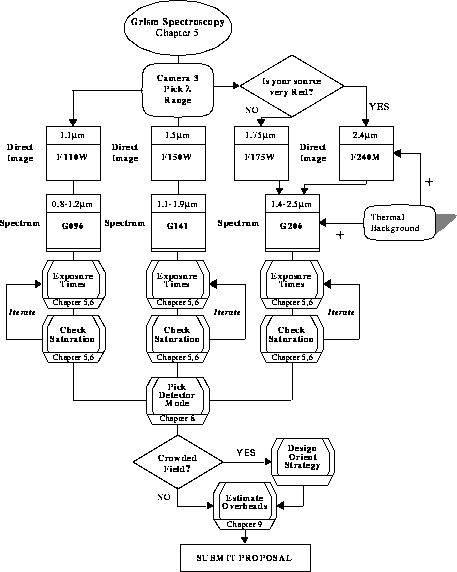
Sensitivity
Background radiation will be a greater concern for grisms than for imaging observations. Every pixel on the array will receive background radiation over the spectral bandpass of the particular grism, while the source spectrum will be dispersed over many pixels. Therefore, the ratio of the source to background flux will be much lower for the grisms than for the regular imaging mode filters. The expected detected background rate per pixel is shown in Table 5.3 below for the three grisms. The increase in the background flux for grism C is dramatic. Use grisms A and B when possible. Grism C is for the longer wavelengths only.
Table 5.3: Grism Background Radiation
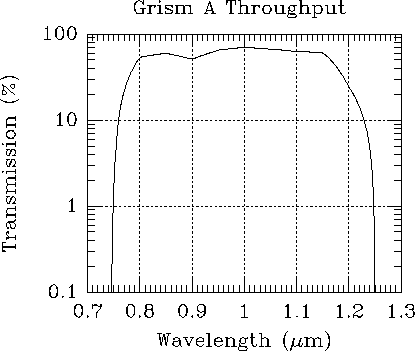
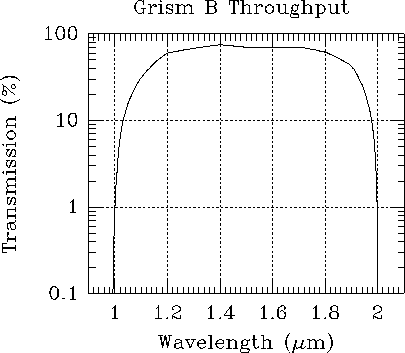
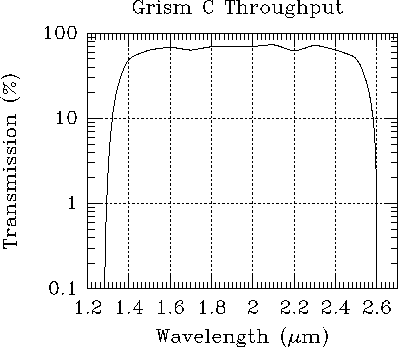
Figures 5.10 through 5.12 present the basic information for the three NICMOS grisms. Note that for Grism C, the large thermal background means that exposures can never be longer than about five minutes, even for faint sources, because the detector will be saturated by the background. As with other modes, observers should use the Exposure Time Calculator to estimate the signal-to-noise and exposure times for grism observations.
The ETC also provides a line correction factor curve. To use this, find the wavelength of your line and read off the correction factor  G from the graph. As described in Chapter 4 multiply the line flux by this factor and add to the continuum flux. The integration time may now be calculated from the sensitivity curve as if you had a pure continuum source. To use the sensitivity curves look up the integration time required for your source flux on the sensitivity curve for the signal to noise you want. Then go to the associated exclusion zone curve and check that you are not in the shaded areas. If you are, adjust your integration time appropriately until you are in the clear area. If you are to the left of the vertical dashed line then you must use bright object mode.
Grism A: G096
Figure 5.10: Grism A Throughput.
Grism B: G141
Thermal background is important.
Figure 5.11: Grism B Throughput.
Grism C: G206
High thermal background. Use only for bright sources.
Figure 5.12: The Grism C Throughput.
Grism Analysis Software
Software is being developed at the ST-ECF for the analysis of grism observations. Using this, the observer will be able to fully extract spectra of single objects from the images, including the disentanglement of overlapping spectra and extended sources. To obtain the best results it is recommended in fields with multiple or extended sources that grism images be obtained at more than one spacecraft roll angle (preferably 3 or more), and it is essential that the image spectrum pair be obtained as described. If the matching image is not obtained, reduction and analysis of the grism data may be very difficult.
Grism images can be calibrated in the regular way using Calnic A. Calnic A will perform all steps as for direct images with the exception of flatfielding. This step is skipped, and the quantum efficiency as a function of wavelength should be taken into account when extracting spectra. Software to extract spectra from calibrated grism images has been developed at the Space Telescope - European Coordinating Facility (ST-ECF). The programs are written in IDL, and a valid IDL license is necessary to run those programs. The software is available at http://ecf.hq.eso.org/nicmos/nicmos.html. There are two versions of the grism extraction software, the interactive version NICMOSlook and the pipeline program "Calnic C". For detailed documentation on the programs, consult the above WWW page or contact Wolfram Freudling (wfreudli@eso.org). The programs run both under IDL 4.x and IDL 5.0.
For grism spectroscopy of extended objects or crowded fields, observations of the same field with a variety of roll angles is advisable. Such data might be handled by extracting the spectra of a particular object from the image where there is the least amount of blending of the spectrum with other objects. A more promising procedure is to reconstruct a position-wavelength cube with a simultaneous deconvolution of all the grism images. Experimental software (again in IDL) has been developed at ST-ECF and further information is available at http://ecf.hq.eso.org/nicmos/nicmos.html.
[Top] [Prev] [Next] [Bottom]
stevens@stsci.edu
Copyright © 1997, Association of Universities for Research in Astronomy. All rights
reserved.
Last updated: 07/24/97 15:31:56