


1.1.1 Field-of-View
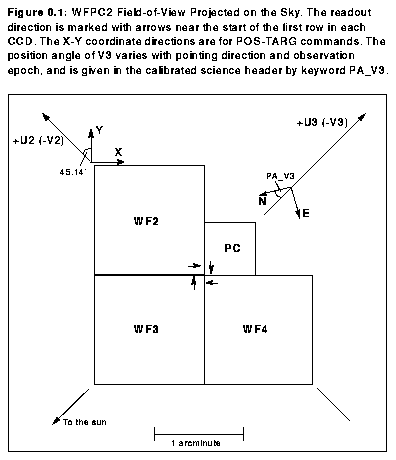
The WFPC2 field-of-view is divided into four cameras by a four-faceted pyramid mirror near the HST focal plane. Each of the four cameras contains an 800x800 pixel Loral CCD detector. Three cameras operate at an image scale of 0.1" per pixel (F/12.9) and comprise the Wide Field Camera (WFC) with an "L" shaped field-of-view. The fourth camera operates at 0.046" per pixel (F/28.3) and is referred to as the Planetary Camera (PC). There are thus four sets of relay optics and CCD sensors in WFPC2. The four cameras are called PC1, WF2, WF3, and WF4, and their fields-of-view are illustrated in Figure 1.1 (see also "CCD Position and Orientation on Sky" on page 159). Each image is a mosaic of three F/12.9 images and one F/28.3 image.
Figure 1.1: WFPC2 Field of View Projected on the Sky.
Narrow band filters include those for emission lines of Ne V (3426Å), CN (~3900Å), [OIII] (4363Å and 5007Å), He II (4686Å), Hb (4861Å), He I (5876Å), [OI] (6300Å), Ha (6563Å), [NII] (6583Å), [SII] (6716Å and 6731Å), and [SIII] (9531Å). The narrow-band filters are designed to have the same dimensionless bandpass profile. Center wavelengths and profiles are uniformly accurate over the filter clear apertures, and laboratory calibrations include profiles, blocking, and temperature shift coefficients.
There are also two narrow band "quad" filters, each containing four separate filters which image a limited field-of-view: the UV quad contains filters for observing redshifted [OII] emission and are centered at 3767Å, 3831Å, 3915Å, and 3993Å. The Methane quad contains filters at 5433Å, 6193Å, 7274Å, and 8929Å. Finally, there is a set of narrow band "linear ramp filters" (LRFs) which are continuously tunable from 3170Å to 9762Å; these provide a limited field-of-view with diameter ~10" .
At ultraviolet wavelengths there is a solar-blind Wood's UV filter (1200-1900Å). The UV capability is also enhanced by control of UV absorbing molecular contamination, the capability to remove UV absorbing accumulations on cold CCD windows without disrupting the CCD quantum efficiencies and flat field calibrations, and an internal source of UV reference flat field images.
Finally, there is a set of four polarizers set at four different angles, which can be used in conjunction with other filters for polarimetric measurements. However, due to the relatively high instrumental polarization of WFPC2, they are probably suitable only for measurements on strongly polarized sources (>3% polarized).
Exposures of bright targets are limited by saturation effects, which appear above ~53000 detected photons per pixel (for setting ATD-GAIN=15), and by the shortest exposure time which is 0.11 seconds. There are no instrument safety issues associated with bright targets. Detection of faint targets is limited by the sky background for broad band filters at visual wavelengths. For narrow band and ultraviolet filters, detections are limited by noise in the read-out amplifier ("read noise"), which contributes an RMS noise equivalent to ~5 detected photons per pixel.
Mechanisms inside WFPC2 allow optical alignment on-orbit. The 47 pick-off mirror has two-axis tilt capabilities provided by stepper motors and flexure linkages, to compensate for uncertainties in our knowledge of HST's latch positions (i.e., instrument tilt with respect to the HST optical axis). These latch uncertainties would be insignificant in an unaberrated telescope, but must be compensated for in a corrective optical system. In addition, three of the four fold mirrors, internal to the WFPC2 optical bench, have limited two-axis tilt motions provided by electrostrictive ceramic actuators and invar flexure mountings. Fold mirrors for the PC1, WF3, and WF4 cameras are articulated, while the WF2 fold mirror has a fixed invar mounting. A combination of the pick-off mirror and actuated fold mirror (AFMs) has allowed us to correct for pupil image misalignments in all four cameras. Since the initial alignment, stability has been such that mirror adjustments have not been necessary. The mechanisms are not available for GO commanding.
1.1.2 Spectral Filters
The WFPC2 contains 48 filters mounted in 12 wheels of the Selectable Optical Filter Assembly (SOFA). These include a set of broad band filters approximating Johnson-Cousins UBVRI, as well as a set of wide U, B, V, and R filters, and a set of medium bandwidth Strömgren u, v, b, and y filters. 1.1.3 Quantum Efficiency and Exposure Limits
The quantum efficiency (QE) of WFPC2+HST peaks at 13% in the red, and remains above 5% over the visible spectrum. The UV response extends to Lyman a wavelengths (QE~0.5%). Internal optics provide spherical aberration correction.1.1.4 CCD Detector Technology
The WFPC2 CCDs are thick, front-side illuminated devices made by Loral. They support multi-pinned phase (MPP) operation which eliminates quantum efficiency hysteresis. They have a Lumogen phosphor coating to give UV sensitivity. Details may be summarized as follows:
1.1.5 UV Imaging
WFPC2 had a design goal of 1% photometric stability at 1470Å over a month. This requires a contamination collection rate of less than 47 ng cm-2 month-1 on the cold CCD window. Hence, the following features were designed into WFPC2 in an effort to reduce contaminants:
The CCDs were initially operated at -77 C after launch, which was a compromise between being as warm as possible for contamination reasons, while being sufficiently cold for an adequate dark rate. However, at this temperature significant photometric errors were introduced by low-level traps in the CCDs. This problem with the charge transfer efficiency of the CCDs has been reduced since 23 April 1994 by operating the CCDs at -88 C, but this leads to significantly higher contamination rates than hoped for. On-orbit measurements indicate that there is now a decrease in throughput at a repeatable rate of ~30% per month at 1700Å, and moreover, that monthly decontamination procedures are able to remove the contaminants completely and recover this loss.1.1.6 Aberration Correction and Optical Alignment
WFPC2 contains internal corrections for the spherical aberration of the HST primary mirror. These corrections are made by highly aspheric surfaces figured onto the Cassegrain relay secondary mirror inside each of the four cameras. Complete correction of the aberration depends on a precise alignment between the OTA pupil and these relay mirrors.