
NICMOS Instrument Handbook for Cycle 11
 |
 |
 |
 |
|
| NICMOS Instrument Handbook for Cycle 11 | |||
|
Bright Object Mode
The time taken to read through a quadrant on the array sets a fundamental limit on the fastest electron collection rate which can be achieved by resetting all the pixels. An inherent consequence of the methods of operating the NICMOS array detectors in the
ACCUMandMULTIACCUMmodes is therefore that there is a minimum possible exposure time, ~ 0.6 seconds (0.203 forMULTIACCUM), set by the time required to read the array. For a very bright object, such as the disk of Jupiter, the time between the reset of a pixel, and its final read is sufficiently long that the pixel saturates. Although the detector arrays are multiplexed by division into four quadrants, each pixel in a 128 x 128 pixel quadrant must be sampled in some order (note that there is no transfer of charge as is done in a CCD).The solution adopted to this problem for NICMOS is the provision of a bright object mode which enables targets to be observed which are ~600 times brighter than is possible in the other modes without saturating. In
Figure A3.1: Bright Object Mode OperationBRIGHTOBJmode, anACCUMsequence of operations is performed on one pixel in each quadrant at a time. That is, the pixel is reset, read, integrated, and read again with the difference between the final and initial readouts being stored as the measured signal and the interval between the reads being the exposure time. This process is repeated sequentially for all pixels in each quadrant. Users can think of this as integrating on a single pixel at a time. The smallest integration time which can be used is 1.024 milliseconds. Figure A3.1 illustrates the operation of bright object mode. Initially, the entire detector is reset. then the first pixel (solid shading) in each quadrant is read. After the requested integration time, the first pixel in each quadrant is read again. Then the second pixel in each quadrant is reset, then read, integrated, and read again. The process continues until all 16,384 pixels in each quadrant have been read twice, separated by the integration time. The image downlinked is made up of the difference between the two reads of each pixel.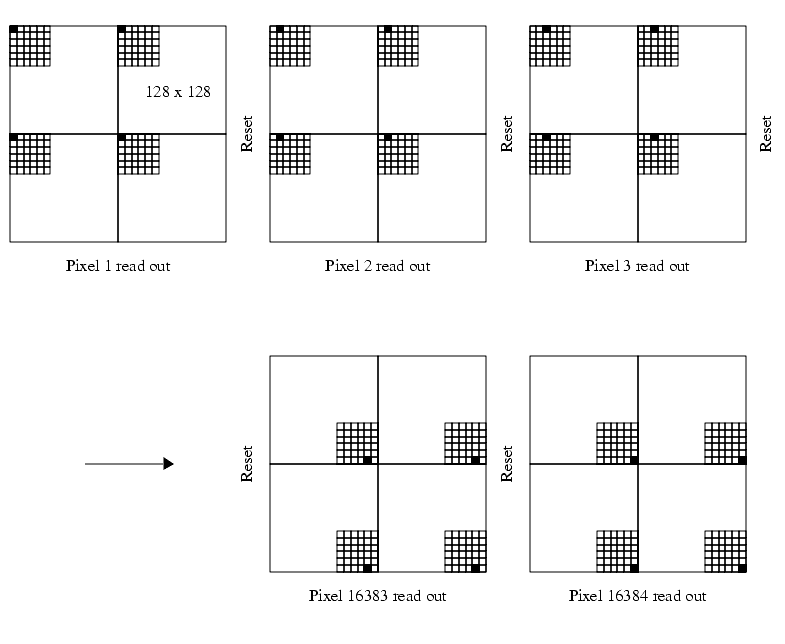
The time required to take a
BRIGHTOBJmode exposure can be rather long. Since photons are only collected in one pixel per quadrant at a time, the time associated with obtaining the frame iswhere EXPTIME is the integration time per pixel (i.e. the observation time is approximately (1282) x the exposure time). For example, if an integration time of 0.1 seconds is used to observe a bright target then the actual time required to complete the observation would be around 27 minutes! This means that allowing for acquisition time only two such exposures could be obtained in a single target visibility period. However, it is not always so serious. In the case of Jupiter for example the integration times required per pixel are only of the order of milliseconds and so the total integration time will only be around 20 seconds.
The longest exposure time which is possible in
BRIGHTOBJmode is 0.261 seconds, requiring 4278 seconds in total. Thus it is possible, in the worst case, for a singleBRIGHTOBJmode exposure to use more than an orbit. In general observers are strongly advised to consider the trade-off between relatively longBRIGHTOBJmode exposures (which take the longest time) and shortMULTIACCUMmode exposures (perhaps using a narrow filter).The advantage of this mode of operation is the ability to acquire objects significantly brighter than the normal saturation limit of the detector.
The disadvantages are several:
- The zeropoint in this mode is strongly non-linear, such non-linearity has not been characterized (nor are there plans to do so). Observations obtained with this mode are not calibrated and possibly not easily calibratable).
- Some observations will take a long time.
BRIGHTOBJmode exposures are therefore very sensitive to the quality of the pointing of HST. They should not be obtained usingGYROguiding mode. In addition, if the object changes (planetary rotation) or if the telescope pointing changes it will affect different parts of the image differently.- The D.C. offset of the detector output is not directly removed in this mode of operation. In general, the signal is very high and the offset does not matter. In some cases it will and this can be a detriment to the signal accuracy.
- There is also no cosmic ray correction or saturation detection in this mode of operation. Although they are still susceptible to cosmic rays, events should be very rare as the integration time per pixel is very short.
|
Space Telescope Science Institute http://www.stsci.edu Voice: (410) 338-1082 help@stsci.edu |
| |
|
|
|