
NICMOS Instrument Handbook for Cycle 11
 |
 |
 |
 |
|
| NICMOS Instrument Handbook for Cycle 11 | |||
|
Accumulate Mode
The Accumulate Readout Mode (
ACCUM) generates the simplest basic exposure. In its simplest incarnation, two sample readout, illustrated in Figure 8.1 it is analogous to a WFPC2 readout. This simple two sample readout strategy is the one to use for short integrations of relatively bright objects, and when you are observing in the background limited regime at long wavelengths. This section is therefore a good place to start to get familiar with the concepts inherent in the operation of the NICMOS arrays, including their non-destructive readout capabilities. The allowedACCUMmode integration times are restricted to 173 tabular values.The first action of an
Figure 8.1: Basic NICMOS Readout-Simple Two-Sample ReadoutACCUMexposure is three passes through the detector resetting all pixels. The reset is immediately followed by a fourth pass through the detector non-destructively reading and storing the pixel values. This marks the beginning of the integration. The final action is a second non-destructive reading of the detector, which marks the end of the integration. The returned image is the difference between the second and the first pass pixel values, and the integration time is defined as the time between the first and second read of the first pixel. The minimum exposure time is ~ 0.6 sec, and the minimum time between successive exposures is ~ 8-12 seconds. ACCUM does not allow pipeline identification of cosmic ray events or to correct for pixel saturation.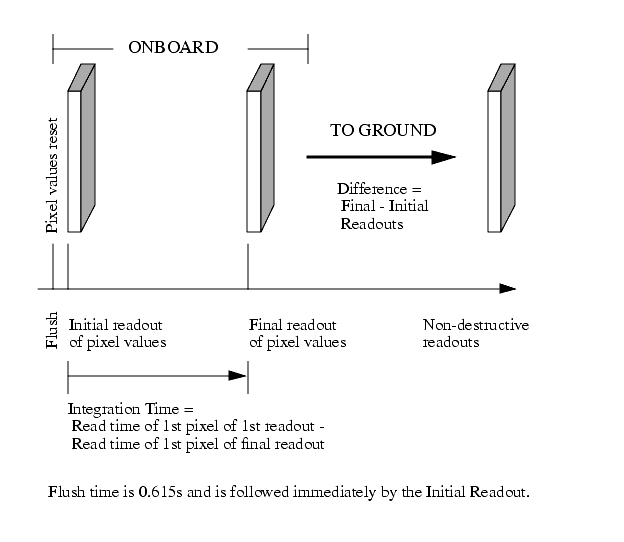
Multiple Initial and Final Sample Readout
The observer has the option of requesting multiple reads in place of the single initial and final readouts in
ACCUMmode. In this case after the detector array is reset it will be followed by 1-25 (specified by theNREADparameter) reads of the initial pixel values which are averaged onboard to define the initial signal level. After the exposure time has elapsed, the final pixel values are again readNREADtimes and averaged onboard. The data downlinked is the difference between the initial and final average signal levels for each pixel. The integration time is defined as the time between the first read of the first pixel in the initialNREADpasses and the first read of the first pixel in the finalNREADpasses. The use of multiple reads inACCUMmode is illustrated in Figure 8.2 for the case ofNREAD= 4.

For Cycle 11 only NREAD =1 or 9 is supported (any other values are considered "available"-unsupported-modes).
The advantage of this method is a reduction in the read noise associated with the initial and final reads, which can reduce the noise in intermediate time integrations on faint sources. In theory the read noise should be reduced by 1/(n)1/2 where n is the number of reads. However, the amplifier glow (see Chapter 7) adds extra signal and associated photon noise for each read, especially towards the corners of the array. Amplifier glow is an additive noise source large enough that for
Figure 8.2:NREAD> 9 there is little further gain in noise. In practice, the maximum improvement in effective read noise over a single initial and final read is no larger than a factor 40-50%, due to the added amplifier glow that each read-out adds to the final noise budget. For integrations where source photon noise or dark current noise exceeds the detector read noise the multiple readouts may not offer much advantage. This option puts a higher burden on the CPU and requires an additional time per readout of 0.3 seconds inFASTmode. This mode does not allow pipeline identification of cosmic ray events or to correct for pixel saturation.ACCUMMode with Four Initial and Final Readouts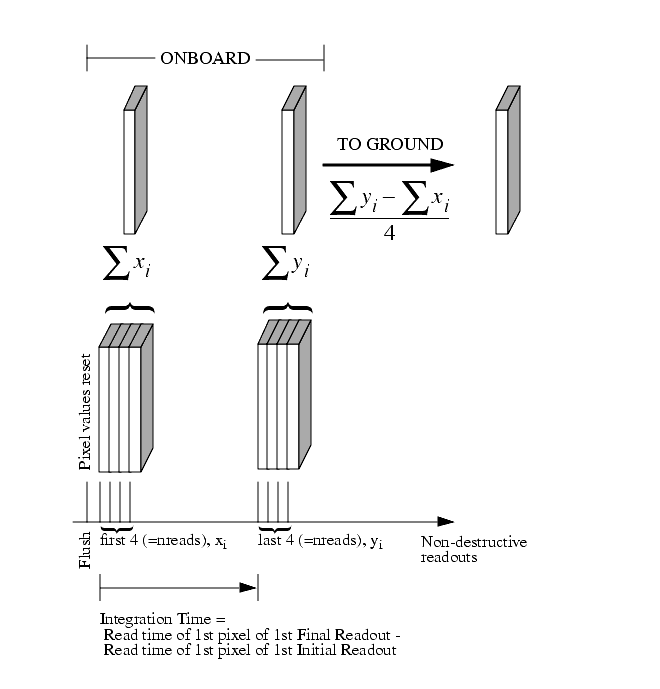
|
Space Telescope Science Institute http://www.stsci.edu Voice: (410) 338-1082 help@stsci.edu |
| |
|
|
|