
NICMOS Instrument Handbook for Cycle 11
 |
 |
 |
 |
|
| NICMOS Instrument Handbook for Cycle 11 | |||
|
Multiple-Accumulate Mode
Normally a single integration on a target results in a single 256x256 image at the termination of the exposure. The non-destructive nature of the NICMOS readout offers more elaborate methods of using the instrument which aim to optimize the scientific content of the results. In particular it is possible to read-out images at intermediate stages of an integration and return both these and the final image to the ground. In this mode of operation, known as Multiple-Accumulate (
MULTIACCUM), each intermediate readout can only consist of a single readout. The observer uses this capability by creating a list of times, specified by theSAMP-TIMEparameters, at which the detector pixels are read out non-destructively creating images of various integration times. The choice of read times during the integration is very flexible, for example they might be linearly spaced or logarithmically spaced. Linearly spaced exposures may be useful for faint targets where cosmic ray filtering is important while logarithmically spaced exposures permit the observation of a wide dynamic range. The process is shown schematically in Figure 8.3 for the case of logarithmically spaced intervals withNSAMP=4. InMULTIACCUMthe detector reset is followed by a single read of the initial pixel values. Then a sequence of non-destructive array readouts are obtained at observer specified times. Up to 25 readouts can be specified spanning a total integration time from 0.203 seconds to 8590.0 seconds. The last read of the detector array ends the exposure and thus the lastSAMP-TIMEwill be equal to the total exposure time. All of the readouts, including the initial readout, are stored and downlinked without any onboard processing. This is different thanACCUMmode as the initial read is also returned and no on board subtraction occurs. For N readouts, this mode requires the storage and transmission (downlink) of N+1 times as much data volume forACCUMmode.In most cases,
MULTIACCUMmode provides the highest quality scientific data. The benefits of obtaining observations inMULTIACCUMmode fall into two areas.
- The dynamic range of the observation is greatly increased. Rather than being limited by the charge capacity of a NICMOS pixel (a few x 105 electrons), an observation's dynamic range is in principle limited by the product of the pixel capacity and the ratio of the longest and shortest exposures (8590.0 and 0.203 seconds). In practice, the PSF and internal stray light will probably be the limiting factors.
- An image can be reconstructed by processing of the stack of readouts to cope with the effects of cosmic rays and saturation.
Figure 8.3: Example
MULTIACCUMprovides the best choice for deep integrations or integrations on fields with objects of quite different brightness except when the background signal is so bright that it requires the use of short exposures. In the absence of compelling reasons, observers should use MULTIACCUM for all observations.MULTI-ACCUMwithNSAMP= 4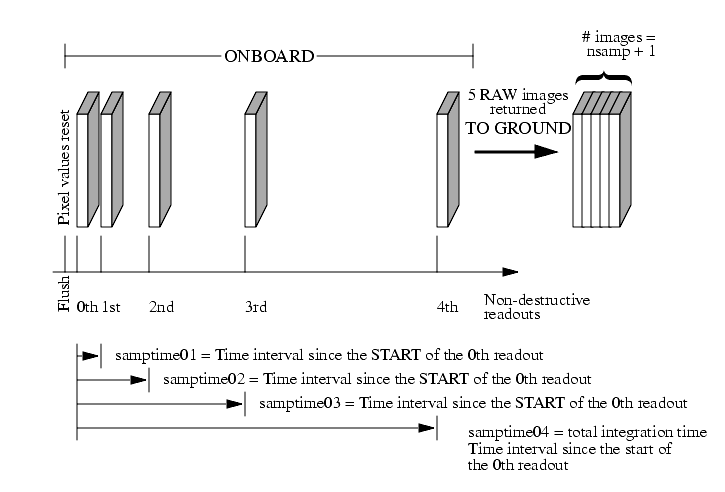
|
Space Telescope Science Institute http://www.stsci.edu Voice: (410) 338-1082 help@stsci.edu |
| |
|
|
|