
HST Data Handbook for WFPC2
 |
 |
 |
 |
 |
|
| HST Data Handbook for WFPC2 | ||||
|
2.4 WFPC2 Paper Products
In the past, observers received a package of so-called paper products as part of the initial data delivery; mailed in paper form, these products provided a quick-look summary of the data. In August 1999, the Archive discontinued printing and mailing of these products; instead, the summaries are now made available in PDF format to observers via the
Archive's Paper Products WWW page. Note, however, that the PDF files on the WWW are available only for the most recent 6 months of data; for older data, observers can generate their own paper products using the STSDAS task pp_dads.2.4.1 Visit-level Output
The pp_dads output consists of two parts, a visit-level overview of the datasets and an exposure-level summary. The visit-level summary is meant to be similar to the observing log in ground-based observations. The information is presented in three separate tables: Target List, Observation List, and Observation Statistics. The Target List gives the targets, including their positions, observed in the visit. The Observation List includes essential information on each dataset, such as rootname, target name, operating mode, aperture, filter, exposure time, and a number of flags intended to alert the user to any procedural problem with the data. The flags are represented graphically by circles, open when the data are okay, filled if any (potential) problem is encountered; see figure 2.2 for a Target List and Observation List example. The Observation Statistics is a table with basic image statistics for each dataset, such as mean counts, background level, and a rough estimate of the limiting magnitude that can be reached with respect to the background level in the image (see figure 2.3). Note that this limiting magnitude is computed with a rather simple, all-purpose algorithm, and is meant only as an approximate indication; it should not be used for any detailed calculations. Image statistics are given separately for each CCD.
2.4.2 Exposure-level Output
The second part of the pp_dads output presents the data exposure by exposure. Usually, there are three pages for each exposure: the first two pages are grayscale representations of the image, one containing all four chips together, the other featuring the PC only (see figure 2.4); the third summarizes various exposure characteristics as well as any flags and error conditions that might have arisen (see figure 2.5). The grayscale presentation on the first page of the four chips together is a crude mosaic; each chip is rotated and placed in the correct position with respect to the others, but the overlap and the small differential rotations between chips (see chapter 1) are not corrected. The next page presents the PC by itself, at a larger scale, which enhances smaller details not evident in the mosaic. The third page, containing the dataset information, is divided into several zones, each summarizing information on a specific topic: the HST Spacecraft Performance Summary, with information on pointing and jitter; the Pipeline Processing Summary, with information on whether the file was processed properly by the pipeline (see chapter 3); the Calibration Data Quality Summary, where any inconsistencies in the choices of calibration files are highlighted; the Exposure Summary, which details when and how the exposure was taken; and the Calibration Status Summary, which reports all reference files used in the calibration and their pedigree, if available. Some basic consistency checks are carried out and the user is alerted to any potential problems.
2.4.3 A note about grayscales
A few comments are in order regarding the grayscale representation of the data. The images are presented as they appear after the standard pipeline processing (see chapter 3). Bias, standard dark, and flatfield corrections have been applied, but hot pixels and cosmic rays are not removed; hence, many images will appear mottled, especially those with exposure times longer than a few hundred seconds. In order to limit the size of the printouts, images are block-averaged (2 x 2), causing some details to be lost. In general, because of the limited resolution of even good black-and-white printers, finer image details are lost (see figure 2.4); the grayscale images cannot in any way replace even a quick look on the screen.
Paper products shipped before August 1997 differ from the current pp_dads output in two main respects. First, they did not have the visit-level summary of observations; some of the information was available via the tape log, but without any data quality flags or image statistics. Second, the exposure-level information was presented in a different way; the dataset information page consisted simply of a printout of the PDQ file (see PDQ Files in appendix B). The grayscale images were produced by a different task, which gave them a different appearance, but the overall information content in them was very similar to the current output. Sample paper products in the current format are shown in figure 2.2 - 2.5. Users who have received paper products in the old format can regenerate them in the new format using pp_dads.
2.4.4 Obtaining paper products
Observers with data taken within the last 6 months may obtain PDF format versions of the paper products from the
Archive's Paper Products WWW page. The query form provides a wide variety of search options such as dataset name, proposal number, observation date, and so on. Any questions or requests for assistance with the search may be directed toarchive@stsci.edu.For data older than 6 months, observers can generate the data products using the STSDAS task pp_dads. At a minimum, the task requires the calibrated science image (
c0h/c0d) and the standard header information (shh/shd) as input files. The jitter files (see section C.3 in appendix C) are optional; if they are missing, the summary of the spacecraft performance information (see figure 2.5), including number of recenterings and jitter measurements in V2 and V3, are left blank by the task.To generate the paper products, load the stsdas, hst_calib, and paperprod packages, then execute the task in the directory containing the input files. The device parameter specifies the output device. In the example below, psi_land directs the summaries to a postscript file, which is written to the /tmp directory. The output_select parameter provides control over the information summarized: cover page, visit page, exposure pages, or all output. Please refer to the online STSDAS help for pp_dads for more details on the available parameters and options.
Figure 2.2: Paper Products: List of Targets and Observations
cl> stsdas
cl> hst_calib
cl> paperprod
cl>pp_dads u*c0h device=psi_land output_select=all
=== Space Telescope Paper Product, Version 2.33 (April 24, 2001) ===
/tmp/psk6741a
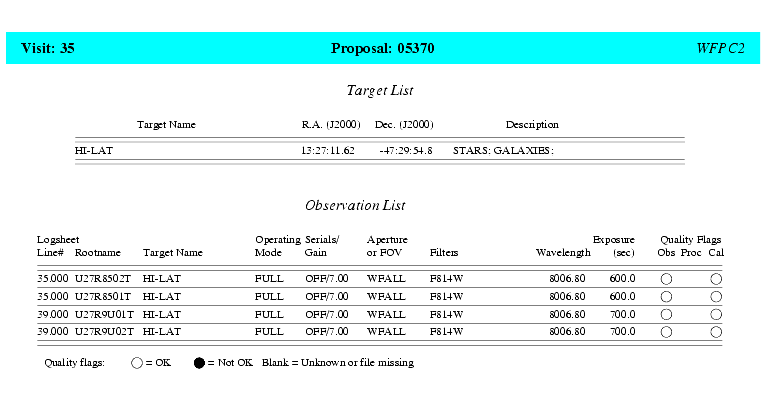
Figure 2.3: Paper Products: Observation Statistics (separately for each CCD)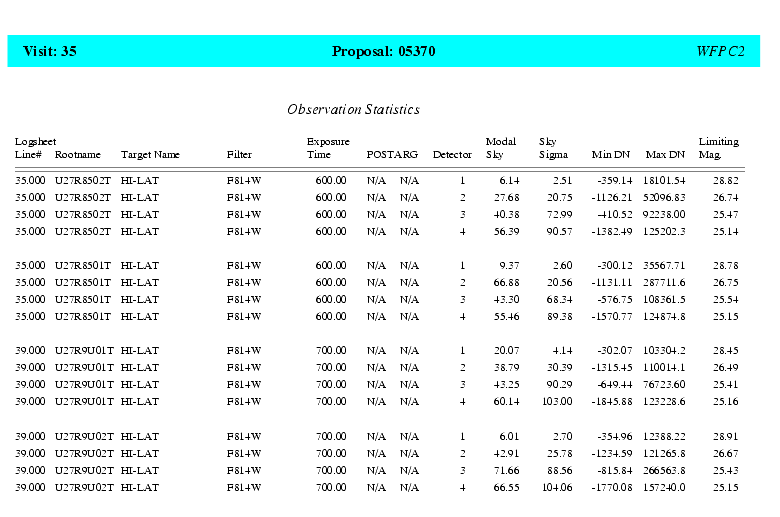
Figure 2.4: Paper Products: Combined Grayscale Display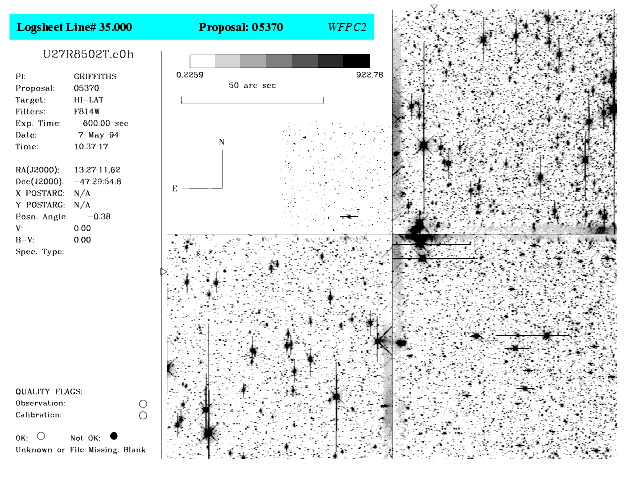
Figure 2.5: Paper Products: Observation Summary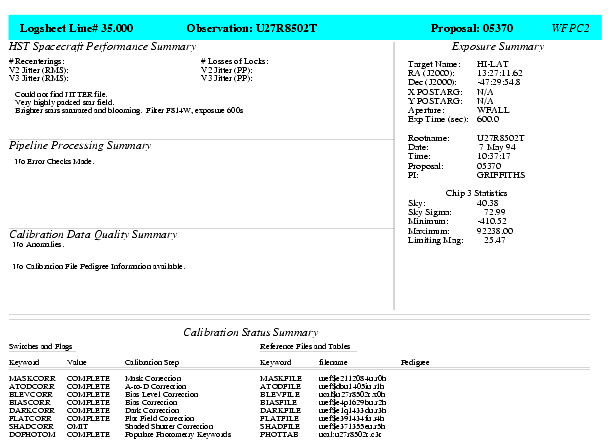
|
Space Telescope Science Institute http://www.stsci.edu Voice: (410) 338-1082 help@stsci.edu |
| |
|
|
|
|