
HST Data Handbook for WFPC2
 |
 |
 |
 |
 |
|
| HST Data Handbook for WFPC2 | ||||
|
4.4 Image Anomalies
In this section we present a number of features which occasionally affect WFPC2 data.
4.4.1 Bias Jumps
The average bias level for each image is obtained from the engineering data file (.x0h/.x0f) separately for even and odd columns. However, WFPC2 is subject to bias jumps, changes of the bias level during the readout. Large bias jumps (> 0.5 DN) are relatively rare, but small bias jumps, at the 0.1 DN level, affect about 15% of all images. figure 4.1 shows a very unusual event where the bias has jumped twice in the same image.
Bias jumps are fairly obvious from a cursory inspection of the image, but users are alerted to their possible presence by a comment in the data quality (
.pdq) and trailer (.trl) files. Bias jumps are currently identified by an automatic procedure in calwp2 that searches the overscan data for possible anomalies (for details seeWFPC2 ISR97-04) and only jumps larger than 0.09 DN are reported. Prior to August 1996, the identification of bias jumps was done manually. Some of the bias jumps found by calwp2 and recorded in the data quality and trailer files are false positives, caused by image features such as strongly saturated stars, which affect the overscan data.There is no standard procedure to remove this defect, but it can be corrected by measuring the jump in the .
x0h(extracted engineering) file or directly in the image, provided the image is clean enough. Standard IRAF procedures such as imexamine or imstat are sufficient to obtain a good estimate of the offset. The offset can then be removed, for instance, by subtracting the bias jump and then copying out the affected chip to another image using the command:
im> imcalc image_in image_out "if (y.lt.YJUMP) then im1 \BJUMP
>>> else (im1 -)"
where YJUMP is the line at which the jump occurs, and BJUMP is its amplitude. The image
Figure 4.1: Bias Jump in Two Chipsimage_outcan then be copied back into the appropriate WFPC image group using the imcopy task.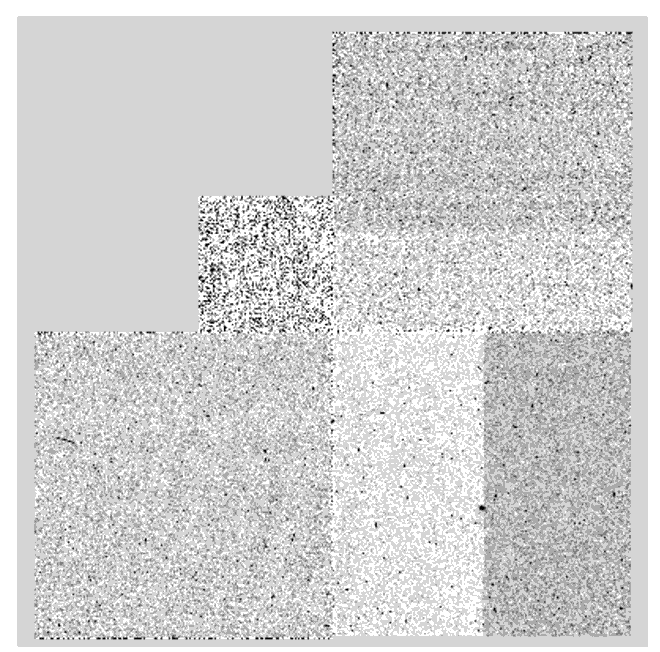
4.4.2 Residual Images
Observations of relatively bright sources can leave behind a residual image. This residual is caused by two distinct effects. In the first, charge in heavily saturated pixels is forced into deeper layers of the CCD, which are not normally cleared by readout. Over time, the charge slowly leaks back into the imaging layers and appears in subsequent images. The time scale for leakage back into the imaging region depends on the amount of over-exposure. Strongly saturated images can require several hours to clear completely. The second effect is caused by charge transfer inefficiencies. At all exposure levels, some charge becomes bound temporarily to impurities in the silicon of the CCD. The effect is most noticeable in images with high exposure levels, probably because electrons become exposed to more impurities as the wells are filled. This effect leaves behind charge both in bright regions of the image and in the part of the chip through which the bright objects were read out.
Figure 4.2 shows a saturated star on PC1 (4.2a) and the residual image seen in an 1800 second dark calibration frame started six minutes later (4.2b). Note that the residual image is bright not only where the PC image was overexposed (effect 1), but also in a wide swath below the star due to the second effect and a narrower swath above the star due to bleeding during the exposure.
Figure 4.2: Saturated Star and Residual Image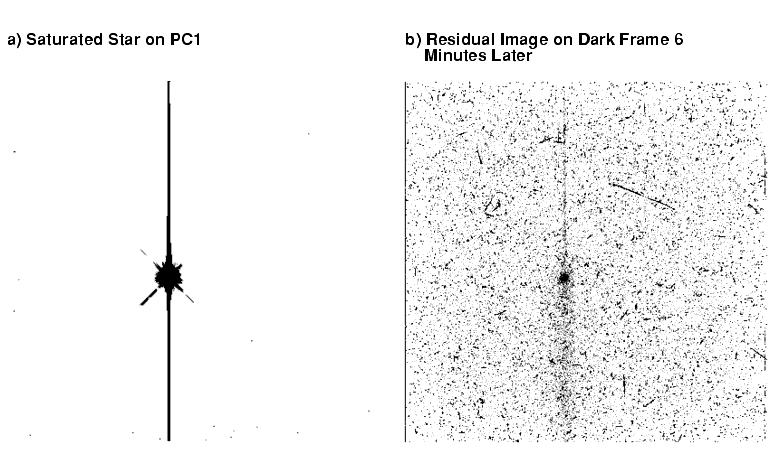
Ghosts
Ghost images may occur on images of bright objects due to internal reflections in the WFPC2 camera. The most common ghosts are caused by internal reflections in the MgF2 field flatteners. In these ghosts, the line connecting the ghost and the primary image passes through the optical center of the chip. The ghost always lies further away from the center than the primary image. Figure 4.3 gives an example of one of these ghosts.
Figure 4.3: Field-Flattener Ghost in WF2-Image Shows Entire CCD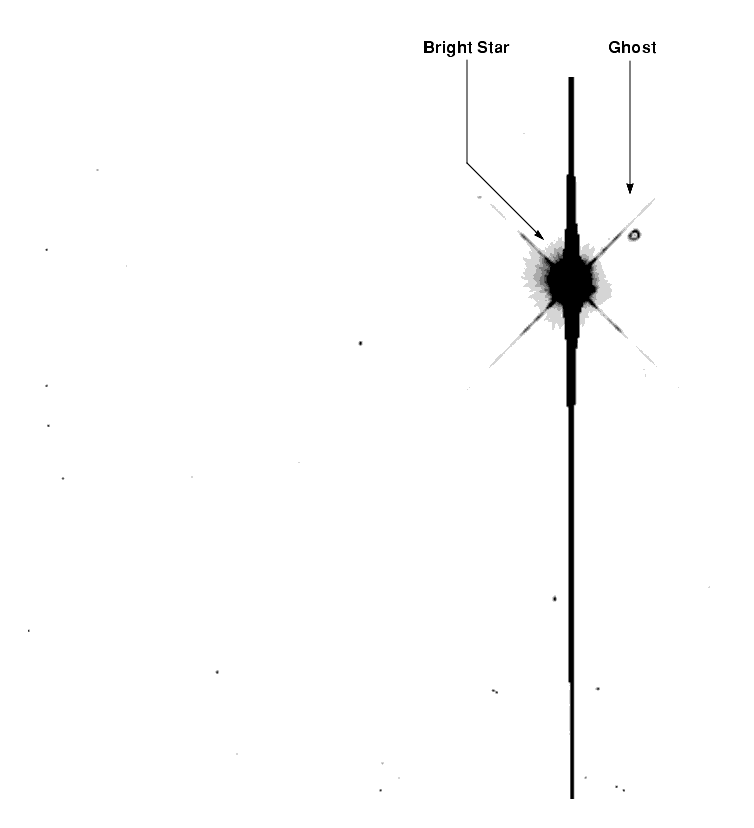
Ghosts may also occur due to reflections on the internal surfaces of a filter. The position of these ghosts will vary from filter to filter and chip to chip. For any given filter and chip combination, the direction of the offset of the ghost from the primary image will be constant, although the size of the offset may vary as a function of the position of the primary image. Filter ghosts can be easily recognized by their comatic (fan-shaped) structure. Particularly bright objects may produce multiple ghosts due to repeated internal reflections. Figure 4.4 shows an example of filter ghosts.
Figure 4.4: Detail of Filter Ghosts on WF4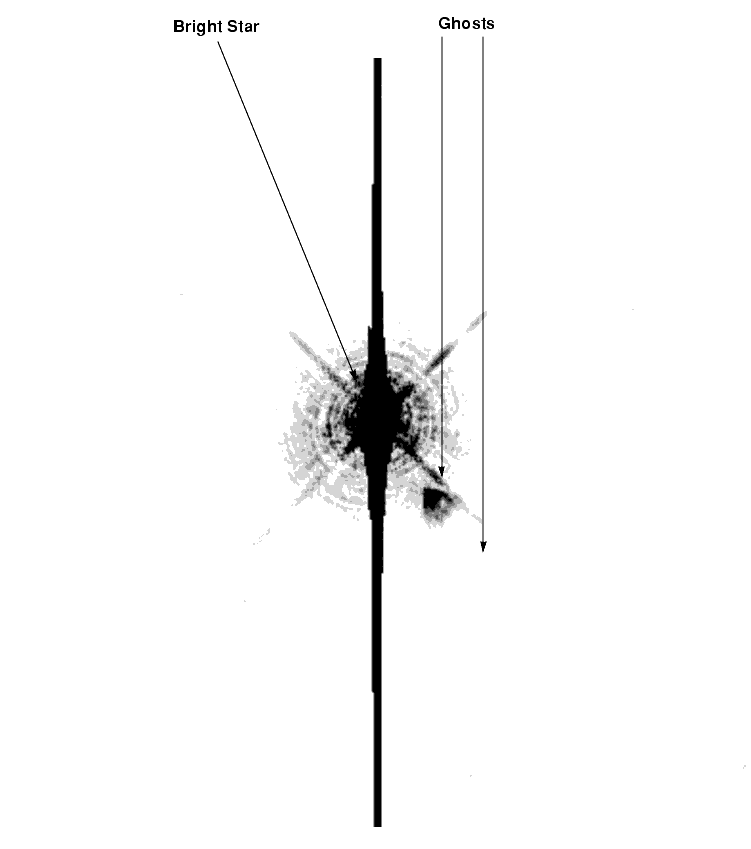
Earth Reflections
Light from the bright sun-lit Earth is, on rare occasion, reflected off of the Optical Telescope Assembly (OTA) baffles and secondary support and into the WFPC2. These reflections can occur when the bright Earth is less than ~40 degrees from the OTA axis. (The default bright Earth limb avoidance is 20 degrees. Science observations are not scheduled at smaller limb angles to the sunlit Earth.) The light raises the overall background level of the field; however, the WFPC2 camera mirror supports can vignette the scattered light, producing either X-shaped or diagonal depressions in the level of the background. Figure 4.5 shows a typical example of the pattern formed by the scattered light. The scattered light in this image has a level of about 100 electrons. The darkest portion of the X is about 40 electrons below the average background level.
Figure 4.5: Scattered Light Pattern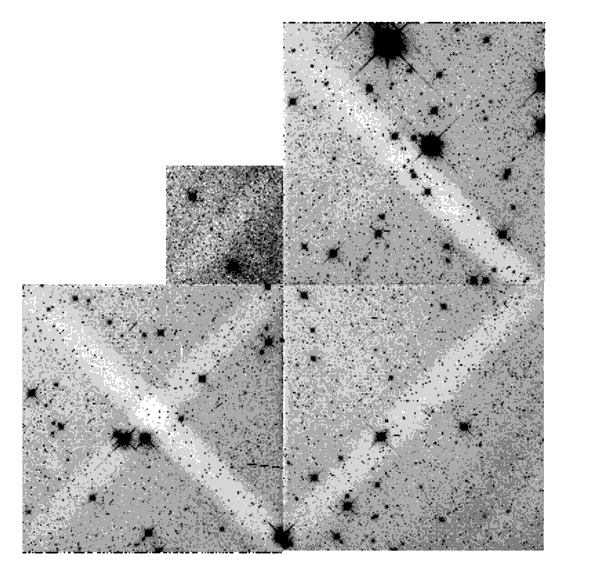
4.4.3 PC1 Stray Light
The WFPC2 was originally intended to contain two separate pyramids-one for four PC cameras and the other for four WF cameras. Budget reductions caused the PC pyramid to be abandoned and the first WF camera to be replaced by a PC camera. However, the pyramid mirror corresponding to the PC camera was not reduced in size. As a result, baffling for the PC chip is not optimal and a bright star falling on the pyramid outside of the PC field of view can produce an obvious artifact, typically shaped like a broad, segmented arc. A star bright enough to produce a total count rate of 1 DN/s on the chip will produce an arc with a count rate of about 1x10⁻⁷ DN/pixel/s over the affected region. When scheduling observations, users should avoid placing stars brighter than V ~ 14 in the L-shaped region surrounding the PC.
4.4.4 Other Anomalies
Other image anomalies, such as bright streaks from other spacecraft, scattered light from bright stars near the field of view, and missing image sections due to dropped data occur on rare occasion. For more information, consult
WPFC2 ISR95-06, which can be obtained through the WFPC2 Web page or through the STScI Help Desk (help@stsci.edu)
|
Space Telescope Science Institute http://www.stsci.edu Voice: (410) 338-1082 help@stsci.edu |
| |
|
|
|
|