
WFPC2 Instrument Handbook for Cycle 10
 |
 |
 |
 |
|
| WFPC2 Instrument Handbook for Cycle 10 | |||
|
Introduction
A set of 48 filters are included in WFPC2 with the following features:
- It approximately replicates the WF/PC-1 "UBVRI" photometry series.
- The broad-band filter series extends into the far UV.
- There is a Strömgren series.
- A Wood's filter is available for far-UV imaging without a red leak.
- There is a 1% bandpass linear ramp filter series covering 3700-9800Å.
- The narrow-band series is uniformly specified and well calibrated.
The filters are mounted in the Selectable Optical Filter Assembly (SOFA) between the shutter and the reflecting pyramid. The SOFA contains 12 filter wheels, each of which has 4 filters and a clear "home" position. A listing of all simple optical elements in the SOFA mechanism, and the location of each element (by wheel number 1-12, and position 1-4) is given in Table 3.1. Wheel number 1 is located closest to the shutter. The categories are simple filters (F), long-pass (LP), wide (W), medium (M), and narrow (N). Most of these filters are either flat single substrates or sandwiches.
The filter complement includes two solar blind Wood's filters, F160AW, and F160BW. F160BW is used in all science observations because the other filter has some large pinholes that lead to significant red leak.
In addition to the above complement of broad and narrow-band filters, WFPC2 features a set of three specialized quadrant (quad or Q) filters in which each quadrant corresponds to a facet of the pyramid, and therefore to a distinct camera relay. There is one quad containing four narrow-band, redshifted [OII] filters with central wavelengths from 3763Å to 3986Å, one quad with four polarizing elements (POL) with polarization angles, 0°, 45°, 90°, and 135°, and one quad with four methane (CH4) band filters with central wavelengths from 5433Å to 8929Å. The polarizer quad filter can be crossed with any other filter over the wavelength range from 2800Å to 8000Å, with the exception of the Methane Quad and Redshifted [OII] Quad which share the same wheel. The SOFA also contains four linearly variable narrow-band ramp (FR) filters (in the twelfth wheel - closest to the focus). The quad and ramp filters are listed in Table 3.2.
In Table 3.1 and Table 3.2, each of the type "A" filters is equivalent to inserting 5 mm of quartz in terms of optical path length, with compensation for wavelength such that focus is maintained on the CCDs. A configuration with no filters in the beam results in out-of-focus images and generally will not be used. With the exception of the quad polarizer and blocking (Type "B") filters, all filters are designed to be used alone. Type "B" filters introduce no focus shift, so they can be used in combination with any type "A" filter. All combinations where the number of type "A" filters is not unity will result in out-of-focus images. The image blur resulting from two or zero type "A" filters at visible wavelengths is equivalent to 2.3 mm defocus in the F/24 beam, which corresponds to 1/5 wave RMS of defocus at 6328Å, and a geometrical image blur of 0.34". While this is a large defocus, the images are still of very high quality compared to seeing limited images. Some such combinations may be scientifically attractive. For example, the Wood's filter may be crossed with another UV filter to provide a solar blind passband (although the efficiency will be low).
Table 3.1: WFPC2 Simple Filter Set. The effective wavelength, width, and transmission quoted are defined precisely in Chapter 6, but here are quoted without the system (OTA+WFPC2) response. H Ly - Red Leak
CaF2 Blocker (zero focus) Woods A - redleak from pinholes Woods B Suprasil Blocker (zero focus) - - Interstellar feature - Wide U WFPC2 U, Strömgren u Ne V [OII] 3727 RS - CN Strömgren v [OIII] WFPC2 B Wide B Strömgren b He II H [OIII] Strömgren y (but wider) WFPC2 V F555W generally preferred1 He I & Na I (NaD) Wide V - [OI] H [NII] [SII] WFPC2 R Wide R F814W generally preferred1 F814W generally preferred1 WFPC2 I - [SIII] -
1 Filters F555W and F814W are generally preferred, as they are part of the "standard" WFPC2 filter set, and will tend to have slightly better photometric calibration. See Choice of Broad Band Filters The mean wavelength,
, is similar to that defined in Schneider, Gunn and Hoessel (Ap. J. 264, 337). The width is the FWHM of a Gaussian filter with the same second moment, and is reasonably close to the FWHM. The values tabulated here do not include the CCD DQE or the transmission of the OTA or WFPC2 optics (as given in Figure 2.4). In Chapter 6, the corresponding quantities are given including the effect of the other optical elements and the CCD DQE.
Figure 3.1 summarizes the normalized transmission curves for the simple filters and narrow-band quad filters. It does not include curves for the polarizing quad, or the linear ramp filters which are documented in section Polarizer Quad Filter and section Linear Ramp Filters, respectively. Individual filter transmission curves are shown in the Appendix 1. Figure 3.1 divides the filters into the following groups:
- Long pass filters designed to be used in combination with another filter.
- Wide bandpass filters with FWHM ~25% of the central wavelength.
- Approximations to the UBVRI sequence, generally with wider bandpasses, designed for use on faint sources.
- A photometric set of approximations to UBVRI passbands (see Harris et al. 1991, A.J. 101, 677). Note, however, that the WFPC2 UBVRI series is not the Johnson-Cousins photometric series, neither is it identical with the WF/PC-1 series. See Chapter 6 for detailed comparisons.
- Medium bandpass filters with FWHM ~10% of the central wavelength, including an approximation to the Strömgren photometric series.
- Narrow bandpass filters for isolating individual spectral lines or bands.
- Redshifted [OII] and CH4 narrow bandpass quad filters.
Note that the UV filters have some degree of "red leak," which is quantified in Chapter 6 where the system response is included. We also note that the F1042M filter suffers an anomalous PSF as described in PSF Anomaly in F1042M Filter.
A passband calibration is maintained in the calibration database system (CDBS). It has been updated following on orbit calibrations. The ground based calibration of the narrow-band filters' central wavelengths has not been corrected for temperature effects and is therefore accurate to about 2Å. Because of this, it is not advisable to place narrow emission lines at the half power points of such filters and expect to predict the throughput to high accuracy. The standalone software package XCAL, or SYNPHOT running under IRAF, can be used to access these calibrations which are available on the Institute's WWW page.
Figure 3.1: Summary of Normalized Filter Curves.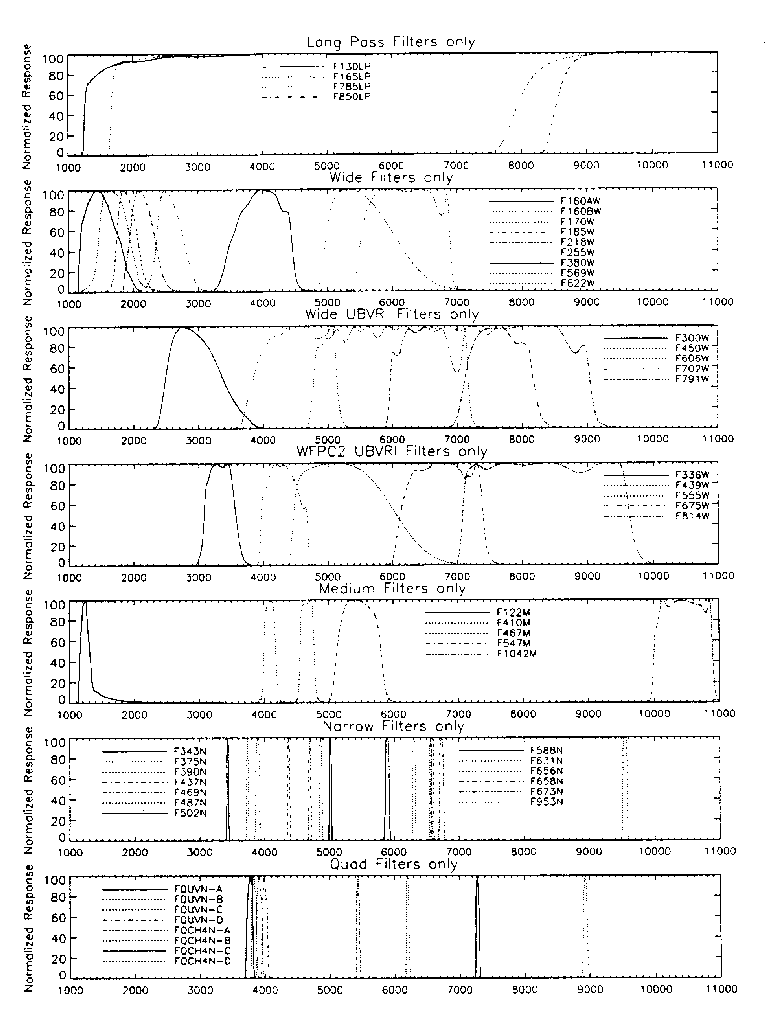
|
Space Telescope Science Institute http://www.stsci.edu Voice: (410) 338-1082 help@stsci.edu |
| |
|
|
|
 (Å)
(Å) l(Å)
l(Å)