Wide Field and Planetary Camera 2 Instrument Handbook for Cycle 14
 |
 |
 |
 |
 |
|
| Wide Field and Planetary Camera 2 Instrument Handbook for Cycle 14 | ||||
|
3.5 Polarizer Quad Filter
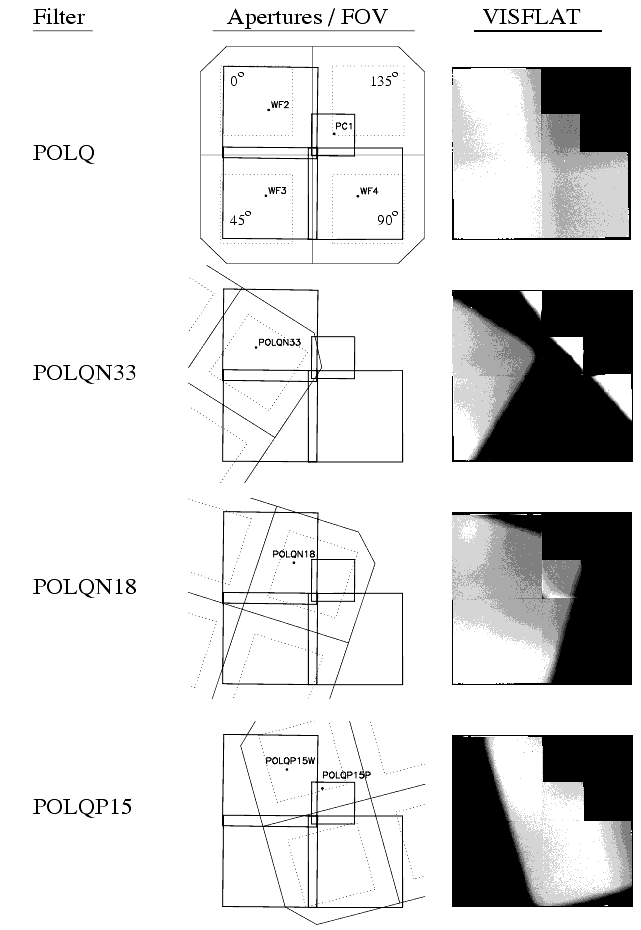
The polarizer quads were also designed to map onto a four-faceted WFC configuration and, consequently, also require a partial filter rotation of -33° to move the filter quadrant 1 (nominal polarization angle 135°) into WFCs 2 and 3, with some vignetting of both camera fields. Several additional partial rotations have been added to allow observations with different polarization angles on the same CCD.
The polarizer quad may be used in several ways: by observing the target with each camera, by observing the target with the same camera using different partial rotations of the polarizer quad, or by observing the target with the same camera using different roll angles of the spacecraft. The first method has the drawback that calibration is complicated by uncertainties in the relative photometric calibration between cameras, while the second method uses the same camera but has non-optimal polarization angles and limited fields of view. The third method may present scheduling difficulties due to constraints on the spacecraft roll angle, and the need to rotate undersampled images. (See Biretta and Sparks 1995, "WFPC2 Polarization Observations: Strategies, Apertures, and Calibration Plans," WFPC2 ISR
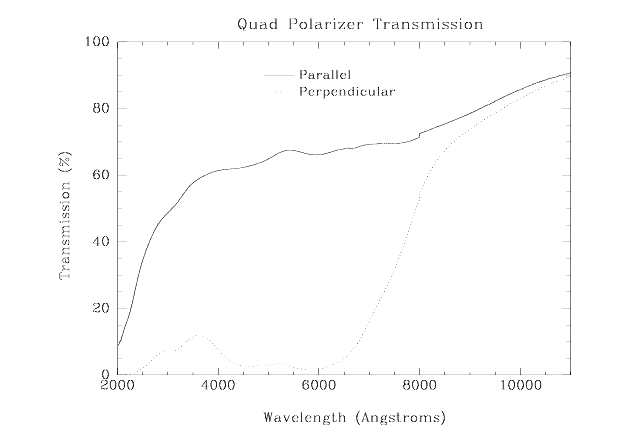
95-01.)The required polarization angle is selected by filter name and aperture location as shown in Table 3.10. The transmission of the quad polarizer is shown in Figure 3.8. The polarizer is afocal and must therefore usually be used with another filter which will largely define the shape of the passband.
The polarizer is designed for problems where large polarizations are observed, and will need very careful calibration for problems requiring precision of order 3% or better.
Figure 3.7: Polarizer Quads. The schematics show the filter projected onto the field-of-view for all rotated positions. Apertures are marked. Dashed lines indicate the central region of each quad which is free of vignetting and cross-talk. Greyscale images are VISFLATs of the polarizer with F555W.
Figure 3.8: Polarizer Transmission for light polarized perpendicular (dotted curve) and parallel (solid curve) to the filter polarization direction.
Table 3.10: Polarizer Quad Filter. Polarization angle 0° lies along +X direction in Figure 3.12.3.5.1 Polarization Calibration
Substantial improvements in the polarization calibration of WFPC2 were made after Cycle 6. These results are fully described in Biretta and McMaster (1997), and are based on a physical model of the polarization effects in WFPC2, described via Mueller matrices, which includes corrections for the instrumental polarization (diattenuation and phase retardance) of the pick-off mirror, as well as the high cross-polarization transmission of the polarizer filter. New polarization flat fields were also made available. Comparison of the model against on-orbit observations of polarization calibrators shows that it predicts relative counts in the different polarizer/aperture settings to 1.5% RMS accuracy.
To assist in the analysis of polarization observations, we provide two Web-based utilities, available at
http://www.stsci.edu/instruments/wfpc2/wfpc2_pol_top.htmlby which users can simulate and calibrate their data. These tools have been upgraded to include effects related to the MgF2 coating on the pick-off mirror, as well as the more accurate matrices for the cross-polarization leakage in the polarizer filter. Differences between the previous and current versions of the tools are typically around 1% in fractional polarization.
|
Space Telescope Science Institute http://www.stsci.edu Voice: (410) 338-1082 help@stsci.edu |
| |
|
|
|
|