Wide Field and Planetary Camera 2 Instrument Handbook for Cycle 14
 |
 |
 |
 |
 |
|
| Wide Field and Planetary Camera 2 Instrument Handbook for Cycle 14 | ||||
|
4.8 Dark Backgrounds
Low dark noise is one of the benefits of MPP, since inverted phase operation suppresses the dominant source of CCD dark noise production (Si-SiO2 surface states). The remaining source of dark noise, thermal generation in the silicon bulk, is determined by the quality of the silicon used in chip fabrication. The intrinsic dark rate of WFPC2 CCDs is <0.01 e- pixel-1 s-1 at temperatures below -80°C.
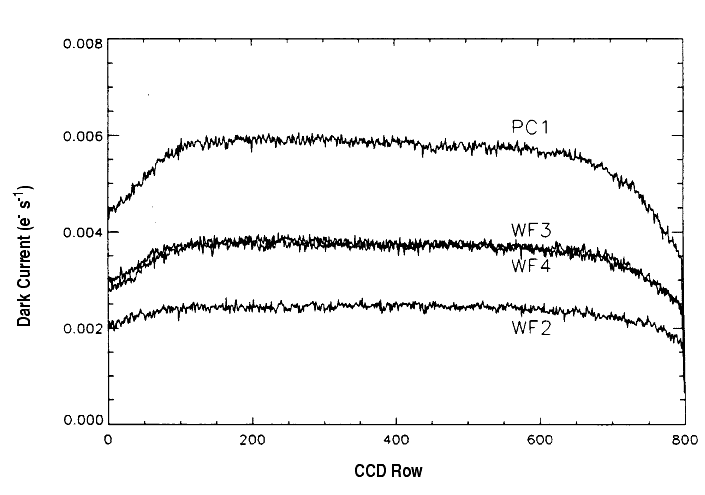
Figure 4.5: Average Dark Rates vs. CCD Row.
The temperature set-points for the WFPC2 TEC coolers are: -88, -83, -77, -70, -50, -40, -30 and -20 °C. The corresponding approximate median dark rates are given in Table 4.2. For instrument health and safety reasons, GOs cannot command temperature changes.
4.8.1 Sources of Dark Current
The dark current appears to have two components: one from electronic sources in the CCD, and a second component whose strength correlates with the cosmic ray flux. The electronic dark current is ~0.001 e- s-1, consistent with the Thermal Vacuum Test data.
The second component of dark current appears only on-orbit, its strength drops towards the edges of each CCD, and it is both chip- and time-dependent. At the current operating temperature, this non-electronic component constitutes up to 80% of the total signal measured in the PC. The fraction and overall level are lower in the other chips, and lowest in WF2. This second component ranges from 0.001 e- s-1 (WF2) to 0.005 e- s-1 (PC). The edge drop off is shown in Figure 4.5, where the average of lines 200-600 for each chip (with hot pixels rejected) is plotted in e- s-1 as a function of column number. The drop near the edge is consistent with luminescence from the CCD windows, shadowed by a field stop mask just in front of the CCD.
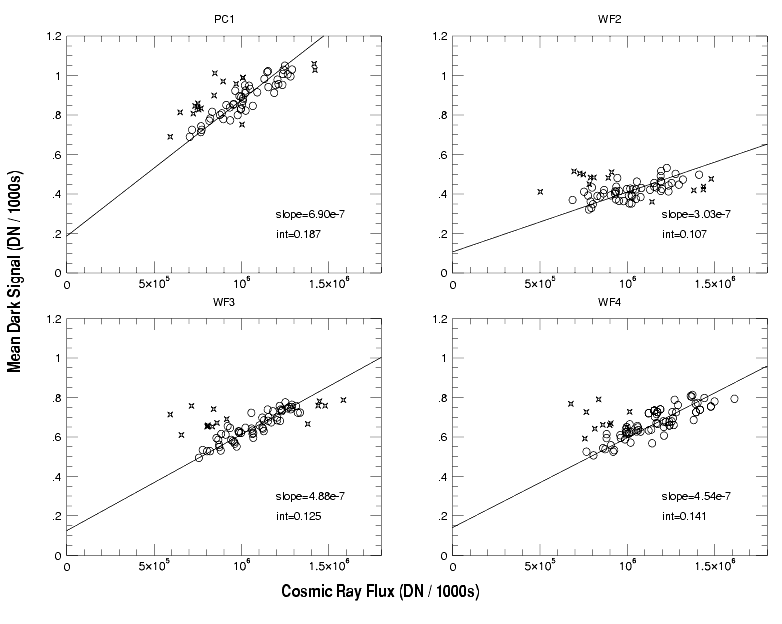
A further indication of the possible origin of this second component is the correlation between its amplitude and the cosmic ray activity in the same exposure, as shown in Figure 4.6. For example, the cosmic ray flux in the PC varies from 7x10⁵ to 13x105 DN per 1000s, while the total dark signal in the PC varies concurrently between 0.0007 and 0.0010 DN s-1. Similar, though slightly smaller effects are seen in the WFC CCDs. These clues point to cosmic-ray induced scintillation of the MgF2 field-flattening windows as a likely source of the second dark current component. This might be caused by impurities in the MgF2 windows; if so, the window of WF2 must contain substantially less impurities. However, other explanations cannot be completely ruled out at this point.
Figure 4.6: Dark Signal vs. Cosmic Ray Flux. Slopes and intercepts ("int") are given on plots. Units are DN/1000s; 1 DN ~ 7 e-.
For the great majority of WFPC2 observations, this effect is negligible. In fact, it is noticeable mainly because the true dark rate is very low at the -88°C operating temperature. However, observations for which the dark current is an important limiting factor, either due to noise or background flatness, will require special handling to remove the signature of the dark current properly, as its amplitude depends on the time-variable cosmic ray flux.
4.8.2 Darktime
As of this writing, the "DARKTIME" keyword in the WFPC2 image headers does not reflect correctly the actual time during which the CCD collects dark current. Instead, DARKTIME is merely set equal to EXPTIME (the exposure time) in the data headers, and this value is used for calibration. The error is small, and usually unimportant, but could be significant for programs aimed at measuring the absolute level of the sky background. The actual darktime in seconds is given by
where t is the requested exposure time in seconds, and n is the number of the CCD (PC1=1, WF2=2, etc.), and int() indicates the next lower integer. A duration of 16.4s is required to clear the CCDs before the exposure begins, and 13.6s is needed to read each CCD after the exposure. External exposures of 180s or longer made with the serial clocks off (CLOCKS=NO; the default setting) suffer an additional 60s of darktime (restart=1). This delay is associated with restarting the serial clocks for readout in exposures where the spacecraft AP-17 processor provides shutter control with loss-of-lock checking. Exposures made with the serial clocks on (CLOCKS=YES) avoid this extra 60s (restart=0).
We note that bias frames contain approximately
seconds of dark current. No attempt is made to subtract this from the bias images when creating calibration files for use in the calibration pipeline. This effect is unimportant for most observations, but could be significant if one averaged many undithered deep exposures of the same field, or if one is interested in measuring the absolute level of the sky background. If the dark current were constant in time, this could be corrected by merely changing the value of DARKTIME used during calibration. However, the hotpixels vary on monthly timescales, so this simple correction is only partially successful.
The timing of dark calibration frames is slightly different from that of external science exposures. Dark calibration frames always have restart=0 in Equation 4.1.
The dark calibration reference file in the pipeline is revised weekly to track variations in the hot pixels. The current method of generating these files is to combine the bright hot pixels from typically five on-orbit dark frames taken over the space of about one week, with the low-level dark current from the average of 120 on-orbit dark frames spanning a much longer time period. This method gives an optimal combination of low noise and accurate tracking of hot pixels. Care is also taken that the same super-bias reference files is used for both science data and generation of the dark reference file, as this tends to reduce the noise in long exposures. (Early dark reference files used a much simpler method, and were typically combinations of about ten dark frames taken over two weeks.)
4.8.3 Dark Current Evolution
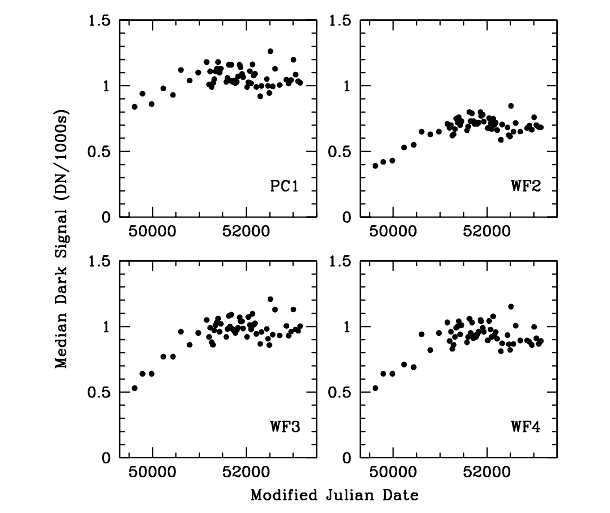
The dark current in WFPC2 has had an interesting evolution over the lifetime of the instrument. Figure 4.7 shows the median dark current for the central 400 x 400 pixels of each CCD at gain 7, each taken just after WFPC2's monthly decontamination. Each data point represents the median of five raw 1800s dark frames (after rejection of cosmic rays and bias subtraction, normalized to units of DN/1000sec). As such, this plot reflects the uniform, low-level dark current near the center of each detector. During the first six years the dark current increased approximately linearly with time; the dark current increased by a factor of about 2 in the WFC CCDs and by a factor of ~1.3 in the PC. But after 1998 (MJD > 51200) the dark current leveled-off, and perhaps decreased somewhat.
Figure 4.7: Dark Evolution from 1994 to 2004.
As mentioned before, there are two primary sources of dark current -- a dominant component which is strongly correlated with the cosmic ray flux in the image (probably due to scintillation in the MgF2 CCD windows; see Figure 4.6), and a smaller thermal dark current in the CCD itself. The dark current increase seen during early years was smaller in the optically vignetted regions near the CCD edges, which suggests much of this increase is related to scintillation effects in the CCD windows. Moreover, the ratio between the dark current at the CCD edge and the CCD center has remained nearly constant throughout the mission (within a range of ~5%; see WFPC2 ISR 2001-05), even though the dark current itself doubled in WF2, WF3, and WF4. Hence, it seems an inescapable conclusion that most of the long-term evolution is related to scintillation effects and variations in cosmic ray flux.
Long-term changes in the cosmic ray flux are perhaps most easily attributed to the solar cycle. The leveling-off of the dark current ~1998 is coincident with the approaching solar maximum which has the effect of reducing the cosmic ray flux at HST's low Earth orbit. Ground-based cosmic ray detectors show a gradual flux increase from 1992 to 1998, followed by a sharper decrease through early 2004. It is possible that other effects might also play some role. For example, portions of the HST orbit near the South Atlantic Anomaly experience higher cosmic ray rates, and it is possible that changes in the HST scheduling system could produce long-term changes in cosmic ray flux and hence dark current. It is also conceivable that long-term changes in the instrument itself might indirectly influence the sensitivity to scintillation effects (e.g. long-term radiation damage might modify the luminescence of camera components).
The thermal dark current of the CCD may also undergo long-term change (i.e. from radiation damage, etc.), and contribute some minor variation. A small increase in the CCD cold junction temperature was seen early in the mission; however, the temperature change can account for only a very small portion of the increase in dark current.
Since the dark current is generally a minor contributor to the total noise in WFPC2 images, its long-term variation is unlikely to impact the quality of WFPC2 observations, except perhaps in special cases (faint sources observed through narrow-band or UV filters, especially in AREA mode).
We note that the variation in dark signal reported here affects all pixels, and thus is distinct from hot pixels which vary in a more cyclic fashion. The hot pixels are highly localized, and are almost certainly due to radiation-damaged sites on the CCD detectors. Their number and intensity increase continuously, but are significantly reduced during decontamination procedures where the CCDs are warmed to +22°C to clear the CCD windows of contaminants. These "decontaminations" were conducted monthly until June 2003, after which their frequency was reduced to 49-day intervals. Apparently the decontaminations anneal defects in the CCDs which produce hot pixels (see Section 4.11).
|
Space Telescope Science Institute http://www.stsci.edu Voice: (410) 338-1082 help@stsci.edu |
| |
|
|
|
|