


S. Casertano used the distribution of faint galaxies in a large number of fields to measure their angular correlation function as a function of their magnitude, color and morphological type (Neuschaefer et al. 1996). The main result is that the fraction of galaxies in pairs does not increase strongly with redshift, in contrast with the conclusions of other, less deep studies.
In a related study, they have detected and measured the weak gravitational shear of the images of background galaxies around a relatively bright foreground object (Griffiths et al. 1996). The detected shear is larger around early-type galaxies, indicating a large mass-to-light ratio (about 100), and its radial variation is consistent with extended dark haloes around such galaxies.
M. Donahue is in the process of completing a suite of space-based observations
of three distant ( --0.9) clusters of galaxies selected from the Extended
Medium Sensitivity Survey, including ASCA X-ray spectra, ROSAT
HRI imaging, and HST WFPC2 imaging. She is collaborating with
M. Dickinson, M Postman (ST ScI), J. Stocke (U. CO), and P. Lee (ST ScI) on an
optical survey of deep ROSAT pointed fields to find distant clusters
and to compare optical and X-ray samples derived from the same fields. Donahue
and M. Voit (ST ScI) have done a detailed case study of the emission line
nebulae in the cooling flow cluster Abell 2597, deriving, for the first time
for a cluster, cooling flow nebulae from model-independent assumptions,
complete nebulae temperatures, gas densities, reddening, and elemental
abundances. Knowing these gas properties allow Voit and Donahue to limit the
physical mechanisms that can heat the nebular gas in cluster cooling flows.
--0.9) clusters of galaxies selected from the Extended
Medium Sensitivity Survey, including ASCA X-ray spectra, ROSAT
HRI imaging, and HST WFPC2 imaging. She is collaborating with
M. Dickinson, M Postman (ST ScI), J. Stocke (U. CO), and P. Lee (ST ScI) on an
optical survey of deep ROSAT pointed fields to find distant clusters
and to compare optical and X-ray samples derived from the same fields. Donahue
and M. Voit (ST ScI) have done a detailed case study of the emission line
nebulae in the cooling flow cluster Abell 2597, deriving, for the first time
for a cluster, cooling flow nebulae from model-independent assumptions,
complete nebulae temperatures, gas densities, reddening, and elemental
abundances. Knowing these gas properties allow Voit and Donahue to limit the
physical mechanisms that can heat the nebular gas in cluster cooling flows.
M. Fall continued his work with Charlot (IAP, Paris) and Pei (JHU) on the global approach to star and galaxy formation. From observations of quasar absorption systems, it is possible to infer the global histories of gas consumption and metal production in galaxies from z = 4 to the present; and from this information it is possible to deduce the global history of star formation and hence to predict the cosmic emissivity and background intensity at various wavelengths from the far-UV to the far-IR. These predictions are in remarkably good agreement with a variety of measurements and observational upper and lower limits.
Fall and Kulkarni completed a study of the abundance patterns in damped
Lyman- galaxies at high redshifts. They found that the observed
patterns are most compatible with nucleosynthesis in a mixture of type I
and II supernovae and subsequent depletion onto dust grains. The inferred
dust-to-metals ratios in the damped Lyman-
galaxies at high redshifts. They found that the observed
patterns are most compatible with nucleosynthesis in a mixture of type I
and II supernovae and subsequent depletion onto dust grains. The inferred
dust-to-metals ratios in the damped Lyman- galaxies are similar to
those in the Milky Way today, but the dust-to-gas ratios and metallicities
are much lower than those in the Milky Way.
galaxies are similar to
those in the Milky Way today, but the dust-to-gas ratios and metallicities
are much lower than those in the Milky Way.
The Hubble Deep Field promises to provide new and important constraints on
galaxy evolution. H. C. Ferguson was involved in the planning, data reduction,
data distribution, and analysis of the images. A major focus of the initial
analysis has been to identify high-redshift galaxies. Using computations of the
opacity of the IGM, together with an extensive grid of galaxy spectral models
Madau, Ferguson, Dickinson, Fruchter (ST ScI), Giavalisco (OCIW), and Steidel
have identified 69 galaxies with likely redshifts  , and 14 with
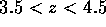 . The metal-formation rate in the universe at these redshifts,
calculated from the integrated UV fluxes of the galaxies, turns out to be
larger than the present-day metal-formation rate, but less than the rate at
. The metal-formation rate in the universe at these redshifts,
calculated from the integrated UV fluxes of the galaxies, turns out to be
larger than the present-day metal-formation rate, but less than the rate at  . Ferguson and Babul (NYU) compared a two models galaxy formation to the
HDF observations. One model has pure luminosity evolution, with a deceleration
parameter
. Ferguson and Babul (NYU) compared a two models galaxy formation to the
HDF observations. One model has pure luminosity evolution, with a deceleration
parameter  . The other has
  but contains a large
population of dwarf galaxies forming stars at
but contains a large
population of dwarf galaxies forming stars at  . Neither model
reproduces simultaneously the observed counts, color distribution, or size
distribution of the HDF galaxies. It is not yet clear whether the problems are
in the detailed star-formation histories, or the underlying cosmological
assumptions.
. Neither model
reproduces simultaneously the observed counts, color distribution, or size
distribution of the HDF galaxies. It is not yet clear whether the problems are
in the detailed star-formation histories, or the underlying cosmological
assumptions.
M. Livio, in collaboration with Giavalisco, Bohlin, Macchetto (ST ScI), and Stecher (LASP), showed how local galaxies observed at UV wavelengths would appear to HST if placed at cosmological distances. They have shown that the dependence of the galaxy morphology on star-formation activity and on wavelength must be understood before conclusions on the morphological evolution of galaxies can be reached.
Livio, with Ferrarese (ST ScI) and the H key project team, discovered a
nova in the Virgo galaxy M100 and derived a distance modulus to this galaxy
which is consistent with the Cepheid distance modulus.
key project team, discovered a
nova in the Virgo galaxy M100 and derived a distance modulus to this galaxy
which is consistent with the Cepheid distance modulus.
R. Lucas, in collaboration with Whitmore, Sparks, Macchetto, and Biretta,
participated in a study of the globular cluster system of M87, from which
a luminosity function was obtained and an estimate of the Hubble Constant
was made. More than a thousand globular clusters were included in the sample,
and the luminosity function was measured to a couple of magnitudes past the
turnover point. Taking into account various other assumptions about the
consistency of luminosity functions for both spiral and elliptical galaxies,
etc., the Hubble constant was estimated to be  in this case, using
this method. The results were published in the 1 December 1995 ApJ Letters
(Whitmore et al. 1995) and in the Science With HST: II conference
proceedings from the December 1995 Paris meeting (Sparks et al.).
in this case, using
this method. The results were published in the 1 December 1995 ApJ Letters
(Whitmore et al. 1995) and in the Science With HST: II conference
proceedings from the December 1995 Paris meeting (Sparks et al.).
Lucas participated in the Hubble Deep Field experiment, from initial planning and field selection, through data reduction and the public release of the initial results. The data show a wealth of galaxies (several thousand) in an area that is nearly blank on the sky survey plates. The target area was chosen to meet the constraints of being as empty as possible on the optical sky survey plates, of having very low radio flux, and very low infrared cirrus, plus it was required to be in an area where good guide stars could be obtained within the HST Continuous Viewing Zone. These data are a rich ground for studying the formation and evolution of galaxies, and for testing new techniques of analysis (crude redshifts based on UV dropout for higher redshift galaxies, etc.), since all but the few hundred brightest galaxies are too faint even for the current capabilities of the Keck telescope to be able to obtain redshifts. The observations were carried out in December 1995 and were released to the community a few weeks later at the AAS Meeting in San Antonio after the first run-through of the data reduction had been completed. Two subsequent versions of the reduced data have been created, using more refined techniques, and these are available via the WWW from ST ScI's HDF page. The program and data are described in Williams et al. in the October 1996 Astronomical Journal.
In support of HST imaging of ten distant ( ) clusters,
M. Postman, Oke (DAO, Caltech), and Lubin (OCIW) have conducted a redshift
survey using the Low Resolution Imaging Spectrograph (LRIS) on
the Keck I 10m telescope. To date, 500 redshifts have been measured in
these 10 fields. Close to 1000 redshifts are expected when the survey is
completed next year. BVRI broad band photometry has already been
obtained for all 10 clusters and JHK infra-red photometry is being acquired
this year. The goal is to study the morphological and spectroscopic properties
of the cluster members. Preliminary results suggest that there is significantly
greater variance in the morphology-density relation at
) clusters,
M. Postman, Oke (DAO, Caltech), and Lubin (OCIW) have conducted a redshift
survey using the Low Resolution Imaging Spectrograph (LRIS) on
the Keck I 10m telescope. To date, 500 redshifts have been measured in
these 10 fields. Close to 1000 redshifts are expected when the survey is
completed next year. BVRI broad band photometry has already been
obtained for all 10 clusters and JHK infra-red photometry is being acquired
this year. The goal is to study the morphological and spectroscopic properties
of the cluster members. Preliminary results suggest that there is significantly
greater variance in the morphology-density relation at  than compared
to what is seen locally (
than compared
to what is seen locally ( ).
).
In a related project, Postman has completed a wide area ( ) deep I band survey. This is the largest, contiguous deep galaxy
survey to date. The
) deep I band survey. This is the largest, contiguous deep galaxy
survey to date. The  limit is I = 24. The survey was conducted
using the KPNO 4m prime focus camera. Co-investigators on the project
include T. Lauer (KPNO), W. Oegerle (JHU), and J. Hoessel (U. WI). The goal of
the survey is to constrain the evolution of large scale structure from
limit is I = 24. The survey was conducted
using the KPNO 4m prime focus camera. Co-investigators on the project
include T. Lauer (KPNO), W. Oegerle (JHU), and J. Hoessel (U. WI). The goal of
the survey is to constrain the evolution of large scale structure from  to the present epoch. This will be done by studying the clustering
properties of both the galaxies and galaxy clusters contained within this
volume. There are over 500,000 galaxies mapped within this area and there are
expected to be approximately 100 clusters at
to the present epoch. This will be done by studying the clustering
properties of both the galaxies and galaxy clusters contained within this
volume. There are over 500,000 galaxies mapped within this area and there are
expected to be approximately 100 clusters at  . Analysis of the
catalog is underway and preliminary results should be available next year.
Spectroscopic follow-up to this imaging survey will begin in the fall of 1997.
. Analysis of the
catalog is underway and preliminary results should be available next year.
Spectroscopic follow-up to this imaging survey will begin in the fall of 1997.
Postman, Lauer, Strauss (Princeton), Colless (Mt. Stromlo), and Graham
(Mt. Stromlo) continue to study the properties of brightest cluster galaxies
(BCGs) and to use the galaxies as distance indicators. Some of this work is
summarized in Graham et al. (1996) where it is found that there are
significant departures from the R law which are real features of BCG
profiles (and are not due to observational errors). By fitting a generalized
de Vaucouleurs profile of the form R
law which are real features of BCG
profiles (and are not due to observational errors). By fitting a generalized
de Vaucouleurs profile of the form R , they find that BCGs typically
have values of N>4. The shape parameter, N, is shown to correlate with
the effective half light radius, such that brighter BCGs have larger N
values. This continues a trend noticed among ordinary and dwarf elliptical
galaxies. The extension of the original Lauer-Postman BCG sample out to
, they find that BCGs typically
have values of N>4. The shape parameter, N, is shown to correlate with
the effective half light radius, such that brighter BCGs have larger N
values. This continues a trend noticed among ordinary and dwarf elliptical
galaxies. The extension of the original Lauer-Postman BCG sample out to
 is nearly complete (imaging is available for all 533 BCG in the
extended survey, dispersions will be available for all of these galaxies by
spring 1997). A revised measurement of the motion of the Local group relative
to this cluster sample is expected by late 1997.
is nearly complete (imaging is available for all 533 BCG in the
extended survey, dispersions will be available for all of these galaxies by
spring 1997). A revised measurement of the motion of the Local group relative
to this cluster sample is expected by late 1997.
M. Voit has been investigating the impact of blastwaves on the evolution of the intergalactic medium. The low overall metallicity of intergalactic gas implies that the enriching stars originated in groups of one million or less and not in large galaxies (Voit 1996a).
With M. Donahue (ST ScI), Voit has continued to explore the goings-on in cooling-flow clusters of galaxies. They do not appear to contain much cold gas (Voit & Donahue 1995), but their emission-line nebulae indicate that some of these clusters sustain star formation at rates 10--100 times higher than that of the Milky Way (Donahue & Voit 1996; Voit & Donahue 1996).
B. Whitmore et al. (1995) used HST observations of over a
thousand globular clusters in M87 to produce a new estimate of the Hubble
constant. The limiting magnitude in V is 26 mag, more than two magnitudes
beyond the turnover of the luminosity function. The distribution is well
fit by a Gaussian profile with a mean of  mag
and a width of
mag
and a width of  mag. The resulting estimate for the Hubble
constant is
mag. The resulting estimate for the Hubble
constant is  km s
km s Mpc
Mpc . The V - I color
distribution is bimodal, with peaks at
. The V - I color
distribution is bimodal, with peaks at 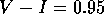 mag and 1.20 mag.
Whitmore (1996) reviewed the use of the globular cluster luminosity
function (GCLF) as a distance indicator. The intrinsic dispersion in
the turnover of the GCLF is  mag for bright ellipticals,
making it competitive with the best distance indicators. The value of
the turnover appears to be nearly universal, with only a weak
second-order dependence on luminosity clearly demonstrated and other
second-order dependencies possible at about the 0.1--0.2 mag level
(e.g., Hubble type, color, and environment). At present the best
estimate of the Hubble constant based on the GCLF can be determined
using seven galaxies in the Fornax cluster, yielding a value of H
mag for bright ellipticals,
making it competitive with the best distance indicators. The value of
the turnover appears to be nearly universal, with only a weak
second-order dependence on luminosity clearly demonstrated and other
second-order dependencies possible at about the 0.1--0.2 mag level
(e.g., Hubble type, color, and environment). At present the best
estimate of the Hubble constant based on the GCLF can be determined
using seven galaxies in the Fornax cluster, yielding a value of H km s
km s Mpc
Mpc .
.